Key Highlights
- The DEATH BETS Act, introduced on March 10 by Rep. Mike Levin (D-CA) and Sen. Adam Schiff (D-CA).
- It would permanently ban any CFTC-registered exchange from listing contracts tied to war, terrorism, assassination, or an individual’s death.
- The bill follows $529 million in Iran-related volume on Polymarket, a class-action lawsuit against Kalshi over its “death carveout,” and the quiet deletion of a nuclear detonation market.
It took ten days. On February 28, U.S.–Israeli airstrikes hit Iran, and prediction markets absorbed the shock in real time, processing hundreds of millions of dollars in wagers on the trajectory of the conflict.
On March 10, Congress answered. Rep. Mike Levin and Sen. Adam Schiff introduced the DEATH BETS Act—the Discouraging Exploitative Assassination, Tragedy, and Harm Betting in Event Trading Systems Act—bicameral legislation that would permanently prohibit any CFTC-registered entity from listing contracts tied to war, terrorism, assassination, or an individual’s death.
The bill amends Section 5c of the Commodity Exchange Act with a new subsection targeting two categories of contracts. The first covers any agreement that “involves, relates to, or references terrorism, assassination, war, or any similar activity.” The second—and more consequential—prohibits contracts that “involve, relate to, or reference an individual’s death or could otherwise be construed as correlating closely to an individual’s death.” That second clause is the meaningful expansion. It closes the gap between what existing law technically permits and what platforms have actually listed.
The Sequence That Forced Congress’s Hand
The legislative response did not emerge from theory. It emerged from three specific events in rapid succession, each of which escalated the political cost of inaction.
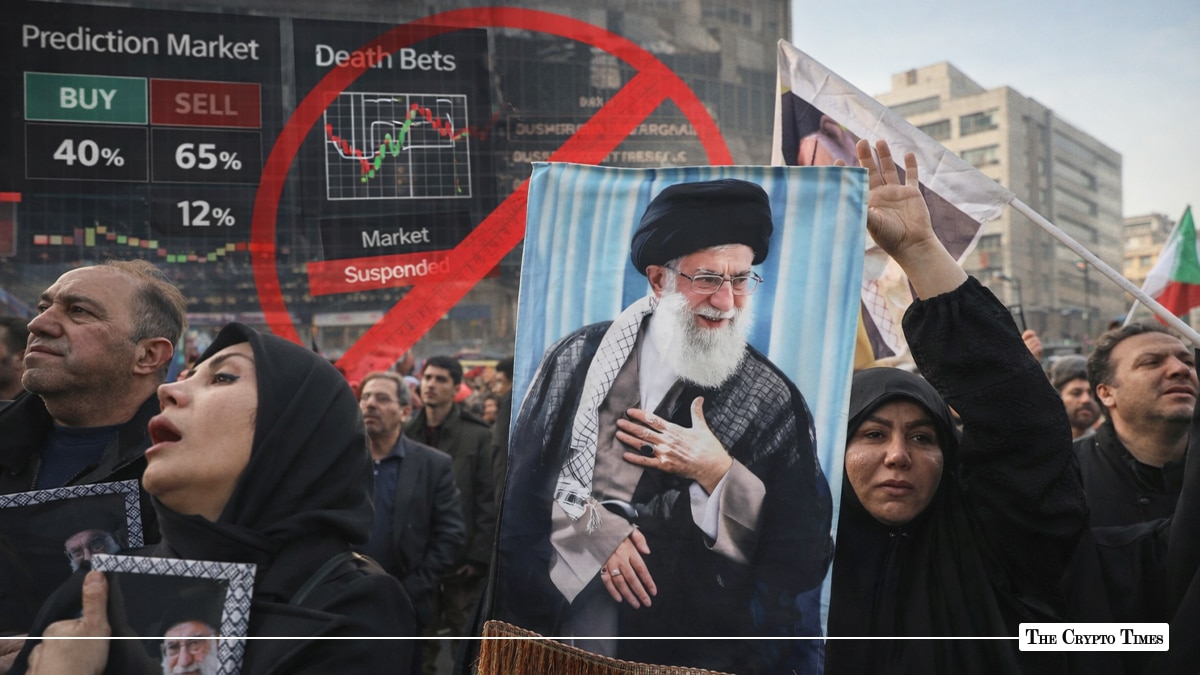
The first was Polymarket’s Iran volume. When confirmation spread that Supreme Leader Ali Khamenei had been killed during the strikes, Iran-related contracts on the platform surged past $529 million. Blockchain analysts flagged sizable positions opened by newly created wallets shortly before major developments became public—raising questions about information asymmetry that remain unresolved.
The second was Kalshi’s settlement debacle. The regulated exchange’s parallel contract on whether Khamenei would leave office drew $54 million in volume. When his death was confirmed, Kalshi invoked a pre-defined “death carveout,” settling positions at the last traded price rather than paying out in full. CEO Tarek Mansour defended the clause on X, arguing it was part of the original CFTC filing. Kalshi absorbed roughly $2.2 million to reimburse trader fees and losses. It was not enough. A class-action lawsuit has since been filed alleging the platform failed to honor $54 million in payouts.
The third was the nuclear market. Days after the Iran frenzy, Polymarket was found hosting a contract on nuclear detonation—carrying over $838,000 in volume and a promoted post on X citing 22% implied odds. After fierce criticism, the platform deleted the market without explanation.
Levin cited the Iran markets directly in his announcement, noting that “over half a billion dollars was wagered on the timing of U.S. military strikes on Iran alone” and calling the situation “unacceptable.”
Why the Bill Targets CFTC Discretion
The DEATH BETS Act is not a request for stricter enforcement. It is a structural rewrite of the CFTC’s authority over a specific class of contracts.
Under current law, the Commission can block war and terrorism contracts, but only if it affirmatively determines they are “contrary to the public interest.” That standard is discretionary. It requires the agency to act. The DEATH BETS Act eliminates that discretion entirely, converting a permissive framework—in which such contracts exist unless the CFTC intervenes—into an absolute prohibition, in which they are banned regardless of the Commission’s posture.
The timing is not incidental. CFTC Chairman Michael Selig has signaled his intention to rewrite prediction market rules, and the Trump administration has adopted a lighter regulatory posture toward derivatives and digital assets. Schiff framed the concern explicitly: “With regulators turning a blind eye, prediction markets have rapidly become the Wild West.” The bill is designed to make the prohibition durable against a deregulatory commission—statutory, not discretionary.
A Legitimacy Problem at $20 Billion
The legislation arrives at an awkward moment for the prediction market industry. Both Kalshi and Polymarket are pursuing valuations in the range of $20 billion. The sector spent much of 2025 constructing a credibility narrative: prediction markets as superior forecasting instruments, vindicated by their performance during the 2024 presidential election, embraced by institutions, and backed by serious capital. Kalshi publicly endorsed Rep. Ritchie Torres’ insider trading bill in January, positioning itself as a partner in responsible regulation.
The Iran week dismantled that narrative in roughly 72 hours. The same product architecture that impressed voters when applied to elections repulsed the public when applied to war. The fact that Polymarket processed half a billion dollars in conflict-related volume while operating without U.S. regulatory oversight and that Kalshi’s regulated contract ended in a carveout dispute and litigation made it difficult for either platform to claim the system was working as intended.
The industry’s response has been reactive. On March 10—the same day the DEATH BETS Act was introduced—Polymarket announced a partnership with Palantir for AI-powered market monitoring. The move reads as preemptive self-regulation: a signal that the platforms intend to police themselves before Congress does it for them. Whether that gesture is sufficient to alter the legislative trajectory is, at this point, an open question.
Prospects and Obstacles
The bill faces the structural challenge common to Democratic-introduced legislation in the current Congress: it requires Republican support to advance. But the politics of “betting on American soldiers’ deaths” do not sort neatly along partisan lines. Bipartisan legislation restricting war-related markets is already in motion from Reps. Blake Moore (R-UT) and Salud Carbajal (D-CA), suggesting the underlying appetite for action extends beyond the Democratic caucus.
For the prediction market industry, the calculus has shifted. The question is no longer whether Congress will attempt to regulate event contracts on conflict and death—that is now underway. The question is whether the industry can shape the terms or whether the terms will be shaped for it. The DEATH BETS Act, in its current form, offers no carveouts, no safe harbors, and no grandfathering provisions. It is a ban.
The broader regulatory environment remains in flux. Chairman Selig’s planned rulemaking could either render the legislation redundant—if the CFTC acts first and decisively—or accelerate it if the Commission’s approach is perceived as too accommodating. Either way, the window in which prediction markets could list contracts on armed conflict without triggering a legislative response has, by all appearances, closed.