Key Highlights
- Vitalik Buterin updated his X profile to a Milady NFT, drawing immediate attention to the collection.
- Milady Maker’s floor price surged roughly 50% following the profile change.
- The collection’s floor value jumped to around 1.07 ETH, totaling approximately 10,700 ETH across 10,000 NFTs.
Ethereum co-founder Vitalik Buterin started the new year with a post that didn’t announce a fork, a deadline, or a roadmap. Instead, it read like a pause — the kind someone takes when they feel a project is moving fast but not always in the right direction.
“Welcome to 2026! Milady is back,” Buterin wrote on X. He also switched his profile picture to a Milady Maker NFT, a move that instantly pulled attention toward a collection many people thought had already had its moment.
But the post itself wasn’t about Non-Fungible Tokens (NFTs), prices, or markets. It was about Ethereum and what it risks losing if it keeps chasing whatever happens to be popular.
Looking back at 2025, without victory laps
Buterin acknowledged that 2025 was a productive year for Ethereum. Gas limits increased. Blob capacity went up. Node software became more reliable. zkEVMs crossed performance milestones that, not long ago, felt theoretical. Combined with PeerDAS, Ethereum moved closer to a version of itself that can scale without leaning too heavily on centralization.
Those wins mattered. But they weren’t the point.
The concern, as Buterin framed it, is that Ethereum can still miss its own goals even while shipping upgrades. The network doesn’t exist to win narratives, he argued — not tokenized dollars, not political memecoins, not any short-term meta that fills blockspace for a while and then disappears.
Ethereum, he said, is supposed to be infrastructure.
What Buterin means by “world computer”
The phrase “world computer” gets used often in Ethereum circles, sometimes without much thought. Buterin used the post to spell out what he actually means by it.
Ethereum is meant to support applications that don’t depend on trust in developers, companies, or intermediaries. Apps that keep working even if the original team vanishes. Apps where users don’t need permission to continue using them. Apps that don’t quietly fail the moment a cloud provider has an outage or a centralized service is compromised.
He described this as the “walkaway test.” If users can walk away from the people who built a system and the system still works, then it’s doing something right.
That standard isn’t limited to finance. Buterin placed identity, governance, and future forms of digital public infrastructure in the same category. Privacy, he stressed, isn’t optional in any of this.
Why this shouldn’t sound extreme
One of the more grounded parts of the post was how Buterin framed decentralization as something society once had by default. Wallets worked without asking permission. Books didn’t stop functioning if a company went bankrupt. Cars didn’t require subscriptions to unlock basic features.
Today, many products quietly depend on centralized control, remote updates, and ongoing approval. Lose access, lose functionality.
Ethereum, in Buterin’s view, is a pushback against that direction — not perfect, not finished, but aimed at restoring user control at the infrastructure level.
To do that, Ethereum has to be usable at scale and actually decentralized, not just in theory. That applies both to the base blockchain and to the software people use to interact with it. Progress is happening, he said, but it needs to go further.
Milady Maker sees sharp jump in activity
Milady Maker, an NFT collection released in August 2021 by the Remilia Collective, saw a sudden burst of trading over the past day. The floor price moved up to 1.07 ETH, roughly 27% higher than the previous day, initially had pumped around 47%, while about 220 ETH worth of Miladys changed hands across just over 200 sales. That was enough to put the collection back into the top ten by floor price.
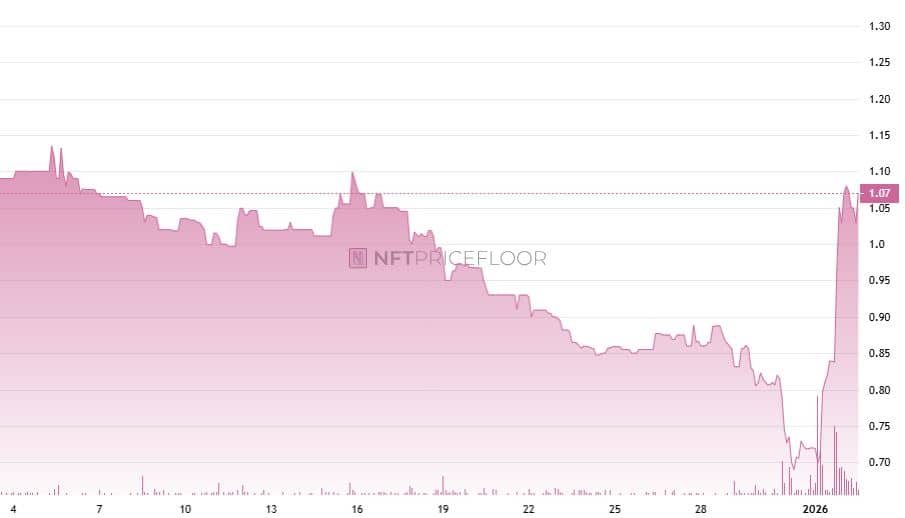
The rise came at a time when most of the NFT market had been relatively inactive. Over the past seven days, Milady NFTs changed hands at an average price of 0.91 ETH, with sales spanning from 0.67 ETH to 2.95 ETH, suggesting steady buying rather than a single unusually large trade.
Milady Maker has a fixed supply of 10,000 NFTs. At current prices, that puts the collection’s floor value at around 10,700 ETH. Only about 2% of the supply is listed for sale, and ownership is spread across a little more than 5,100 wallets, covering just over half of the collection.
The collection originally minted at 0.06 ETH, putting current floor prices more than 16 times higher than mint, even after several market downturns since its 2021 launch.
Why “Milady” suddenly matters again
The Milady reference is what gave the post its edge.
Milady Maker is an NFT collection launched in August 2021 by the Remilia Collective. It’s known for its anime-style avatars, heavy internet-culture influence, and a history that includes both deep community loyalty and repeated controversy. Over the years, it has been praised, mocked, criticized, and dissected, sometimes all at once.
Around the time of Buterin’s post, Milady Maker’s floor price jumped sharply, moving above one ETH alongside a surge in trading volume. The timing made people connect dots, even though Buterin made no comment about value, trading, or investment.
Whether intentional or not, the reference pulled an old NFT project back into the spotlight at a time when NFTs are no longer driving the crypto conversation.
Where the NFT market actually is right now
NFTs are far removed from their peak years. In 2021 and early 2022, the market ballooned on speculation, celebrity attention, and the belief that every new collection might matter. At the height of the cycle, NFTs were estimated to carry over $100 billion in market value, with monthly trading volumes reaching $4–5 billion at times.
That phase burned out quickly. As crypto markets turned in 2022, NFT liquidity dried up even faster. Prices across most collections fell sharply, trading activity collapsed, and overall NFT volumes dropped by more than 90% from peak levels. Thousands of projects effectively stopped trading altogether.
By 2025, NFTs were no longer a dominant crypto narrative — but they weren’t gone either. Forecasts for 2026 reflect that uncertainty. Some estimates suggest NFT revenues could shrink to well under $500 million, while more optimistic projections still point to a market worth tens or even hundreds of billions, largely depending on adoption in areas like gaming and virtual worlds.
What exists today is a much smaller, quieter market, concentrated around a limited number of older collections that still attract consistent attention.
Not a comeback, but not the end either
There’s no clear sign that NFTs are about to reclaim the spotlight. Volumes are still far below past highs, and mainstream enthusiasm hasn’t returned.
But moments like this suggest NFTs may be settling into a different role — less speculative, more tied to identity, community, and on-chain culture. If Ethereum succeeds in becoming the resilient infrastructure Buterin described, NFTs could exist quietly inside that system instead of driving it.
What the post was really about
In the end, Buterin wasn’t making a call on NFTs or markets. He was drawing a line.
Ethereum doesn’t need to win every trend, he argued. It needs to build something that keeps working when trends pass, companies fail, and narratives shift.
“Milady is back” wasn’t a price signal. It was a cultural one, and a reminder that Ethereum’s original ambition still matters, even when it’s inconvenient.
Also Read: Vitalik Buterin Calls for Renewed Focus on Ethereum in 2026