In the early days of the blockchain revolution, the Decentralized Autonomous Organization (DAO) was hailed as the ultimate “corporate killer.” The vision was simple yet profound: an organization with no CEO, no physical headquarters, and no middle management. By replacing human fallibility with smart contracts, DAOs promised a world where “code is law” and every member held an equal stake in a hyper-efficient, neutral entity.
However, by 2026, the honeymoon phase has officially ended. While the technology to execute decisions automatically is better than ever, the human element—governance—has become a massive bottleneck. Many DAOs today are stuck in a “governance trap,” spending more time debating how to vote than actually building products.
We saw this clearly in January 2026. While the technology works, its sociology is broken. Just look at the recent Optimism Superchain vote or the Uniswap Fee Switch debates. These weren’t town halls; they were board meetings where a handful of whales dictated the fate of millions of dollars, leaving the ‘community’ to rubber-stamp the decision.
How a DAO Actually Operates
To understand the current crisis, one must first look at the “Proposal Pipeline.” Unlike a traditional company where a board of directors meets behind closed doors, a DAO’s lifeblood is its public ledger.
Who can propose changes?
- Permissionless: Some DAOs allow anyone with a wallet to submit a proposal. While democratic, this often leads to “governance spam,” where the community is flooded with low-quality or scam requests.
- Threshold-based: Most mature DAOs (like Uniswap or Aave) require a “minimum stake.” You might need to hold 0.1% or even 1% of the total token supply just to put a proposal on the ballot.
The Pipeline:
- Ideation: Discussion on Discord or a governance forum
- Formal Proposal: A technical document submitted to a platform like Snapshot.
- Voting Period: Token holders cast their votes over a period of three to seven days.
- Execution: If passed, the smart contract automatically executes the code—moving funds or updating the protocol—without needing a human “signer.”
The Three Pillars of the Governance Crisis
Despite this elegant technical flow, the “autonomous” dream is hitting three major roadblocks:

1. Voter Apathy:
In 2025 and 2026, data showed that participation rates in major DAOs frequently dipped below 10%. When members are asked to vote on everything from multimillion-dollar grants to the color of a logo, “decision fatigue” sets in. This creates “ghost town” governance where a tiny, active minority makes decisions for the silent majority.
2. The “Whale” Problem:
Most DAOs use a “one-token-one-vote” system. This has inadvertently birthed a new form of digital oligarchy. Wealthy “whales” or venture capital firms can effectively veto or push through any proposal, turning the “decentralized” mission into a playground for the 1%. This can technically make a DAO centralized.
3. Analysis Paralysis:
In a fast-moving tech world, speed is life. A CEO can make a decision in minutes; a DAO often takes weeks to move a proposal through the pipeline. This lag time has caused many projects to lose their competitive edge as they remain paralyzed by internal debate.
When “Code is Law” Becomes a Weapon
The most dangerous consequence of the “Governance Trap” isn’t just slow progress—it’s the risk of Governance Capture. In a system where voting power is a tradable commodity, malicious actors can treat a DAO like a corporate raider would a traditional company, but with the speed and anonymity of blockchain.
1. The Build Finance “Coup” (Feb 2022)
If other governance issues are “heists,” Build Finance was a scorched-earth invasion. Billed as a “venture builder” for crypto projects, Build Finance was literally taken over by a single malicious actor who used the organization’s own democratic tools to dismantle it.
A user known as “Suho.eth” put forward a proposal to take full control of the project’s minting keys, treasury, and governance. After an initial attempt failed, the attacker doubled down with a “stealth” strategy.
To ensure the second attempt passed, the attacker disabled the DAO’s “proposal bot” and Gitbook (documentation site). This effectively blinded the community; because no one was “watching the gates,” the proposal passed with almost no counter-votes.
Once the keys were handed over by the smart contract, the attacker minted over 1 billion new BUILD tokens, drained the treasury of approximately $470,000, and laundered the funds. The project was effectively killed overnight. In a DAO, management isn’t a board of founders; it’s whoever holds the most tokens.
2. The Compound Finance “Golden Boys” Incident (July 2024)
One of the most famous examples of a “Whale Attack” occurred within Compound Finance, a titan of DeFi. A small group of investors, known as the “Golden Boys,” successfully passed a proposal to divert $24 million (5% of the treasury) into a yield-bearing vault they controlled.
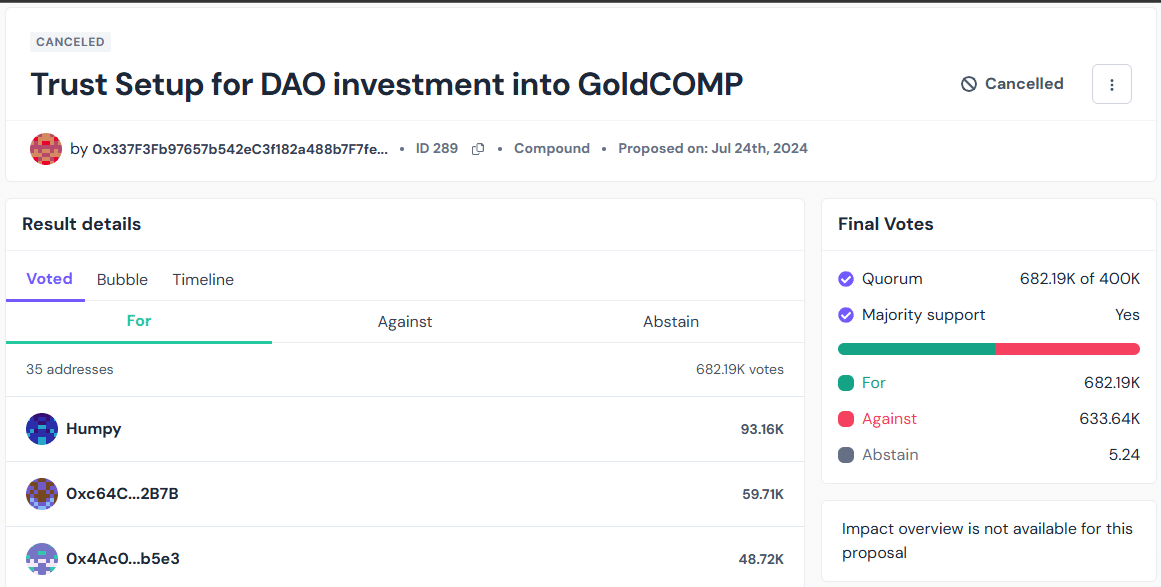
They didn’t find a bug in the code. Instead, they quietly accumulated COMP tokens on exchanges and through delegation until they had enough power to force the vote through during a period of low community participation.
It was a “governance heist” performed in broad daylight. While an “amicable” solution was eventually reached through intense social negotiation, the event proved that a DAO without high participation is essentially an open vault for wealthy whales.
3. The Tornado Cash Takeover (May 2023)
In another high-profile attack, a malicious actor submitted a proposal that looked like a routine technical update but contained hidden code. Once the community passed the vote, the hidden code granted the attacker complete control over the DAO’s treasury.
This highlighted the “Information Gap.” Most DAO members vote based on the title of a proposal because they cannot read the underlying smart contract code. This creates a massive security hole where “Governance Theater” masks malicious intent.
4. The Beanstalk Farm Exploit (April 2022)
Beyond whales, attackers have used Loans—which is borrowing millions of dollars in tokens for just a few seconds—to manipulate votes. By borrowing a massive amount of voting power, passing a proposal to drain the treasury, and then returning the loan all in a single transaction, hackers have bypassed the need to even own the tokens they are using to “govern.”
Beanstalk Farms exploit was a purely mathematical execution. It proved that if you can “buy” a majority for just one second, you can own the entire protocol.
On April 17, 2022, an attacker used a Flash Loan to borrow nearly $1 billion in assets from Aave and Uniswap. They used this massive capital to instantly acquire a 67% “supermajority” of the protocol’s governance tokens.
Beanstalk’s code had an emergencyCommit function. It allowed a proposal to execute immediately if it reached a 2/3 majority, bypassing the standard multi-day waiting period. Within the same single blockchain transaction, the attacker borrowed the money, voted for a malicious proposal they had seeded 24 hours earlier (BIP-18). This triggered the emergencyCommit function and attacker drained $182 million from the treasury, and repaid the loan.
Vitalik Buterin’s Warning
The cracks in the system have caught the attention of Ethereum Co-Founder Vitalik Buterin. In a series of 2025 and early 2026 statements, Buterin issued a stark warning.
We Need More DAOs—But Different And Better DAOs: Vitalik
He argues that the current “token-holder voting” model is fundamentally broken because it replicates the flaws of traditional politics. His recent critiques highlight three major shifts:
Concave vs. Convex Governance:
Buterin suggests that different problems need different voting styles. “Concave” problems (like setting a budget) benefit from compromise and wide community input. “Convex” problems (like a major strategic pivot) require decisive, high-conviction leadership that current DAOs lack.
Privacy and ZK-Proofs:
He is advocating for Zero-Knowledge (ZK) voting to prevent “social signaling,” arguing that public voting makes governance a “social game” where people vote to look good rather than to do what’s right.
AI Integration:
Buterin suggests that AI can help reduce “decision fatigue” by summarizing dense forum debates and filtering votes for the community.Vitalik also argued that “walking away from DAOs would be a mistake.”
Why Ethereum Needs High-Quality DAOs To Survive
Vitalik outlined five critical areas where Ethereum needs high-quality DAOs to survive:
1. Optimizing Oracle Design:
Current oracles are too easily manipulated; we need DAOs to ensure “truth” enters the blockchain neutrally. If the oracle is token based, whales can manipulate the answer on a subjective issue and it becomes difficult to counteract them.
2. On-Chain Dispute Resolution:
For things like DeFi insurance, we need decentralized “courts” to make subjective judgments.
3. Keeping Lists Honest:
DAOs are needed to maintain the lists. Preventing “hidden power” by using DAOs to maintain safe-lists of verified apps and registries.
4. Helping Startup Projects:
Allowing fast, community-led funding for short-term projects that don’t need a full legal entity.
5. Long-Term Project Stewardship:
Ensuring protocols don’t die just because the original founding team moves on. DAOs are needed for long term project maintenance.
Alongside his DAO comments, Vitalik has pushed for “Protocol Simplification” in 2026. He warns that if Ethereum’s code becomes an “unwieldy mess” that only a few experts understand, then decentralization is an illusion.
He argues that for a DAO to be truly autonomous, the underlying protocol must be simple enough to pass the “Walkaway Test”: if the core developers disappeared today, could a new team understand and run the network tomorrow?
DAOs Turning Votes into Value
To escape the trap, the next generation of DAOs is moving away from simple voting and toward more nuanced models. As we move through late January 2026, the “Governance Trap” is being broken by hard economics. Two of the largest DAOs in history are currently executing “Economic Pivots” that tie their tokens directly to network revenue.
1. The Optimism Superchain Revenue Share:
On January 22, 2026, the Optimism Collective initiated a landmark vote to allocate 50% of Superchain sequencer revenue toward monthly OP token buybacks for 12 months, directly linking network growth to token value beginning in February.
This proposal strengthens the token’s role in the ecosystem. It signals a transition from pure governance utility to a model where token demand scales with network adoption across chains like Base, Uniswap, Ink and World Chain.
2. Uniswap “Unification”:
After years of “Analysis Paralysis,” Uniswap activated its long-debated ‘Fee Switch’ in late 2025. Protocol fees now programmatically burn UNI tokens, turning a “governance-only” asset into a deflationary value-accrual asset. This proposal establishes a long-term model for how Uniswap would operate.
This proposal shifts operational duties from the Foundation to Labs, putting them in charge of ecosystem support, funding, governance, and developer relations. As of January 2026, early data shows annualized burns reaching millions of dollars, proving DAOs can move from “theater” to “business.”
The “Governance Trap” isn’t a sign that DAOs have failed; it’s a sign that they are maturing. As we move through 2026, the focus is shifting from “decentralizing everything” to “decentralizing what matters.” For DAOs to reclaim their original goal, they must find a way to let the code handle the routine and let the humans focus on the vision.