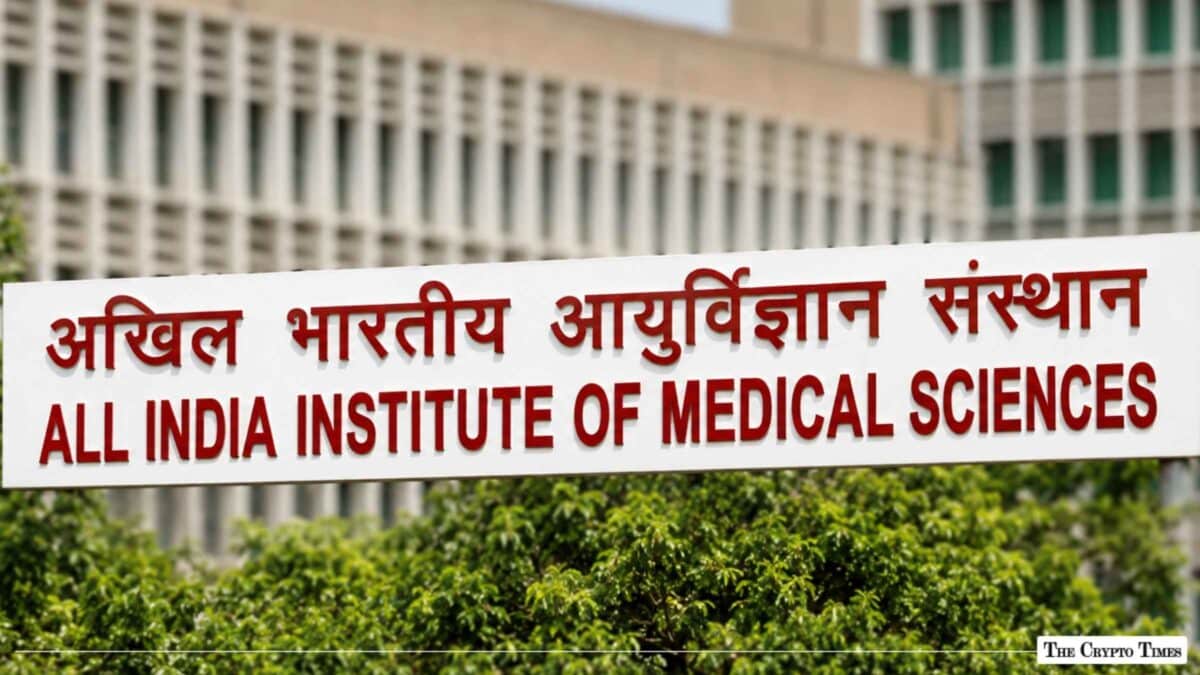
While most conversations about blockchain in India still orbit around token prices and exchange rules, a very different rollout has been happening in the background. The latest evidence surfaced on Sunday, when the All India Institute of Medical Sciences (AIIMS), Delhi, declared results for over 460 faculty positions, filled through a recruitment process that placed a blockchain layer between candidate marks and the final merit list.
According to a report by ETHealthWorld, the six-month drive drew more than 3,200 applicants for 265 posts at AIIMS New Delhi and 199 posts at the AIIMS-CAPFIMS campus at Maidan Garhi, spanning over 50 disciplines and covering roles from Assistant Professor to Professor.
How the system actually worked
The mechanics, based on the AIIMS statement, are worth reading closely because they are less dramatic than the headline suggests. Evaluation marks for every candidate were locked digitally using one-time passwords. A pre-configured software module then generated the merit list from those locked marks using pre-defined algorithms, with human intervention allowed only for breaking ties.
This is almost certainly not a public chain of the kind that runs Ethereum or Solana. It reads far closer to a permissioned, audit-friendly ledger, the sort of implementation that Indian government agencies have been building toward under the National Blockchain Framework. The design goal here is not decentralization; it is tamper-evidence: once marks are committed, any later edit leaves a trace.
The bigger pattern
The AIIMS announcement is easier to read once it is placed inside a longer policy arc. India has been signalling a “blockchain yes, crypto no” posture for several years, and the funding and infrastructure have quietly followed. That thesis was documented in The Crypto Times’ earlier report on India’s blockchain push getting its biggest funding round yet, which noted healthcare as one of 10 priority sectors identified by the Ministry of Electronics and Information Technology (MeitY).
The direction was set even earlier, when MeitY released the National Strategy on Blockchain in December 2021, listing e-governance, healthcare, education, land records and finance as target sectors. Crypto Times covered that release in its dispatch on India’s national strategy for blockchain-driven e-governance. The AIIMS hire is one of the first large, visible field tests of that policy applied to human resources rather than land parcels or supply chains.
What it gets right
- Marks locked with OTPs are considerably harder to alter after the fact than a spreadsheet cell or a paper sheet.
- Automated merit generation shrinks the surface area for manual “adjustments” that have historically dogged public-sector recruitment in India.
- A six-month cycle for a 460-post medical hire at Assistant Professor to Professor level is not slow by AIIMS standards, and it beats the pace of several comparable central institutions.
- The design is portable. Other central bodies with similar recruitment volumes can copy the architecture without reinventing it.
The parts still unclear
Neither AIIMS nor the government has released a technical whitepaper explaining how the system works. Without one, claims that it is “blockchain-based” and “tamper-proof” cannot be independently verified. The announcement also does not clarify whether the blockchain is permissioned, who operates the validating nodes, or whether candidates and regulators will have access to an independent audit trail.
There is also a broader concern. While algorithm-based merit lists reduce manual decision-making, they shift trust to the algorithm itself. If the scoring and ranking method is not made public, transparency has not necessarily improved—it has simply moved from people to software. Human intervention is still allowed for tie-breaks, which is the same stage where disputes have arisen in previous government recruitment processes.
Why this matters for the ecosystem
For readers who follow Web3 and blockchain policy, the AIIMS hire is a small but useful data point. It suggests that India’s practical blockchain deployment story is landing inside government workflows, not consumer apps.
The stack showing up in these announcements looks closer to permissioned enterprise systems than to public chains, and the users are ministries and central institutions, not retail investors. Whether that counts as “adoption” depends on how the term is defined, but it is the direction current policy and current spending are pointing toward.
The next test will be replication. If AIIMS-CAPFIMS is followed by similar rollouts at other central universities, at the Union Public Service Commission’s (UPSC) specialized drives, or at state-run medical colleges, the AIIMS build starts to look like a template. If not, it joins a long list of well-run pilots that never scaled.
Also Read: India’s Long-Awaited Crypto Report Heads to Parliament This Monsoon Session