Key Highlights
- The SEC is preparing to propose new rules governing the offer and sale of crypto assets.
- The proposal could include regulatory exemptions and safe harbors for certain digital assets.
- The initiative forms part of SEC Chairman Paul Atkins’ broader 2026 regulatory agenda.
The U.S. Securities and Exchange Commission (SEC) is preparing a major rulemaking proposal for crypto asset offerings, stepping up its independent oversight while Congress continues its prolonged work to pass the CLARITY Act.
According to the agency’s latest regulatory agenda, published on Tuesday, the Division of Corporation Finance is considering recommending that the Commission propose rules governing the offer and sale of crypto assets, with a Notice of Proposed Rulemaking (NPRM) targeted for July 2026.
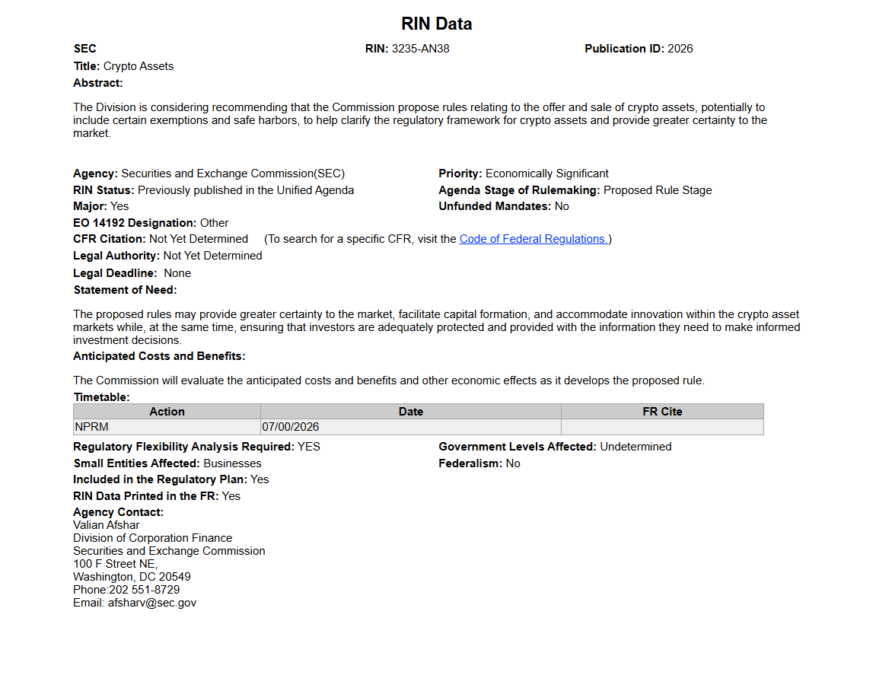
Listed under RIN 3235-AN38, the initiative has been designated economically significant, reflecting its potential impact on the U.S. digital asset market.
SEC wants clearer crypto rules
According to the agenda, the proposed rules are intended to clarify how crypto assets should be offered and sold under federal securities laws. The SEC said the framework could include certain exemptions and regulatory safe harbors to provide greater legal certainty while preserving investor protections.
The Commission said the proposal is designed to facilitate capital formation, support innovation within crypto markets, and ensure investors receive the disclosures necessary to make informed investment decisions. The SEC also noted that it will evaluate the economic costs and benefits of the proposal as the rulemaking process develops.
Part of Atkins’ broader regulatory agenda
The proposal forms part of SEC Chairman Paul Atkins’ broader regulatory agenda, which places digital assets alongside wider capital markets reforms. Today, Atkins outlined plans to modernize securities regulation by streamlining the public listing process, expanding investment opportunities beyond accredited investors, and establishing clearer rules for emerging technologies, including crypto assets.
The latest crypto initiative marks one of the first concrete regulatory proposals under that agenda and signals a shift away from the SEC’s previous reliance on enforcement actions toward a formal rulemaking process aimed at providing greater regulatory clarity for the digital asset industry.
Moving beyond enforcement
The proposal would represent a notable change in the SEC’s regulatory approach. For much of the past several years, crypto companies have argued that the Commission relied primarily on enforcement actions rather than clear rules to determine how securities laws applied to digital assets.
By initiating formal rulemaking, the SEC appears to be acknowledging the need for a more transparent regulatory framework. Although the agency has not yet released draft language, industry participants are expected to closely watch whether the proposed exemptions and safe harbors address longstanding concerns surrounding token issuance, fundraising, and compliance obligations.
The CLARITY Act is still moving
The SEC’s rulemaking effort comes as Congress continues working on the CLARITY Act, legislation designed to establish a broader market structure framework for digital assets. Earlier this year, the bill cleared another procedural milestone by reaching the U.S. Senate calendar, positioning it for eventual floor debate following its progress through committee.
While the SEC’s proposal focuses specifically on how crypto assets are offered and sold, the CLARITY Act seeks to define the broader legal framework governing digital asset markets, including regulatory jurisdiction, exchange oversight, and token classifications. The two initiatives are widely viewed as complementary efforts that could collectively reshape the U.S. regulatory landscape for crypto.
Lummis says America’s leadership is at stake
Supporters of the CLARITY Act argue that agency rulemaking alone cannot provide the long-term certainty the industry requires.
In an X post on Tuesday, Senator Cynthia Lummis said the legislation represents a much broader decision about America’s role in the future financial system. “The CLARITY Act is not just a ‘crypto bill’. It’s a decision about whether America leads the next financial system or watches from the sidelines,” she wrote.
Lummis has consistently argued that comprehensive legislation remains necessary to establish clear regulatory boundaries while allowing innovation to remain in the United States.
What’s next for crypto regulation
Taken together, the SEC’s proposed rulemaking and Congress’s work on the CLARITY Act suggest U.S. crypto policy is entering a new phase. Rather than relying primarily on enforcement actions, regulators and lawmakers are increasingly attempting to build a formal legal framework covering both crypto asset issuance and broader digital asset markets.
Whether those efforts ultimately align or create overlapping regulatory obligations will likely shape the future of the U.S. crypto industry for years to come. With the SEC expected to release its proposal later this month and Senate negotiations over the CLARITY Act continuing behind the scenes, the coming weeks could prove pivotal for digital asset regulation in the United States.
Also Read:- South Korea Mandates New Court Rules for Crypto Seizure by October