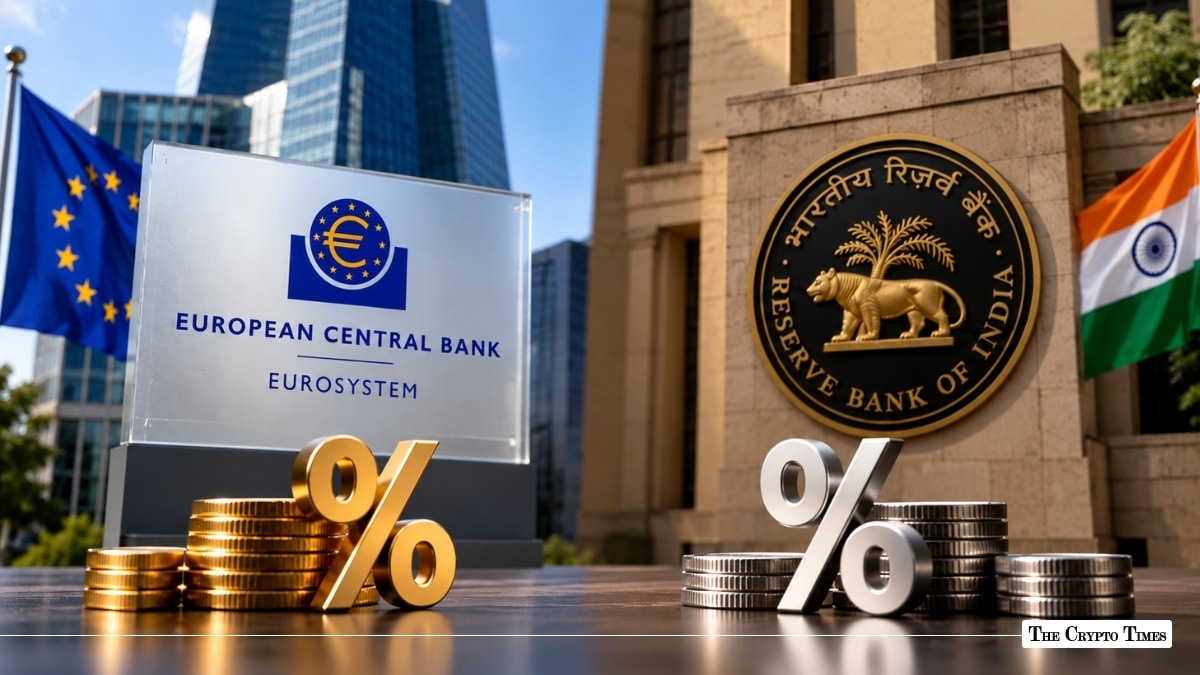
The India stablecoin premium indices measure the prices of USDT and USDC in rupees against a USD/INR reference rate derived from the European Central Bank’s (ECB’s) euro reference rates. They do not use the RBI or FBIL rate because the ECB allows free reuse of its rates with attribution, while FBIL benchmark data is distributed under licence. Anyone can also download the ECB file and recompute the denominator.
At the 16 October 2026 fix, USDT cost ₹100.03 in India against a reference rate of ₹95.0578, a peg-adjusted premium of +5.37%, according to the India USDT Premium Index. The USD/INR rate is the denominator in each calculation, so changing the source can change the reported premium.
Key Highlights
- The ECB publishes its euro reference rates under a permissive licence, so the index can redistribute the denominator and anyone can reproduce a fix independently.
- One denominator works across all fifteen indices. The RBI publishes only an INR rate, so a family covering nine currencies would need nine different sources.
- ECB rates land around 16:00 CET, hours after the Indian fix window closes, so every fix prices against the prior business day’s rate deterministically.
- The rate’s date is cited with every fix, and it may be carried across weekends and holidays for at most five calendar days before a fix refuses.
- The index is not an official benchmark and does not claim to replace the RBI reference rate or FBIL.
What the premium compares
The premium is the gap between what Indians pay for a stablecoin and what a dollar costs at a reference exchange rate. Each index takes the median of exchange prices sampled between 11:30 and 12:30 IST, then divides by the USD/INR reference and by the coin’s own global dollar price.
The India USDC Premium Index uses the same structure. At the 13 October fix, USDC cost ₹100.09 against ₹95.7750, a premium of +4.51%. Both series are listed on the India stablecoin premium hub.
The RBI rate and the FBIL rate are one benchmark family
The RBI no longer computes the USD/INR reference rate. Financial Benchmarks India Private Limited (FBIL) took over the computation and publication from 10 July 2018, and the RBI stopped issuing its daily press release after 9 July 2018. On 2 August 2018 the RBI told banks to use the FBIL conversion rate for CRR and SLR reporting of foreign currency assets and liabilities.
The real comparison is therefore ECB against FBIL.
| ECB euro reference rate (INR) | FBIL USD/INR reference rate | |
|---|---|---|
| Publisher | European Central Bank | Financial Benchmarks India Pvt Ltd |
| Quoted as | EUR/INR, crossed with EUR/USD to get USD/INR | USD/INR directly |
| Timing | Set around 14:10 CET, published around 16:00 CET | Window 11:30 to 12:30 Mumbai time, published around 1:00 pm |
| Method | Firm quotes and trade rates from major FX platforms, checked against tolerances | Volume-weighted average of onshore spot trades in a random 15-minute window |
| Reuse | Free with the ECB cited and any modification stated | Redistribution needs an FBIL licence |
How the ECB-derived rate is built
The ECB has published a euro reference rate for the Indian rupee since 2 January 2009. It publishes no direct USD/INR rate, so the index divides EUR/INR by EUR/USD from the same ECB file.
On 15 October 2026, the ECB set EUR/INR at 106.5408 and EUR/USD at 1.1208. Dividing gives ₹95.0578 per dollar, the reference rate used at the 16 October fix.
The ECB publishes around 16:00 CET, which is evening in India. That is after the 12:35 IST fix, so the index uses the most recent ECB rate dated before the fix date. A Monday fix uses Friday’s rate.
Why the ECB rate fits an open index
The ECB lets users reuse information from its website if the ECB is cited as the source and any modification is stated. A cross rate is a modification, so each index page carries the line “USD/INR derived from ECB euro reference rates. Source: ECB statistics.”
Each fix also shows the date of the ECB rate it used, and the CSV download includes that date. A reader can check the denominator against the ECB file.
The index did not start with the ECB rate. It launched with a blend of third-party market rate APIs and switched on 25 July 2026, because one source’s terms forbade programmatic redistribution and its values could not be independently reproduced. The switch restated 18 published fixes, raising each premium by 3.9 to 20.9 basis points, according to the methodology and corrections log.
Why the index does not use FBIL
The FBIL rate is built from onshore Mumbai trades, so it sits closer to the Indian market. It also comes with licence terms. FBIL’s pricing guidelines say market data vendors and redistributors need an FBIL licence to redistribute benchmark data. Its data fee FAQ says index construction based on FBIL data is a separate activity that needs its own usage licence.
The premium series is published openly, with CSV and JSON downloads. The data hub states that India’s official benchmark is not redistributable on the ECB’s terms. The methodology keeps FBIL as the intended benchmark if redistribution licensing is ever confirmed. FBIL’s licensing terms may change over time.
What the ECB choice costs
The ECB reference rate used for each fix predates the fixing date. It is roughly 19 hours old at the close of the fixing window from Tuesday to Friday, and roughly 67 hours old on Monday. After TARGET holidays the index carries the latest rate for up to five calendar days, and publishes no fix beyond that.
The two rates also measure different moments. FBIL’s window is late morning in Mumbai. The ECB sets its rates around 14:10 CET. Readers comparing the premium with the FBIL rate should expect some difference.
The ECB states that its reference rates are for information only and are not intended for market transactions, directly or as a benchmark. The index follows the same limit. Its pages say it is not an official FX rate, not a trading signal and not for contract settlement.
Questions readers ask
Is the premium based on the RBI reference rate?
No. It uses a USD/INR rate derived from ECB euro reference rates, and every index page says it is not India’s official reference rate.
Does the RBI still publish a USD/INR reference rate?
No. FBIL has computed and published the rate since 10 July 2018, and the RBI discontinued its own daily release after 9 July 2018.
Why does the index use the previous day’s ECB rate?
The ECB publishes around 16:00 CET, after the 12:35 IST fix. The index uses the latest rate dated before the fix date, which also makes every fix reproducible later.
Could the index move to the FBIL rate?
The methodology names FBIL as the intended benchmark if redistribution licensing is confirmed. A formula change needs seven days’ public notice and a parallel run.
The India stablecoin premium indices are published for informational and journalistic purposes. They are not investment advice, not an official FX benchmark and not intended for contract settlement.