In 2026, cryptocurrency is no longer just a speculative asset to buy and hold. It has rapidly evolved into a functional, everyday currency.
Last year, global stablecoin transaction volumes surged past the $33 trillion mark. This incredible growth means digital dollars are now rivaling the transaction volumes of traditional payment giants like Visa and Mastercard.
The shift is primarily being driven by consumer demand. A recent survey reveals that nearly 39% of merchants in the United States already accept cryptocurrency at checkout, and 84% of these business owners believe crypto payments will become standard within the next five years.
From crypto-linked debit cards and merchant payment gateways to digital gift cards and AI-powered autonomous payments, the infrastructure for spending digital assets has matured rapidly. This guide breaks down exactly how each method works in 2026.
The Rise of Crypto Debit and Credit Cards
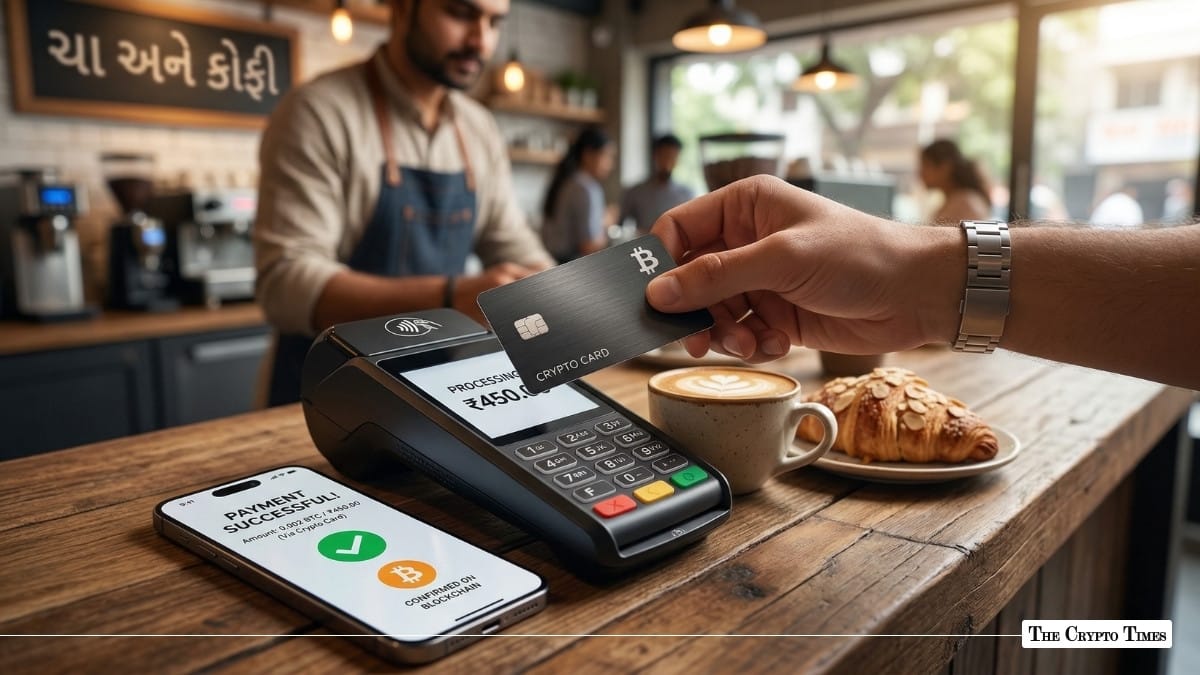
The easiest and most practical bridge between decentralized digital assets and traditional commerce is the crypto-linked debit or credit card.
Historically, users had to sell their crypto on an exchange, wait for the fiat currency to settle, and then transfer it to a bank account. In 2026, modern crypto cards eliminate this friction entirely.
They use “implicit conversion,” meaning your assets are held in crypto and automatically converted to fiat at the exact millisecond you swipe or tap your card.
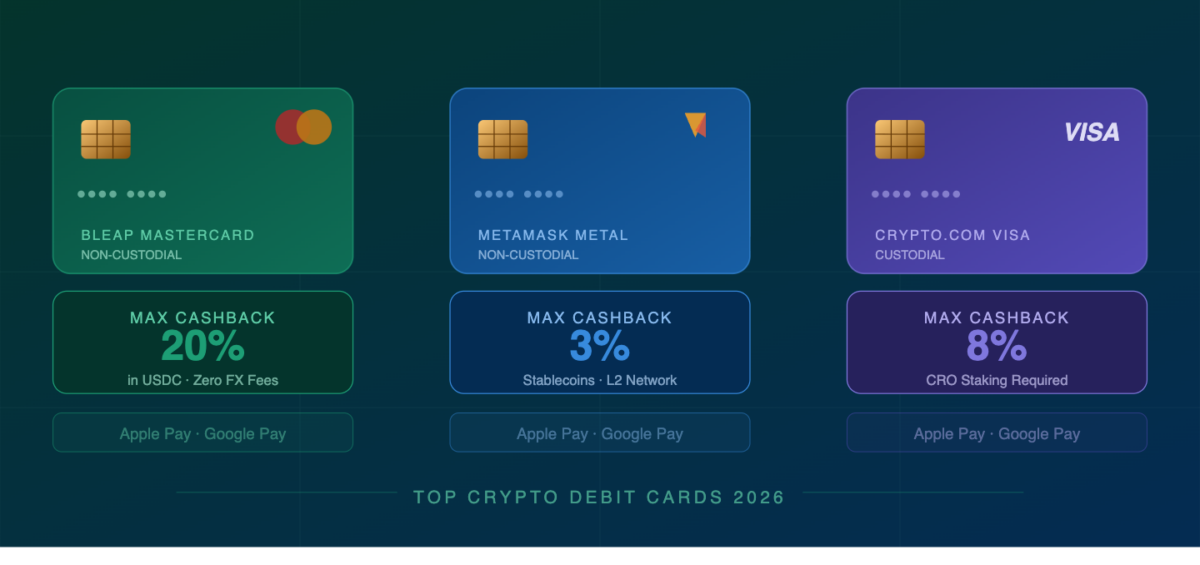
The best card for you depends on whether you prefer self-custody or the convenience of an exchange. Here’s how the two categories stack up. The Bleap Mastercard is the top non-custodial option, offering up to 20% cashback in USDC with zero conversion fees. For traditional exchange users, the Crypto.com Visa offers up to 8% cashback, provided users meet specific token staking requirements.
Non-Custodial Card Leaders
Self-custody is also gaining ground. Consumers are increasingly moving away from centralized exchanges in favor of self-custody.
The MetaMask Card, developed in partnership with Mastercard, allows users to spend stablecoins directly from their digital wallets. It supports Apple Pay and Google Pay, and leverages Ethereum Layer-2 networks like Linea and Base to minimize network transaction costs. The premium Metal tier offers 3% cashback on the first $10,000 spent.
The Bleap Mastercard is another major non-custodial player. It uses Multi-Party Computation (MPC) wallet technology to secure funds. Bleap charges zero foreign exchange or conversion fees and offers up to 20% cashback in USDC, making it a strong choice for global travelers.
Custodial Card Leaders
For users who prefer the convenience of an exchange, centralized cards remain highly popular.
The Crypto.com Visa Card is a dominant force, offering generous rewards for users willing to stake its native CRO token. Staking higher amounts can unlock up to 8% cashback, alongside full reimbursements for streaming services like Netflix and Spotify.
The Nexo Card offers a unique “dual-mode” feature. Users can instantly toggle between a Debit Mode—which earns up to 14% annual interest on unspent balances—and a Credit Mode, which allows users to borrow fiat currency against their crypto collateral without selling it.
2026 Crypto Card Comparison
| Card Provider | Custody Type | Conversion / FX Fees | Max Rewards | Apple/Google Pay |
|---|---|---|---|---|
| Bleap Mastercard | Non-Custodial | 0% Conversion, No FX Fee | Up to 20% (USDC) | Yes |
| MetaMask Metal | Non-Custodial | 0% Foreign Transaction | Up to 3% (Stablecoins) | Yes |
| Crypto.com Visa | Custodial | 1% Top-up + Tiered FX | Up to 8% (CRO) | Yes |
| Bybit Card | Custodial | 0.9% Conv / 0.5% FX | Up to 10% | Yes |
| Coinbase Card | Custodial | 2.49% Liquidation Fee | Up to 4% | Yes |
| Wirex Card | Custodial | 1.5% Trans / 1% Top-up | Up to 8% (WXT) | Yes |
(Comparison table compiled from latest 2026 data)
Direct Merchant Acceptance and Enterprise Gateways
While intermediary cards are useful, the direct integration of crypto payments into merchant checkout flows represents the real sign of mainstream adoption.
Major retailers already accepting crypto directly include AMC Theatres, Microsoft, and Newegg. Beyond individual brands, millions of independent e-commerce merchants now accept crypto through enterprise gateways like Shopify, PayPal, BitPay, and Coinbase Commerce.
The infrastructure behind this is maturing fast. Shopify has integrated USD Coin (USDC). directly into its core Shopify Payments stack. This allows merchants to accept digital dollars natively without requiring third-party plugins. Settlement occurs on the Base Layer-2 network to ensure rapid, low-cost execution.
PayPal has expanded the reach of its federally regulated, dollar-backed stablecoin, PYUSD. As of March 2026, PYUSD is available in 70 global markets. Merchants accepting PYUSD receive their settlements in minutes rather than the days required by traditional cross-border payment rails.
At the network level, legacy payment giants are fully embracing the blockchain. Visa, in collaboration with Bridge, has expanded its stablecoin-linked card program, allowing businesses to settle transactions on-chain in over 100 countries. Mastercard has also launched its Crypto Partner Program, partnering with over 100 crypto-native companies to build compliant, scalable, and programmable global commerce flows.
The Gift Card Bridge and Privacy Alternatives
Despite the expansion of direct crypto gateways, many local merchants and regional grocery chains still lack the technology to process on-chain payments.
To bridge this gap, a thriving secondary market of crypto-to-gift-card platforms has emerged. These platforms allow consumers to buy digital gift cards using crypto, which can then be spent at traditional retailers.
Platforms like Bitrefill, Coinsbee, and Cardstorm let you instantly swap Bitcoin or stablecoins for digital gift cards accepted at thousands of major supermarkets, airlines, and hotel chains globally.
Bitrefill is the industry standard, offering a catalog of over 4,500 global vendors, including Amazon, Walmart, and Uber. However, to comply with tightening anti-money laundering (AML) regulations, Bitrefill requires user registration and enforces identity verification for frequent users.
For users prioritizing privacy, alternative platforms like Cardstorm have gained significant market share. Cardstorm operates entirely without Know Your Customer (KYC) requirements, offering an anonymous, fast checkout experience for prepaid Visa/Mastercard products and retail gift cards.
The Indian Market: UPI Integration and Stricter Regulations
India remains one of the largest and most dynamic cryptocurrency markets globally, despite maintaining a strict regulatory framework.
The most transformative development for Indian users is the integration of crypto platforms with the Unified Payments Interface (UPI). UPI processes over 20 billion transactions monthly, allowing for instant, feeless mobile value transfers.
Fiat on-ramps and off-ramps, such as Onramp.money, have built deep API linkages with the UPI network. This infrastructure allows Indian consumers to instantly swap their crypto for Indian Rupees (INR) and receive the funds directly in their bank accounts via UPI, entirely bypassing slow traditional banking rails. Platforms like KuCoin have introduced features that generate dynamic QR codes, allowing users to pay traditional merchants by liquidating crypto on the backend.
However, this technological convenience is offset by stringent taxation and compliance mandates.
Profits from trading, selling, or spending crypto are taxed at a flat 30% rate under Section 115BBH, with no ability to offset losses. Section 194S also requires a 1% Tax Deducted at Source (TDS) on the transfer of crypto assets. New rules in Budget 2026 impose a ₹200 daily penalty for failing to report transactions.
The 1% TDS remains the largest friction point for traders, as it locks up capital on every single trade, reducing market liquidity. The lack of loss set-offs means that a trader who loses money on Bitcoin but profits on Ethereum must pay the full 30% tax on the Ethereum gains without any deductions.
To enforce this tax regime, the Financial Intelligence Unit (FIU-IND) implemented strict KYC protocols in January 2026. Basic document uploads are no longer sufficient. Regulated exchanges must now force users to take “live selfies” that track eye and head movements to block AI deepfakes. Exchanges must also permanently log the exact geographic coordinates and IP addresses of users during the onboarding process.
Global Compliance: The EU MiCA Regulation
Regulatory convergence is not limited to India. The European Union has fully implemented the Markets in Crypto-Assets Regulation (MiCA).
MiCA establishes uniform market rules for crypto-assets across the EU, focusing on consumer protection, transparency, and the strict supervision of stablecoin issuers. Entities providing crypto services under previous national laws have a grandfathering transition period that expires in July 2026, after which they must be fully authorized under the MiCA framework to operate.
For consumers, MiCA’s most noticeable impact is on stablecoins. Issuers of “significant” stablecoins (those exceeding €5 billion in circulation or 10 million holders) face heightened reserve, governance, and liquidity requirements. This has already affected how major stablecoins operate within the EU, with Tether’s USDT facing compliance pressure and Circle’s USDC positioning itself as MiCA-compliant.
This regulatory clarity, while demanding for startups, is ultimately driving the institutional adoption required to make crypto a mainstream payment rail.
The Future: AI Agents and Autonomous Payments

Looking forward, the most revolutionary shift in crypto expenditure is the rise of Agentic Commerce.
What is agentic commerce in crypto?
Agentic commerce refers to an ecosystem where Artificial Intelligence (AI) agents execute financial transactions autonomously. Using blockchain protocols, these agents are given wallets and can spend stablecoins to negotiate and pay for premium data, software APIs, or digital goods without human approval.
Traditional banking APIs and credit card networks are too slow and require too much manual authentication for AI agents to use efficiently. Blockchains, however, are programmable.
Networks are actively building infrastructure for this. The BNB Chain, for example, deployed the ERC-8004 standard in early 2026, which creates verifiable on-chain identities for AI agents. Paired with Non-Fungible Agents, these software entities can own their own wallets and autonomously spend funds to complete tasks.
Similarly, the x402 protocol is reviving the old internet standard for “Payment Required,” allowing AI agents to execute high-frequency micro-transactions using stablecoins over fast networks like Solana. McKinsey projects that agentic commerce could mediate trillions of dollars in global trade by 2030, with cryptocurrency serving as its native financial rail.
Conclusion
The ability to spend cryptocurrency like cash has definitively arrived in 2026. The barriers of slow settlement times, exorbitant network fees, and clunky user interfaces have been largely eradicated by the integration of Layer-2 blockchains, stablecoins, and global payment networks like Visa and Mastercard.
Whether you are using an MPC-secured debit card, swapping assets for an Amazon gift card, or relying on an AI agent to manage your digital subscriptions, the utility of decentralized money has never been greater. However, consumers must remain vigilant. As the technology becomes frictionless, global tax authorities and regulatory bodies are implementing increasingly sophisticated surveillance and taxation architectures. To successfully navigate this new financial era, users must blend technological adoption with meticulous compliance.
Disclaimer:
Some elements of this content may have been enhanced with the help of our artificial intelligence (AI) assistants for purposes such as basic refinement, review, image generation, and translation to deliver high-quality news in a shorter time frame. However, all AI-assisted content is reviewed and approved by our team to ensure accuracy, fairness, and editorial integrity.