The cryptocurrency market has undergone a radical transformation over the past few years. What began as a speculative frontier dominated by manual day traders has evolved into a sophisticated financial ecosystem where algorithmic trading is the norm, not the exception.
While institutional players now command a significant portion of daily volume, utilizing high-frequency algorithms to capture value in milliseconds, retail investors face an uphill battle. The speed of modern markets simply outpaces human reaction time. To remain competitive, individual traders have turned to automated solutions.
Crypto trading bots—once the exclusive domain of developers with Python skills—have democratized access to institutional-grade strategies. These scripted programs operate 24/7, removing the physiological limitations of sleep and the psychological pitfalls of emotion-driven decision-making.
The market for trading bots has bifurcated. On one end, highly accessible exchange-integrated solutions require zero setup. On the other, complex SaaS platforms offer granular control for professional strategists. This guide provides a comprehensive analysis of the 11 most significant crypto trading bots defining the 2026 landscape, evaluated on security architecture, cost-efficiency, and suitability for modern market structure.
Crypto trading bots: The psychological edge of automation
The primary value proposition of a trading bot is often misunderstood. It is not merely about executing trades faster than a human; it is about consistent, emotionless execution. Human traders are biologically wired to fail in volatile markets.
Fear causes traders to sell at the bottom of a crash, locking in losses. Greed causes them to hold winning positions too long, watching unrealized gains evaporate. This phenomenon, known as “round-tripping,” is a common destroyer of retail capital.
In contrast, crypto trading bots operate on strict conditional logic. If the parameters dictate a sale, the bot executes without hesitation—it does not feel hope or fear. In volatile crypto markets where assets can swing 20% in hours, this emotional detachment is a statistical advantage.
The 24/7 market reality
Traditional equity markets offer traders a natural respite during evenings and weekends. Cryptocurrency markets do not. A significant percentage of price discovery occurs outside US trading hours—during Asian sessions and over weekends—when many traders are asleep.
Manual traders are forced to choose between sleep and opportunity. Automated systems bridge this gap, monitoring order books and technical indicators around the clock. This is particularly vital for strategies like arbitrage and grid trading, which rely on high-frequency execution to capture micro-profits that a human cannot physically execute hundreds of times per day.
Security in a post-breach era
The trading bot industry faced a reckoning in 2022 and 2023. High-profile API key leaks at major platforms shook user confidence and resulted in significant fund losses. These events fundamentally reshaped security standards across the industry.
Today, security is the primary evaluation metric. Traders must look for platforms that enforce IP whitelisting, mandated two-factor authentication (2FA), and robust encryption for API key storage. The rise of Fast API and OAuth connections has also improved safety by allowing bots to connect to exchanges without the user ever manually handling a raw API secret key—drastically reducing the attack surface for phishing and clipboard hijacking.
Methodology and selection criteria
The following factors informed the selection and ranking of the 11 bots in this 2026 guide:
- Beginner-to-Intermediate Accessibility: The “Time to First Bot” metric.
- Cost-to-Value Ratio: Break-even trading volume based on updated 2026 pricing.
- Security Architecture: API encryption and exchange connection methods.
- Strategy Depth: Customization ceiling for advanced traders.
- Exchange Compatibility: API rate limits and supported trading pairs.
- AI and Automation Capabilities: Parameter optimization and regime detection.
11 crypto trading bots for your strategies

1. Pionex: The frictionless entry point
Pionex stands as a distinct entity in the trading bot landscape. Unlike most competitors, which are third-party software connecting to external exchanges, Pionex is an exchange with built-in automation. This hybrid architecture solves the two biggest hurdles for beginners: API management and monthly subscription costs.
- Business Model: Pionex charges zero monthly subscription fees. It monetizes through trading fees set at a highly competitive 0.05% for both makers and takers—half the standard rate of many major competitors.
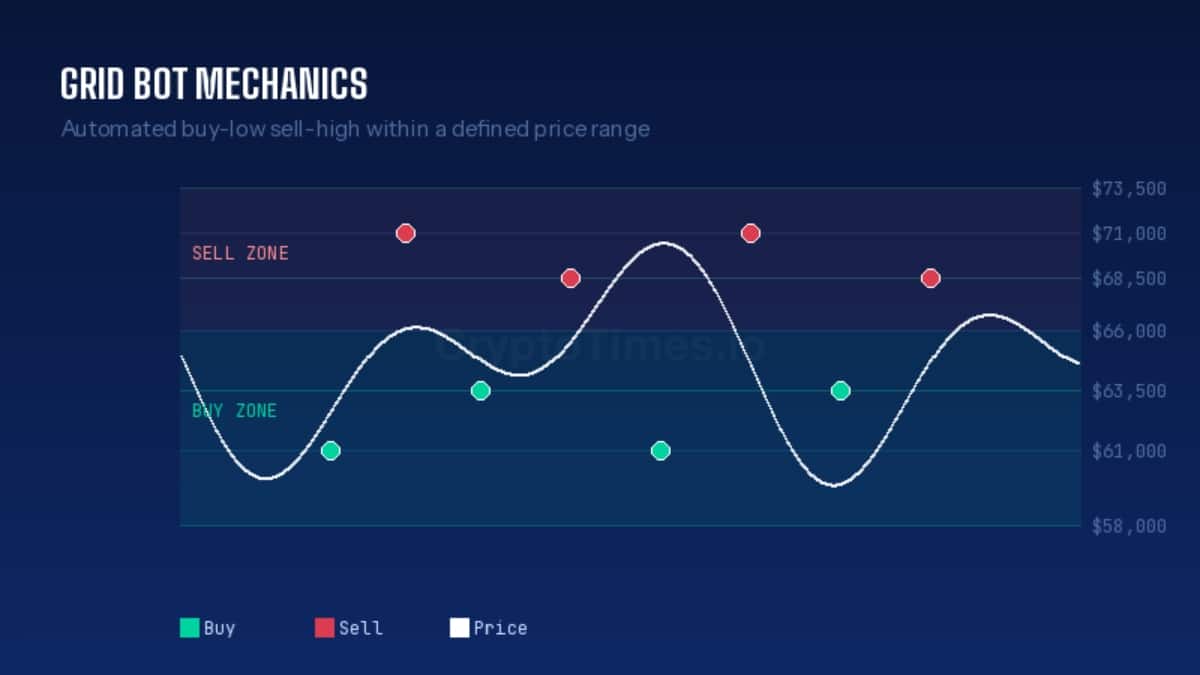
- Grid Trading Bot: The flagship product. Users define a price range, and the bot slices this range into multiple levels, placing buy orders below the current price and sell orders above. As price fluctuates, the bot captures the spread repeatedly.
- Spot-Futures Arbitrage Bot: Exploits the funding rate mechanism in perpetual futures markets by holding a spot position and an equal short futures position (delta neutral). The trader collects funding fees from long traders without directional price exposure.
- Supported Bots: 16 built-in bots total, including DCA, Infinity Grid, TWAP, and Rebalancing. All are free to use.
2. 3commas: The Professional’s Command Center
3commas is arguably the most feature-rich third-party bot platform available to retail traders. It occupies the middle ground between beginner accessibility and professional-grade control, making it the go-to platform for serious strategists.
- Core Bot Types: DCA Bot (the platform’s flagship), Grid Bot, Options Bot, and Signal Bot.
- TradingView Integration: 3commas connects directly with TradingView webhooks, enabling traders to trigger bot actions based on custom Pine Script signals.
- SmartTrade Terminal: A unified trading terminal that supports simultaneous take-profit and stop-loss orders, trailing stops, and conditional order chains.
- 2026 Pricing: Starter ($15–$20/month), Pro ($40–$50/month), Expert ($110–$140/month).
3. Cryptohopper: The Signal Marketplace Leader
Cryptohopper differentiates itself through its external signal marketplace and cloud-based execution architecture. The bot runs on Cryptohopper’s servers, meaning it operates seamlessly even when the user’s computer is off.
- Signal Marketplace: Traders can subscribe to third-party signal providers who sell their technical analysis triggers, allowing users to automate strategies built by veterans.
- Strategy Designer: A visual, no-code interface for building complex conditional strategies using indicators like RSI, MACD, and Bollinger Bands.
- 2026 Pricing: Pioneer (Free, manual/portfolio only), Explorer ($24.16/month), Adventurer ($57.50/month), Hero ($107.50/month).
4. Bitsgap: The Multi-Exchange Aggregator
Bitsgap‘s primary value proposition is its ability to manage bots across multiple exchanges from a single unified dashboard, addressing the fragmentation problem for traders with capital spread across Binance, Kraken, KuCoin, and others.
- GRID and DCA Bots: Bitsgap’s GRID bot includes a powerful backtesting engine that shows hypothetical performance for any trading pair before going live.
- Portfolio Analytics: Cross-exchange portfolio tracking with P&L visualization and performance benchmarking against BTC and ETH.
- 2026 Pricing: Basic ($23–$29/month), Advanced ($55–$69/month), Pro ($119–$149/month). Includes a 7-day free trial.
5. Coinrule: The Rule-Based Automation Engine
Coinrule targets non-technical traders with a template-first approach. Users build “if-this-then-that” style rules using a visual editor rather than configuring complex bot parameters manually.
- Template Library: 200+ pre-built rule templates covering trend-following, DCA, rebalancing, and risk management strategies.
- Demo Trading: Full paper trading environment with real market data, allowing strategy testing without capital risk.
- 2026 Pricing: Starter (Free), Investor ($29.99/month), Trader ($59.99/month), Fund ($749/month for institutional volume).
6. TradeSanta: The Simplicity Champion
TradeSanta prioritizes speed of setup over depth of customization, making it ideal for beginners who want to get a strategy running within minutes.
- Long and Short Bots: TradeSanta supports both long (DCA-down) and short (DCA-up) strategies natively—crucial for bear market trading.
- Extra Orders: Configurable additional buy orders that trigger at specified intervals below the initial entry, functioning as a manual DCA layer.
- Pricing: Basic ($18/month), Advanced ($32/month), Maximum ($45/month).
7. WunderTrading: The TradingView Bridge
WunderTrading is purpose-built for traders who use TradingView as their primary charting platform and want to automate the execution of Pine Script strategy signals without writing custom execution code.
- Webhook Automation: TradingView alerts are routed through WunderTrading’s webhook system to execute live orders on connected exchanges.
- Copy Trading: Includes a copy trading module allowing users to mirror the portfolios of verified signal providers.
- Pricing: Free (1 bot), Basic ($3.47/month), Pro ($13.97/month), Premium ($62.97/month)—among the most aggressive pricing in the industry.
8. Gunbot: The Self-Hosted Privacy Option
Gunbot occupies a unique position as a self-hosted bot. The software runs on the user’s own hardware (a PC, VPS, or Raspberry Pi), meaning no API keys or funds ever leave the user’s direct control.
- Privacy Architecture: Because Gunbot runs locally, there is no centralized third-party server that could be breached. API keys are stored only on your machine.
- Strategy Depth: Supports 30+ built-in strategies including Bollinger Bands, EMA spread, and custom JavaScript strategies.
- Pricing: One-time license fee ($99 Starter, $179 Standard, $599 Pro)—no recurring subscription, making it the most cost-efficient tool for long-term users.
9. Mizar: The DeFi-Aware Platform
Mizar bridges the gap between centralized exchange (CEX) automation and decentralized finance (DeFi) awareness, offering standard bot strategies alongside smart copy trading.
- Smart DCA: Mizar’s DCA implementation includes intelligent entry conditions based on technical indicators rather than fixed price drops, reducing the risk of averaging into prolonged downtrends.
- Performance Metrics: Users can browse verified strategy providers by Sharpe ratio, drawdown, and win rate.
- Pricing: Free tier available; premium plans start at $19/month.
10. HaasOnline: The Institutional Powerhouse
HaasOnline caters to advanced traders, quantitative analysts, and developers who find standard consumer platforms too restrictive.
- HaasScript: The platform features its own purpose-built scripting language (HaasScript), allowing users to code virtually any trading logic imaginable.
- TradeServer: Users can run HaasOnline on their own secure TradeServer, ensuring maximum privacy and execution speed.
- Pricing: Highly premium. Cloud subscriptions typically range from $49 to $149/month, while self-hosted licenses are priced annually.
11. OctoBot: The Open-Source Alternative
For tech-savvy users who want transparency and customizability without the high price tag of enterprise software, OctoBot is the premier open-source trading bot.
- Community-Driven: Completely open-source, meaning the code is continually audited and improved by a community of developers.
- Web Interface: Despite being open-source, it features a clean web interface for managing profiles, backtesting, and live trading.
- Pricing: Free (Self-hosted open-source). Cloud-hosted options are available for a small monthly fee for those who don’t want to manage their own servers.
Also Read: How to Use Crypto Trading Bots: Step-by-step Beginner’s Guide
AI Trading Bots: The Next Generation of Automation
Artificial intelligence has become the most heavily marketed feature in crypto trading, but it is vital to separate the reality from the buzzwords.
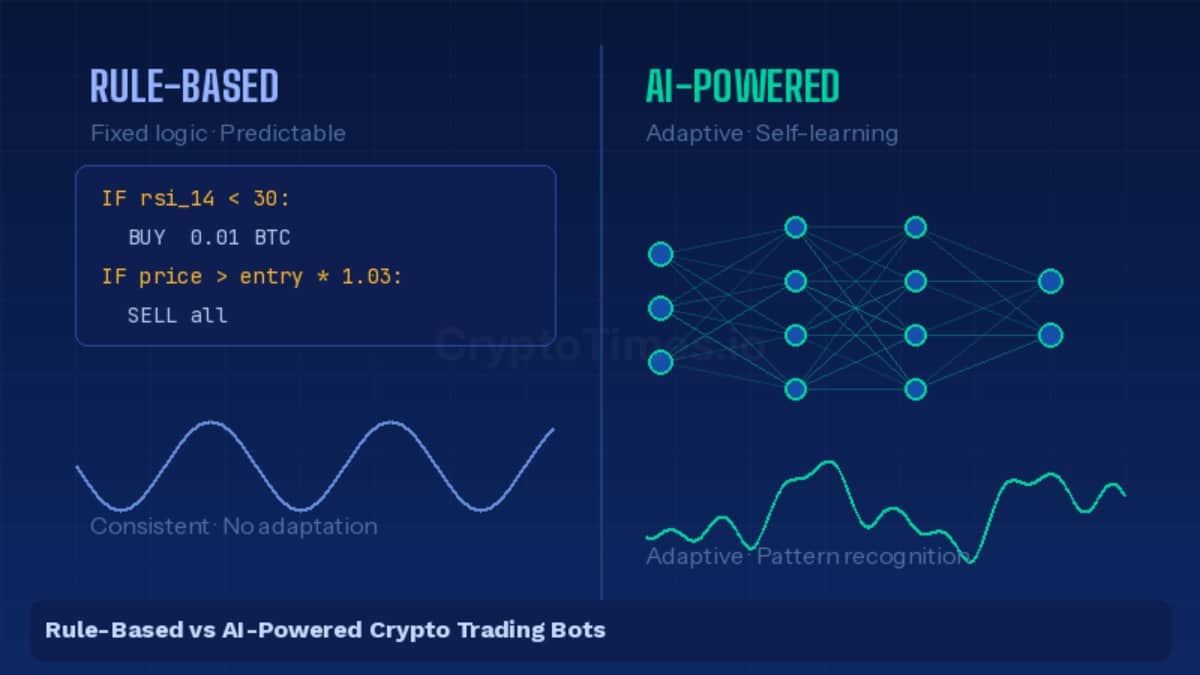
Traditional rule-based bots execute fixed logic: “if RSI drops below 30, buy.” AI-powered tools in platforms like 3commas and Cryptohopper generally act as Parameter Optimizers. They do not use generative AI to guess market sentiment; rather, they use machine learning models to backtest massive datasets and recommend the exact grid spacing, DCA steps, or indicator combinations most likely to succeed based on current volatility regimes.
Rule-Based vs. AI-Powered Bots
| Feature | Rule-Based Bot | AI-Powered Bot (Parameter Optimizer) |
| Signal Generation | Fixed indicators (RSI, MACD) | ML model trained on historical volatility |
| Market Adaptation | Manual reconfiguration required | Self-adjusting grid/DCA parameters |
| Backtesting | Historical rule replay | Out-of-sample model validation |
| Transparency | Full — logic is highly visible | Partial — model weighting can be opaque |
| Best For | Stable, predictable markets | Volatile or regime-shifting markets |
When evaluating AI features, look for platforms that clearly disclose whether the AI is advisory (suggesting parameters, like PionexGPT) or executive (directly placing trades).
DCA Bots: Dollar-Cost Averaging on Autopilot
Dollar-cost averaging (DCA) is one of the oldest and most empirically supported investment strategies: investing fixed amounts at regular intervals to reduce the impact of volatility on your average cost basis. A DCA bot automates this process and adds conditional intelligence—buying more when prices fall, and taking profit automatically when prices recover.
How DCA Bots Work
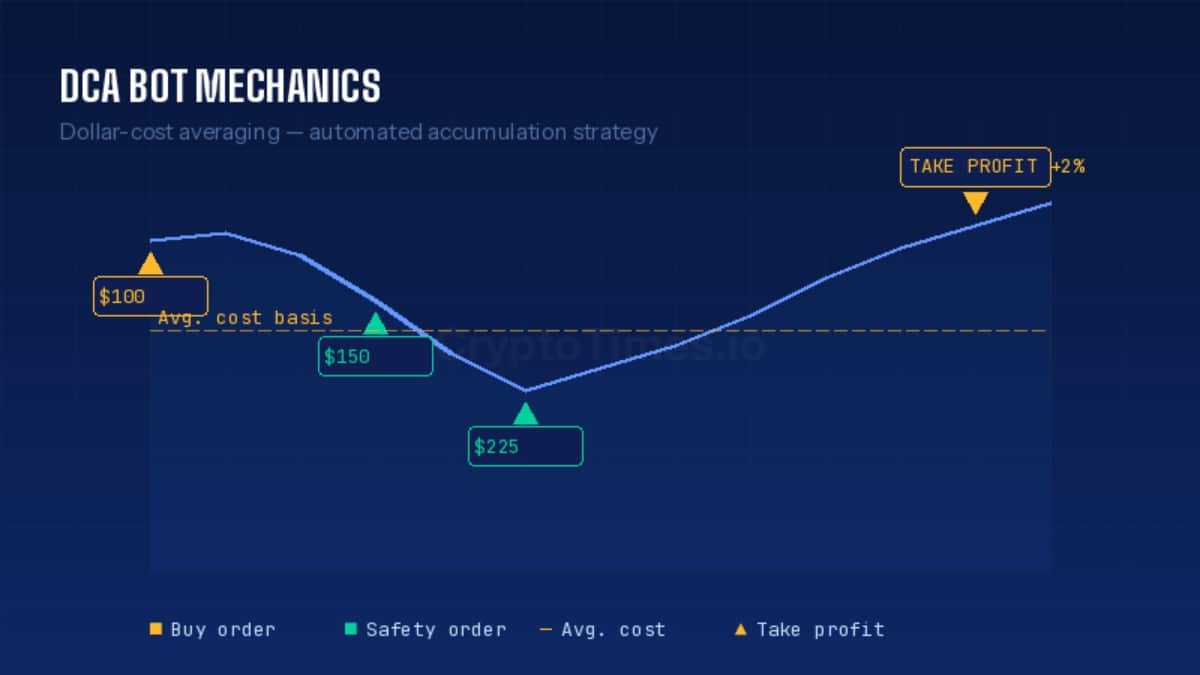
A DCA bot places an initial buy order (the “base order”) and then places additional “safety orders” at pre-configured price drops below the entry.
Example Configuration:
- Base order: $100 of ETH at $3,000.
- Safety order 1: $150 of ETH if price drops 3% (to $2,910).
- Safety order 2: $225 of ETH if price drops an additional 3% (to $2,823).
- Take profit: Sell the entire consolidated position when the price rises 2% above the new average cost.
DCA vs. Grid Bot: Which Should You Use?
- Use a Grid Bot in flat, ranging markets where price oscillates within a known band (e.g., Bitcoin bouncing between $60k and $65k for weeks).
- Use a DCA Bot in volatile markets where you expect an eventual recovery but face unpredictable short-term drops. 3commas is widely considered the market leader for deep DCA configurations.
Crypto Scalping Bots: Capturing Micro-Profits at Speed
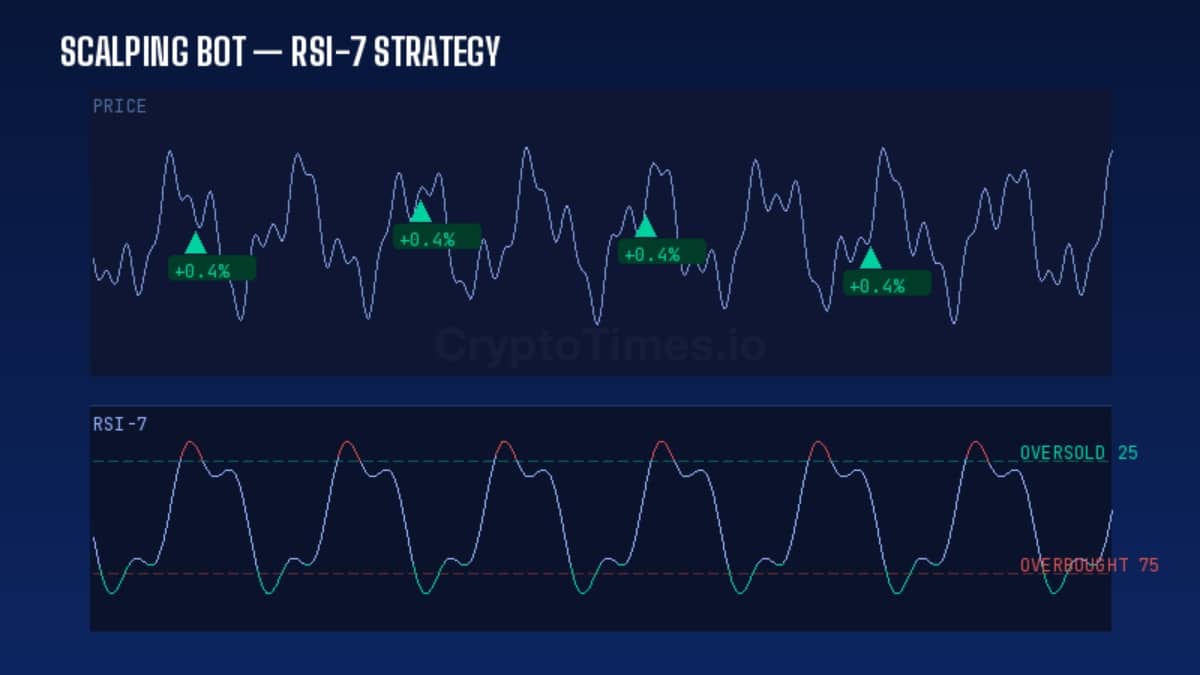
Scalping is a high-frequency strategy that targets small, frequent profits from rapid price movements—typically holding positions for seconds to minutes. A scalping bot executes hundreds of trades per day.
The Impact of Fees on Scalping
Scalping bots are incredibly sensitive to exchange trading fees. If your bot targets a 0.3% profit per trade, but your exchange charges a 0.1% maker/taker fee, your net profit after the round trip (buy and sell) is only 0.1%.
This is why platforms like Pionex (with 0.05% standard fees) or using Binance with BNB fee discounts are practically mandatory for scalping strategies.
The RSI-7 Strategy
The RSI-7 (7-period Relative Strength Index) is a highly popular scalping indicator. Unlike the standard RSI-14, the RSI-7 is hyper-sensitive to short-term price movements, generating frequent signals. A standard scalping setup triggers a buy when the RSI-7 drops below 25 on a 5-minute or 15-minute chart, targeting a rapid 1% to 1.5% take-profit.
Best Exchanges for Bot Integration
If you choose a third-party SaaS bot (like 3commas or Bitsgap), you must connect it to an exchange via API.
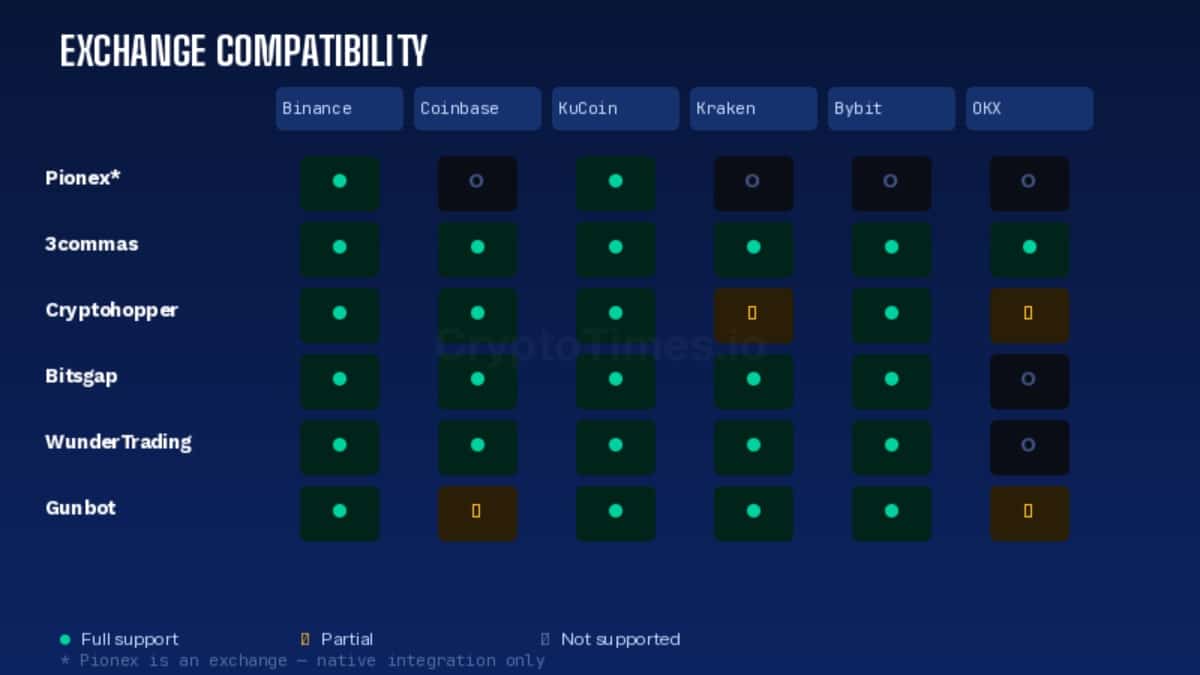
- Binance: The undisputed king of bot integration. Massive liquidity, low fees (0.1% base), and a highly permissive API with high rate limits suitable for rapid trading.
- Kraken: Excellent for European and US traders. Kraken’s API supports complex WebSocket feeds and IP whitelisting. Highly compatible with 3commas and Gunbot.
- Coinbase Advanced: The safest regulatory bet for US users. However, Coinbase API rate limits are stricter than Binance’s, making it suitable for Grid and DCA bots, but poor for high-frequency scalping.
- KuCoin: Offers excellent native (free) bots right in the app, but also integrates flawlessly with external platforms for traders who want more complex parameters.
Beginner Decision Guide: Choosing Your First Bot
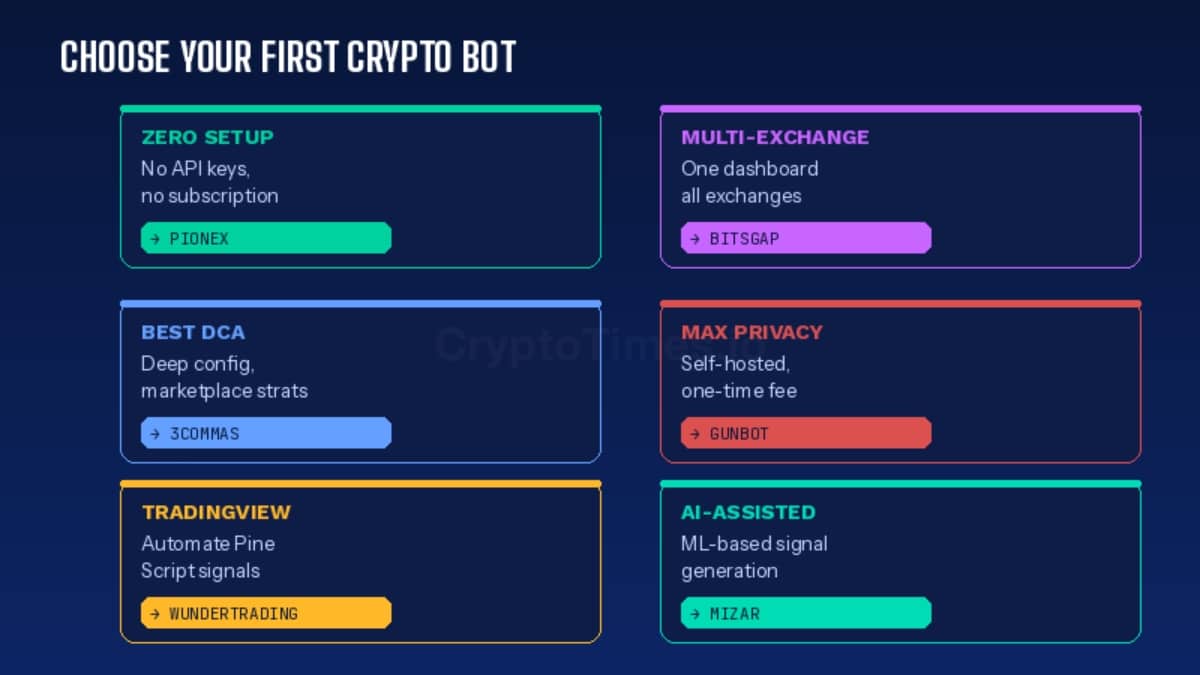
With 11 platforms and dozens of strategies, the choice can feel overwhelming. Use this framework to narrow your options based on your capital and goals:
Step 1: Match Your Portfolio Size to the Cost Model
- Under $2,000: Pionex (Free) or WunderTrading ($3.47/mo). Do not pay $50/month for a bot if your portfolio is small; the fees will eat your margins.
- $2,000–$10,000: 3commas Starter ($15/mo) or Cryptohopper Explorer ($24/mo). The subscription costs become negligible relative to potential portfolio gains.
- $10,000+: Consider a Gunbot one-time license for maximum long-term cost efficiency and privacy, or HaasOnline for institutional-grade scripting.
Step 2: Start with Paper Trading
Every platform covered here (except the self-hosted Gunbot) offers paper trading—simulated trading with real market data but no real funds.
- Run your strategy in paper mode for a minimum of 2 weeks.
- Evaluate performance across an uptrend, downtrend, and sideways market.
- Start live trading with only 10% of your intended allocation.
Conclusion
The crypto bot landscape in 2026 is mature, highly secure, and accessible. The choice of platform ultimately comes down to your technical comfort, your portfolio size, and your willingness to pay subscription fees.
For absolute beginners, Pionex remains the frictionless champion with its built-in exchange and zero-fee bot structure. For intermediate traders looking to scale, 3commas provides the deepest integration and best DCA tools on the market. For quantitative developers, HaasOnline and OctoBot offer the ultimate control.
Regardless of the platform, the fundamental rule of automation remains unchanged: Bots do not guarantee profits; they guarantee execution. Treat bot configuration as a strategic skill, manage your risk tightly, and prioritize capital preservation over aggressive return targets.
Disclaimer: This report is for informational purposes only. Cryptocurrency trading involves substantial risk of loss and is not suitable for every investor. Automated trading tools do not guarantee profits and may result in losses during extreme market volatility. Always conduct independent research
Disclaimer:
Some elements of this content may have been enhanced with the help of our artificial intelligence (AI) assistants for purposes such as basic refinement, review, image generation, and translation to deliver high-quality news in a shorter time frame. However, all AI-assisted content is reviewed and approved by our team to ensure accuracy, fairness, and editorial integrity.