Circle’s stock (CRCL) held steady on Friday, October 16, 2026, as the company reported $1.4 billion in revenue from its USDC business during the first half of the year.
The company said $819 million went to distribution partners and transaction costs, while another $473 million covered business operations and infrastructure. The remaining share amounted to approximately 7% of revenue, according to Circle’s breakdown.
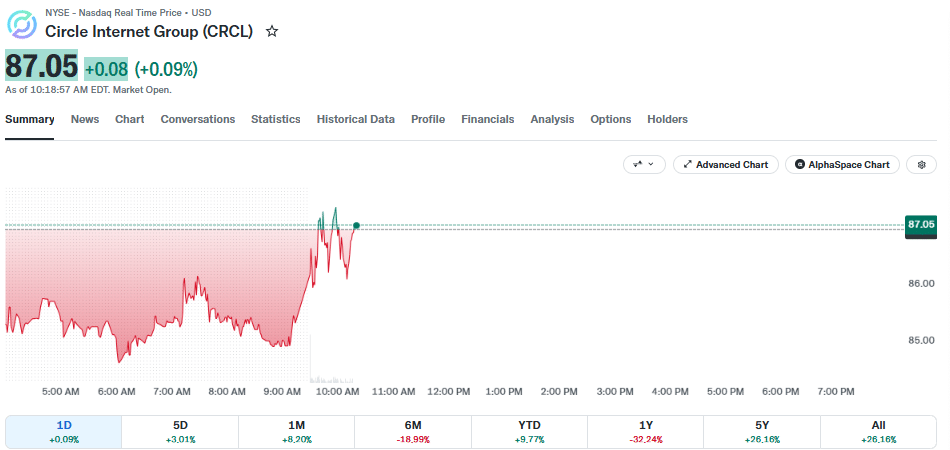
According to data from Yahoo Finance (on October 16 at 14:18 UTC), CRCL traded at $87.05, up 0.09% within the last 24 hours. The stock had risen from an intraday low around $85, while its market capitalization stood at around $22.09 billion. Average trading volume was approximately 13.2 million shares.
Circle outlines how USDC revenue is distributed
In a report, Circle Chief Commercial Officer (CCO) Kash Razzaghi explained how the company allocates revenue generated by its USDC business, citing the costs of maintaining the stablecoin’s availability for businesses and users across global markets.
According to Razzagh, USDC settled more than $36 trillion in onchain transactions during the first half of 2026. He also mentioned that Circle minted and redeemed more than $315 billion worth of the stablecoin, averaging about $1.7 billion daily, including weekends and holidays.
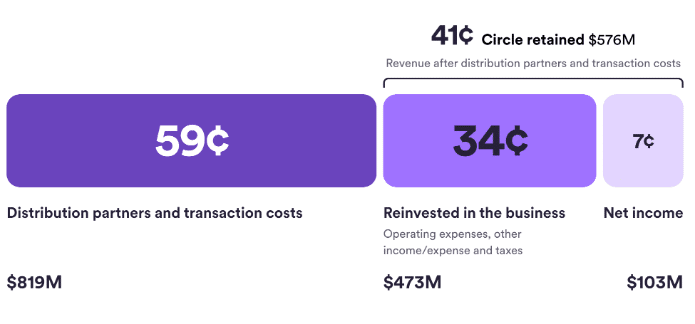
The CCO said 59 cents of every dollar Circle earned went to distribution partners and transaction costs. Another 34 cents went toward licensing, banking relationships, compliance, cash needed for redemptions, new products, and blockchain connections. That left about seven cents in net profit for every dollar earned.
“Those are the numbers behind a digital dollar in production: trillions in settlement, billions converted to and from fiat every day, and most of the economics flowing to the partners who build on it,” Razzaghi said.
Distribution partners remain central to USDC growth
Circle said it relies on exchanges, wallets, banks, fintech companies, and payment networks to make USDC available to customers. These partners can earn a share of the income generated by the reserves supporting the stablecoin, with larger USDC balances helping them earn more.
In the report, the firm said that Coinbase, which it described as its largest and longest-standing partner, reported that the average amount of USDC held across its products reached $20 billion in the second quarter, a 44% increase from a year earlier.
“But Coinbase is one partner in a much larger network,” the firm said.
Circle also signed a five-year commercial agreement with Binance in September, alongside a $100 million investment from the exchange. Razzaghi said more than 150 other partners have an economic interest in USDC’s growth.
According to Circle’s report, USDC accounted for roughly 77% of global stablecoin transaction volume in June, up from 60% a year earlier.
Redemptions and payment access add to operating costs
Circle said customers can redeem USDC for free through standard banking channels, where settlement can take up to two business days. Eligible businesses using Circle’s payment network and other platform services can also qualify for free, near-real-time redemptions.
To make faster payments possible, Circle keeps cash available through its banking partners. This allows the company to meet redemption requests even when traditional banks are closed, but maintaining that cash and access to payment services comes at a cost.
The report said Circle redeemed $71.8 billion worth of USDC in the first quarter of 2026. It also reported that combined minting and redemption volume reached $170 billion in the second quarter, up 105% from a year earlier.
Circle expands payment and blockchain services
Circle is also expanding its payment and blockchain services. Its Arc public mainnet has launched with USDC as the token used to pay transaction fees.
In September, the company agreed to acquire Singapore-based payments firm Tazapay in a $400 million all-stock deal, subject to regulatory approval and other closing conditions.
Moreover, in Africa, payment network Onafriq is integrating USDC into its cross-border services across more than 40 markets. Recently, the European Banking Authority classified USDC as the European Union’s first significant e-money token under its crypto-assets rules, with new supervisory arrangements scheduled to begin on November 12, 2026.
Razzaghi said these services require continued spending on banking access, compliance, liquidity and blockchain infrastructure. Circle argues that these investments support USDC’s availability across markets and allow businesses to convert the stablecoin into dollars for payments.
Also Read: Vitalik Wraps AI Agents in Tor + zkAPI for True Paranoid Mode