
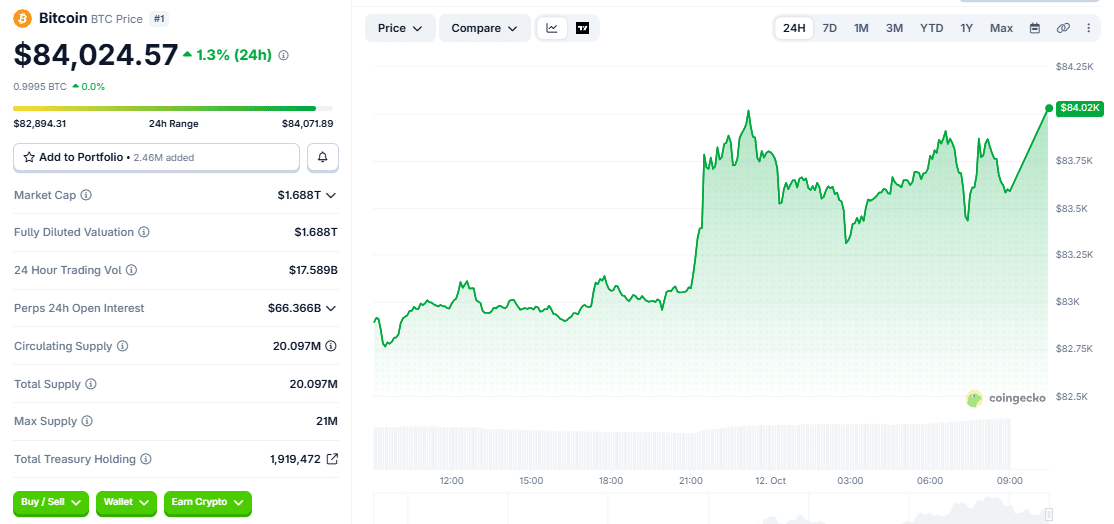
Bitcoin moved back above $84,000 on Monday as the cryptocurrency recovered from last week’s decline. BTC traded at approximately $84,024.57 at 04:55 UTC on October 12, up 1.3% over 24 hours, according to CoinGecko data. Its 24-hour range was $82,894.31 to $84,071.89.
The price snapshot showed Bitcoin with a market capitalization of approximately $1.688 trillion and 24-hour trading volume of around $17.589 billion. Perpetual-futures open interest stood at approximately $66.366 billion. Bitcoin remained down about 3.3% over seven days, leaving the latest move as a recovery within a weaker weekly trend rather than confirmation of a sustained reversal.
The rebound follows a sharp selloff that hit major cryptocurrencies last week. On October 9, Bitcoin fell 3.3% as Ethereum dropped 5.7%, amid heavy liquidations and pressure across digital assets.
Why Bitcoin Is Recovering
Short liquidations point to a possible squeeze
Bitcoin’s rebound coincided with a wave of liquidations concentrated in bearish positions. Over the 24 hours to approximately 05:30 UTC on October 12, about $46.68 million in Bitcoin positions were liquidated, according to CoinGlass data. Of that total, approximately $39.61 million involved short positions, compared with $7.06 million in long positions.
The imbalance was also visible over a shorter period. Short positions accounted for about $15.89 million of the $22.19 million in Bitcoin liquidations over 12 hours. When Bitcoin rises, traders betting on lower prices can be forced to close their positions, adding buying pressure and amplifying an upward move. This pattern is consistent with a possible short squeeze, although liquidation figures alone cannot establish how much of the price increase it caused.
Futures turnover also increased across major exchanges. The supplied exchange data showed 24-hour futures volume rising approximately 113% on Binance to $6.52 billion, 127% on OKX to $3.42 billion, and 147% on Bybit to $2.59 billion.
These increases indicate heavier derivatives trading, but volume by itself does not establish the direction of net buying or confirm stronger spot-market demand. The distinction matters because futures positions can amplify price movements in both directions.
Long positioning creates a two-sided risk
Derivatives positioning also suggests that traders were leaning toward further gains at the time of the snapshot. Binance’s Bitcoin account long/short ratio was approximately 1.34, while OKX’s was around 1.41. Binance’s top-trader position ratio stood near 1.55, according to the supplied data.
These ratios require careful interpretation. Account-based long/short ratios measure the balance of accounts on each side, while position-based ratios compare the size of long and short exposure among a defined group of traders. They do not measure the amount of new spot buying entering the market. The long-leaning figures also present a potential risk. If Bitcoin continues to rise, short liquidations could add momentum. If the price reverses, a crowded long side could leave the market vulnerable to forced selling in the opposite direction.
The latest derivatives data therefore support the possibility that short covering helped fuel Bitcoin’s rebound, but they do not establish that a durable recovery is underway.
ETF outflows ease after two heavy selling sessions
U.S. spot Bitcoin exchange-traded funds recorded approximately $487.1 million in net outflows on October 7 and another $244.1 million on October 8, according to SoSoValue data. The direction changed on October 9, when the funds recorded approximately $21.1 million in net inflows. The positive session followed two days of withdrawals totaling more than $731 million, making the inflow modest compared with the preceding selling.
The figures offer a more mixed picture than a simple claim that ETF selling has ended. The October 9 inflow was a single session and did not offset the earlier withdrawals. Because U.S. ETF markets were closed over the weekend, there were no new daily fund-flow figures during Saturday and Sunday.
The Crypto Times previously reported on the broader market decline and subsequent stabilization in its Bitcoin price coverage following the volatile week. Whether the latest inflow marks a sustained return of institutional demand will depend on subsequent sessions.
Has the selloff run its course?
Bitcoin’s recovery follows a period of heavy liquidations that added to pressure across the crypto market. The market saw more than $1.1 billion in liquidations as the selloff deepened, with Bitcoin moving toward the low $80,000s.
The decline was also accompanied by ETF withdrawals and concerns about the Federal Reserve’s policy outlook. The Fed’s September meeting minutes indicated that most policymakers considered another rate increase by year-end likely to be appropriate, although views on the policy outlook differed.
The latest price recovery and short-heavy liquidations suggest that some bearish derivatives positions have been forced out. However, that does not prove that the broader deleveraging phase has ended. The rise in futures activity and long-leaning account ratios also show that leverage remains relevant to the next move.
Analysts have highlighted the importance of macroeconomic conditions alongside positioning and fund flows. Nexo analyst Iliya Kalchev pointed to Federal Reserve signals, Treasury yields, and ETF flows as factors likely to influence Bitcoin’s direction.
For now, the evidence supports a more limited conclusion: the immediate selling pressure may have eased, and short covering may have contributed to the rebound, but sustained spot demand and subsequent ETF flows will be important to assessing whether the recovery can continue.
Geopolitical risks remain in the background
Bitcoin’s rebound also comes as markets weigh interest-rate expectations alongside geopolitical developments that could affect energy prices, inflation and broader risk sentiment.
On October 12, oil prices fell after U.S. President Donald Trump announced a proposed energy ceasefire between Russia and Ukraine and a deal involving additional Russian diesel supplies. However, Ukrainian President Volodymyr Zelenskyy said he was awaiting details of the ceasefire, while Russian attacks on Ukrainian energy infrastructure continued.
At the same time, escalating Middle East tensions, including attacks claimed by Yemen’s Iran-backed Houthis and reported strikes on tankers, kept energy-supply concerns in focus. Brent crude remained above $103 a barrel during Monday’s trading. The dollar also held near an 18-month high as investors assessed geopolitical risks and awaited U.S. inflation data.
These developments matter for Bitcoin through potential changes in risk appetite, energy costs, and interest-rate expectations. Higher oil prices could add to inflation concerns and reduce expectations for monetary easing, while an easing of supply risks could have the opposite effect. But these are potential transmission channels, not evidence that geopolitics directly caused Bitcoin’s Monday rebound.
What Could Move Bitcoin Next?
September CPI takes center stage
The next major scheduled U.S. macroeconomic release is the Consumer Price Index report for September, due Wednesday, October 14, at 8:30 a.m. Eastern Time, according to the U.S. Bureau of Labor Statistics calendar.
The inflation report will arrive ahead of the Federal Reserve’s October 27–28 meeting. A reading above expectations could reinforce concerns about persistent price pressures and interest rates staying higher for longer. A softer reading could ease some of those concerns. The market reaction will also depend on the report’s details and how investors interpret them alongside other economic data.
Thursday brings another set of scheduled U.S. releases, including the September Producer Price Index and retail sales data. The Crypto Times’ Crypto Week Ahead calendar covers the week’s inflation releases, bank earnings, Evernorth’s expected XRPN Nasdaq debut, and Friday’s Bitcoin and Ether options expiry.
Bitcoin’s $84,000 level remains in focus
Bitcoin’s move above $84,000 puts attention on whether the price can sustain that level after the weekend recovery. The $87,000 area has acted as resistance in recent trading, while a move back toward the low $80,000s would put the latest rebound under pressure.
Those levels are reference points from recent price action, not reliable predictions of where Bitcoin will trade next. ETF flows, derivatives positioning, geopolitical developments and the upcoming inflation report may help determine whether the recovery attracts follow-through buying or gives way to renewed volatility.
For now, Bitcoin has recovered part of last week’s losses, but it remains lower over the seven-day period. Short liquidations and increased futures activity provide a possible explanation for the rebound, but the next ETF sessions and Wednesday’s CPI release will offer further evidence of whether market conditions are stabilizing.
Also Read: Crypto ETFs See $964M in Outflows Over Two Days as Bitcoin Funds Lose $244M