
Ethereum climbed back above $2,500 on October 10 as the broader crypto market stabilized after a volatile week. ETH traded at approximately $2,508.83 at 15:52 UTC, up 0.8% over 24 hours, according to CoinGecko data. The token reached an intraday high of $2,513.03 within a 24-hour range of $2,473.24 to $2,513.03.
At the time of the snapshot, Ethereum had a market capitalization of approximately $306.3 billion and 24-hour trading volume of around $5.64 billion. Perpetual-futures open interest stood near $43.65 billion, according to the figures cited in the market snapshot.
The recovery came as U.S. spot-Ethereum exchange-traded funds continued to record net outflows. At the same time, corporate treasury demand remained in focus after BitMine Immersion Technologies reported holdings of more than 6 million ETH.
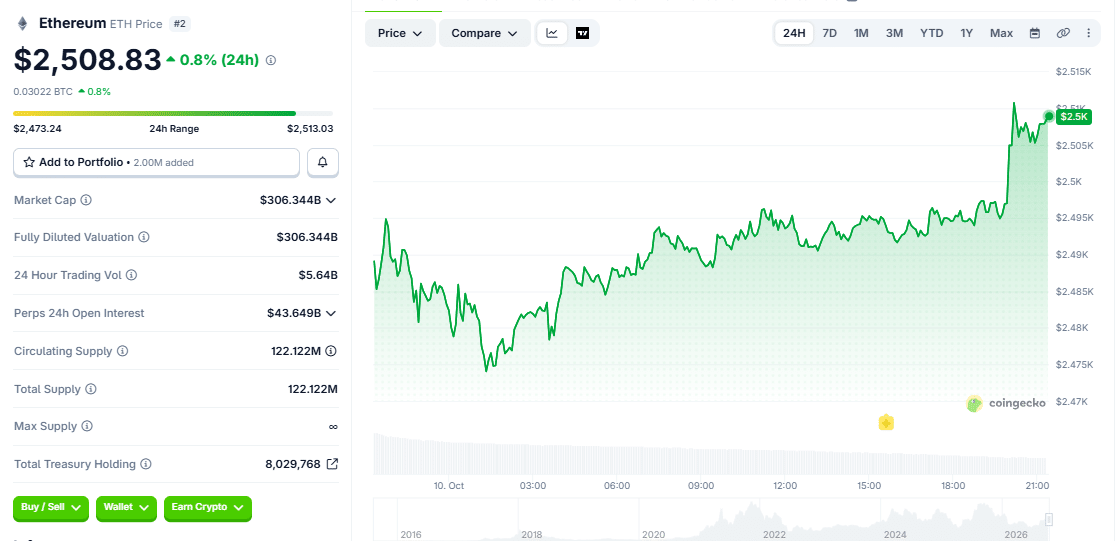
Why ETH Is Trading Above $2,500
Ethereum’s move above $2,500 marked a modest recovery after the token came under pressure earlier in October. The price increase coincided with a broader stabilization in crypto markets, although the available data does not establish a single catalyst for the move. ETH had fallen below $2,620 earlier in the month as market-wide liquidations reached roughly $175 million.
The latest move puts ETH back above the $2,500 level, but a single session’s gain does not establish that the broader downtrend has ended. Weekend trading conditions can also affect liquidity and amplify short-term price movements.
Ethereum ETF Outflows Reach $491M in Four Sessions
U.S. spot-Ethereum ETFs recorded net outflows for four consecutive sessions from October 6 through October 9, according to Farside Investors’ ETF flow data. The funds recorded approximately $201.9 million in net outflows on October 6, $160.9 million on October 7, $72.5 million on October 8 and $56.1 million on October 9. Combined, the four sessions saw about $491.4 million leave the funds.
Daily outflows declined over the period, with October 9’s figure substantially smaller than the October 6 total. That is a change in the pace of withdrawals, but it does not establish that investor demand has recovered or that the flows will soon turn positive.
Despite the recent withdrawals, cumulative net inflows into U.S. spot-Ethereum ETFs remained approximately $13.29 billion in Farside’s data. The contrast highlights the difference between short-term flows and cumulative demand since the products began trading.
Tom Lee’s $50,000 Ethereum Price Prediction
While ETF investors continued to withdraw funds, BitMine chairman and Fundstrat co-founder Tom Lee reiterated a bullish outlook for Ethereum at TOKEN2049 in Singapore.
At TOKEN2049 Singapore, BitMine chairman and Fundstrat co-founder Tom Lee said Ethereum could reach $25,000 to $50,000 during the current market cycle, according to his remarks in the TOKEN2049 video. Lee also said ETH could exceed $5,000 by year-end and linked a potential move toward $7,500 to Bitcoin reaching $100,000. These are Lee’s forecasts, not established price targets or market consensus.
Lee’s broader thesis centers on tokenization and the migration of traditional financial assets onto blockchain networks. He argues that Ethereum could benefit as financial institutions build more products on-chain. His position also warrants context: he chairs BitMine, which has made accumulating ETH a central part of its treasury strategy. That commercial interest is relevant when assessing his bullish outlook, though it does not by itself invalidate his argument.
Glamsterdam Remains on Ethereum’s Roadmap
Ethereum’s next major protocol upgrade, Glamsterdam, is another development being watched by market participants. The upgrade is intended to improve Layer 1 scaling and includes changes such as enshrined proposer-builder separation and block-level access lists.
The Ethereum Foundation confirmed that Glamsterdam activated on the Sepolia testnet on October 6. However, a mainnet activation date has not yet been announced, according to the Foundation’s testnet announcement.
The upgrade could be relevant to Ethereum’s longer-term development, but its timing and technical progress do not guarantee a particular market response. Investors will need to distinguish protocol milestones from evidence of increased network usage or demand for ETH.
What to Watch Next for ETH
The immediate question is whether Ethereum can hold above $2,500 and build momentum toward the $2,600–$2,700 range seen earlier in October. ETF flows are another key indicator: continued declines in daily outflows would be different from a confirmed return to net inflows.
Traders will also be watching derivatives positioning. With perpetual-futures open interest near $43.65 billion in the cited snapshot, leveraged positions remain relevant to potential market volatility. Open interest alone, however, does not show whether traders are predominantly bullish or bearish.
Longer term, Ethereum’s price outlook will depend on factors including demand for ETH, network activity, staking economics, institutional adoption and broader market conditions. Unlike Bitcoin, Ethereum has no fixed maximum supply, and its circulating supply is affected by issuance and fee burning.
Lee’s $50,000 scenario puts a striking figure on the bullish case, but the near-term picture remains more mixed: ETH has recovered the $2,500 level while ETF outflows continue and Glamsterdam’s mainnet date remains unconfirmed.
Also Read: Ethereum Price Today Holds Near $2,500 After Eighth Straight ETF Outflow