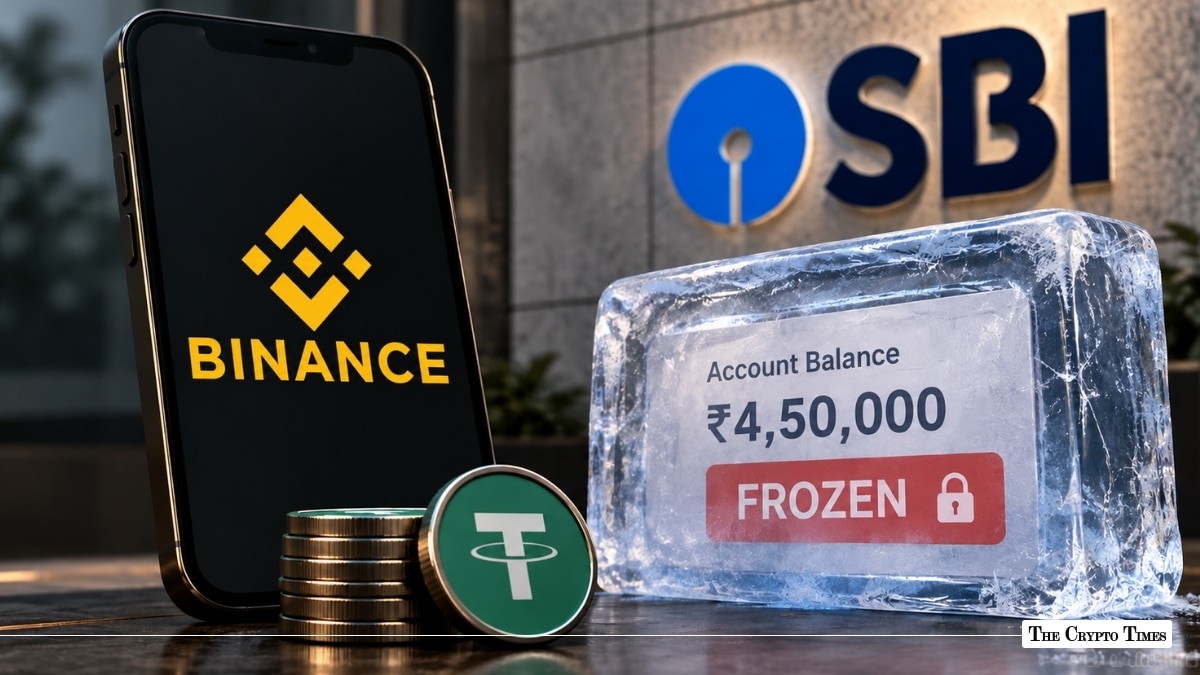
An Indian cryptocurrency user has said his State Bank of India (SBI) account was placed under lien more than once after he sold roughly $1,000 worth of Tether (USDT) to a buyer on Binance’s peer-to-peer (P2P) marketplace.
In a post published on October 2, 2026, the user stated that the holds across his account and a friend’s account now total nearly ₹4.5 lakh, and described the buyer as linked to a scam.
What the User Reported
According to a post on X by user @Krishna16021, he sold about $1,000 in USDT through Binance P2P and received the corresponding amount in Indian Rupees (INR). He said the credit was later marked under lien, and that the same P2P amount was flagged multiple times against the same Unique Transaction Reference (UTR), the identifier banks assign to each transfer. He also stated that part of the money he had transferred to a friend’s account was placed on hold, bringing the total restricted sum to almost ₹4,50,000.
Screenshots attached to the October 2 post show SBI “CBSSBI ALERT” emails notifying the following holds:
- ₹1,01,337, created on September 22, 2026
- ₹1,01,337, created again on October 1, 2026
- ₹16,737, created on October 1, 2026
The three holds visible in the shared alerts add up to ₹2,19,411. The Crypto Times could not establish from the screenshots how the remaining amount in the user’s ₹4.5 lakh estimate was calculated. Account numbers are redacted in the publicly shared images.
The user said he reached out to CyberDost, the cyber safety awareness channel of the Ministry of Home Affairs (MHA), and to the National Cyber Crime Reporting Portal, but did not receive a clear explanation. He added that he holds records of the Binance P2P order and the source of the USDT he sold.
The Crypto Times has not independently verified the Binance order, the UTR trail, or the police complaint referenced in the bank alerts.
A Recurring Problem for Indian P2P Traders
The case adds to a series of similar complaints from Indian crypto users through 2025 and 2026. In June 2026, The Crypto Times reported that Indian crypto users continued to face bank account freezes and liens after P2P trades, including cases where SBI and other banks restricted balances after funds were linked to cybercrime complaints filed in other states.
The Crypto Times’ August 2026 opinion piece examined how routine P2P sales can leave tax-compliant users in prolonged uncertainty when cyber cells direct banks to mark liens under the Bharatiya Nagarik Suraksha Sanhita (BNSS), India’s criminal procedure law. A May 2026 report covered user warnings that even small inflows from flagged accounts have led to wider restrictions on Unified Payments Interface (UPI) access and salary accounts.
How These Freezes Typically Happen
Public reporting and exchange guidance describe a common sequence. A fraud victim sends money to a scammer or a money mule, a person whose account is used to move illicit funds. Those funds, or part of them, are then used to buy USDT or other assets on a P2P platform. When the victim files a complaint, investigators trace the bank credits, and banks act on requisitions from cyber cells by placing a lien or debit freeze on the identified amounts.
Binance has previously acknowledged that P2P sellers have faced frozen accounts after trading with buyers whose payments were later tied to scams. Its support guidance on P2P bank freezes advises sellers to keep order records, refuse third-party payments, and cooperate with banks and local authorities if a freeze occurs.
What Courts and Official Procedures Say
Indian High Courts have weighed in on the scope of such restrictions. Orders from the Kerala High Court in 2026, applying earlier rulings including Dr. Sajeer v. Reserve Bank of India (RBI), have directed banks to let account holders operate their accounts while limiting the hold to the specific amount named in the police requisition, provided the bank has no separate suspicion of money mule activity.
A Standard Operating Procedure issued in January 2026 for the Citizen Financial Cyber Fraud Reporting and Management System (CFCFRMS), which operates under the National Cyber Crime Reporting Portal, sets out processes for the custody, restoration, and grievance redressal of amounts placed on hold.
Users who have described similar cases to The Crypto Times and on public forums report that release of funds usually depends on the investigating officer or a magistrate reviewing trade records, bank statements, and exchange order details. Reported timelines range from several weeks to many months.
No official statement from Binance, SBI, or the Ministry of Home Affairs addressing the October 2 post was available at the time of publication.
This report is based on the user’s public post, bank alert screenshots shared by the user, prior reporting, and publicly available court and exchange materials. It is not a finding that any party committed fraud or that any restricted funds have been permanently seized.
Also Read: Bitget Hackers Lose $700K as Script Error Sends USDC, ETH to Wrong Chainflip Channels