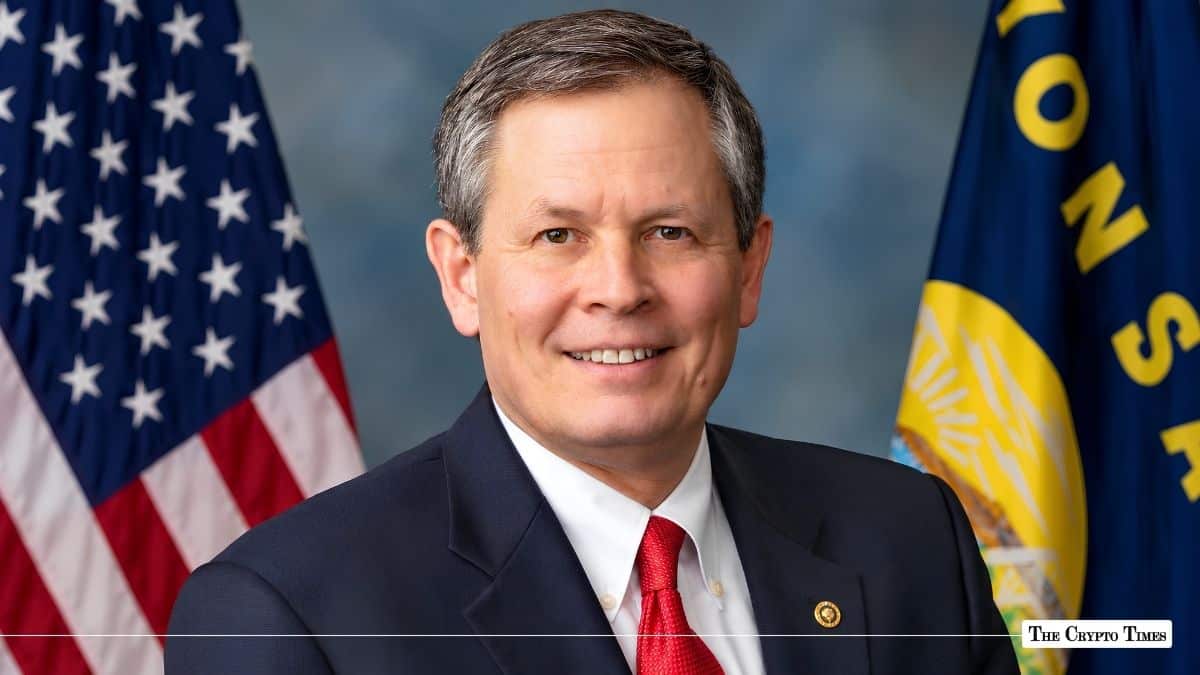
U.S. Senator Steve Daines has introduced a 56-page digital asset tax bill that would exempt certain stablecoin payments from capital gains taxes, while applying existing tax rules to several areas of the cryptocurrency market.
The proposal, called the Aligning Digital Assets with Principles of Taxation Act (ADAPT Act), would generally prevent taxpayers from recognizing gain or loss when using qualifying U.S. dollar stablecoins to purchase goods and services. It would also extend wash-sale and constructive-sale rules to digital assets and establish tax treatment for activities including staking, mining, lending, and network fees.
Daines, a Republican from Montana and member of the Senate Finance Committee, has been developing a digital asset tax framework for more than a year. He outlined the framework during a July Senate Finance Committee hearing, describing it as a combination of existing tax principles and targeted rules for transactions that differ from traditional financial assets.
Stablecoin payments get a tax exemption
The bill’s central provision would remove gain or loss recognition when taxpayers use regulated U.S. dollar stablecoins for purchases of goods and services, subject to the conditions set out in the legislation.
The proposal also provides relief from broker information reporting for qualifying consumer transactions. Trader and dealer activity would not qualify for the exemption.
The provision follows a broader effort in Congress to address the tax treatment of digital assets used for payments. The House Ways and Means Committee’s Digital Asset Tax Certainty Act, approved 38-5 on Sept. 16, also seeks to remove tax barriers around routine digital asset transactions.
Wash-sale rules would extend to crypto
The bill would apply the tax code’s wash-sale restrictions to digital assets, limiting the ability to claim a loss when substantially identical assets are acquired around the time of a sale. It would also extend constructive-sale rules to digital assets, with regulated stablecoins excluded from that provision.
The changes would bring digital asset transactions under anti-abuse rules that already apply to certain traditional financial assets.
Bill covers staking, lending, and network fees
Beyond payments and trading, the proposal addresses several tax questions specific to blockchain activity. It would establish source-of-income rules for staking and mining based on factors including the recipient’s residence and, for certain mining operations, the location of computing equipment and personnel.
The bill would also extend the existing securities-lending nonrecognition framework to certain digital asset loans, allowing qualifying lending transactions to avoid immediate tax recognition.
Another provision would exclude gain or loss on digital assets used to pay network, transaction, or gas fees of $10 or less, subject to restrictions for traders, dealers, and certain high-volume users.
Mark-to-market rules and foreign trading
The proposal would allow eligible digital asset dealers and traders to elect mark-to-market accounting, under which qualifying positions are generally valued at fair market value for tax purposes. It would also extend a securities and commodities trading safe harbor to certain foreign investors trading digital assets through U.S. brokers or for their own accounts. Dealers would be excluded from that safe harbor.
The bill further addresses tax treatment for charitable contributions of widely traded digital assets and staking by certain tax-exempt organizations and investment vehicles.
Proposal defines digital asset categories
The legislation would define terms including digital assets, regulated stablecoins, staking, mining, validation, tokenized assets, bridged assets, and receipt tokens. For widely traded digital assets, the proposal uses a $500 million market-capitalization threshold alongside a liquidity requirement.
It also directs the Treasury Department to issue guidance on how foreign decentralized autonomous organization foundations could reorganize as U.S. corporations, with proposed transitional protections for certain entities established before the bill’s introduction.
Senate and House tax efforts move separately
Daines’ proposal arrives after the House Ways and Means Committee advanced its own digital asset tax legislation in September. The House bill would establish rules for stablecoin transactions, mining and staking, digital asset lending and anti-abuse provisions, among other changes.
The two efforts overlap in several areas, including stablecoin payments and extending existing tax rules to digital assets, but they are separate pieces of legislation.
Senate Finance Committee members have also been working on digital asset tax legislation. Daines said in July that the tax code remains an unfinished part of the broader digital asset framework and that his proposal was intended to combine existing tax principles with rules tailored to blockchain transactions.
House advances separate digital asset tax package
The House Ways and Means Committee has separately advanced a 114-page digital asset tax package introduced by Chairman Jason Smith (R-Mo.) as H.R. 10357 on September 14. The text draws on earlier bills from Representatives Jodey Arrington, Aaron Bean, Mike Carey, Steven Horsford, Mike Kelly, David Kustoff, Max Miller and Rudy Yakym.
The package would exclude gains and losses on digital assets used to pay qualifying network or validation fees of $10 or less. The provision is limited to those fees and does not create a general exemption for small crypto purchases. Taxpayers with more than 5,000 digital-asset transfers in the prior year, along with traders, brokers, dealers and certain transaction validators, would be excluded from the relief.
The House measure also includes wash-sale provisions for digital assets, creating overlap with Daines’ Senate proposal.
Most provisions would apply after 2026
Under the proposal, most provisions would apply to taxable years or transactions after Dec. 31, 2026, while certain sourcing, lending, wash-sale, and constructive-sale provisions would have separate prospective effective dates.
The bill is a legislative proposal and would need to pass both chambers of Congress and be signed into law before its provisions could take effect. No cost estimate was immediately available.
Also Read: CFTC Sends Event Contract Swap Rules to White House for Review