The U.S. Commodity Futures Trading Commission (CFTC) has sent two rules concerning the treatment of event contracts under the federal derivatives framework to the White House for review, putting the agency’s position on prediction markets before the next stage of the rulemaking process.
The two submissions, received by the White House Office of Management and Budget’s Office of Information and Regulatory Affairs on September 28, would separately propose including event contracts within the definition of a “swap” and excluding casino-style gambling products from that definition.
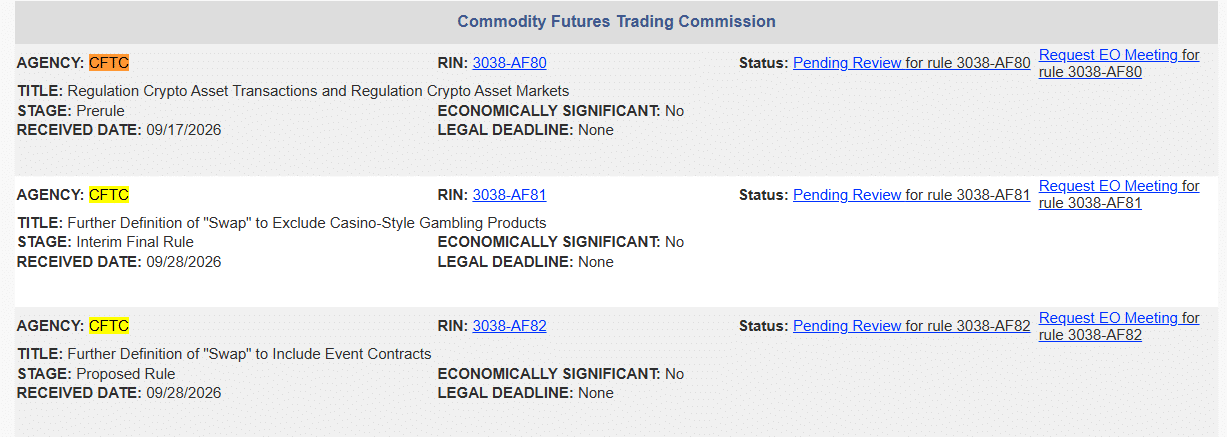
The submissions do not contain the proposed rule text. OMB records classify both measures as not economically significant.
CFTC seeks to define event contracts as swaps
The first measure, identified as RIN 3038-AF82, is titled “Further Definition of ‘Swap’ to Include Event Contracts.” It is listed as a proposed rule and was received by OIRA on September 28.
The move comes as the CFTC continues to assert federal oversight over event contracts traded on prediction-market platforms. These contracts typically pay based on whether a specified event occurs and are offered across areas including sports, politics, economics, and other measurable outcomes.
The second measure, RIN 3038-AF81, is an interim final rule titled “Further Definition of ‘Swap’ to Exclude Casino-Style Gambling Products.” It was also received by OIRA on September 28.
Unlike a conventional proposed rule, an interim final rule can take effect without first going through the full notice-and-comment sequence, although regulators can subsequently receive public input and make changes.
Neither OMB submission provides enough detail to determine how the CFTC would apply the proposed definitions to specific contracts or platforms.
Rules arrive amid prediction-market court fight
The regulatory filings come as the legal status of sports-related event contracts remains contested.
On September 25, the Sixth U.S. Circuit Court of Appeals ruled that Kalshi’s sports-event contracts did not qualify as swaps under the Commodity Exchange Act. The court also held that, even assuming the contracts were swaps, the CEA did not expressly or impliedly preempt Ohio and Tennessee gambling laws.
The ruling followed an August decision by the Ninth Circuit in a separate case involving Kalshi. That court concluded that the company’s sports event contracts were sports gambling and were likely not swaps under the CEA.
The Third Circuit previously reached a different conclusion in litigation involving New Jersey, finding that Kalshi was likely to succeed in arguing that its sports-related event contracts were subject to the CFTC’s exclusive jurisdiction.
The conflicting appellate decisions have left the scope of federal and state authority over prediction markets unsettled.
CFTC and states clash over jurisdiction
The dispute centers on whether event contracts fall within the CFTC’s exclusive federal jurisdiction or remain subject to state gambling laws.
The CFTC has challenged state efforts to regulate prediction markets, while several states have argued that sports-related contracts constitute gambling products subject to state oversight. The federal government has also brought litigation seeking to prevent some states from regulating prediction markets under their gambling laws.
A rule defining certain event contracts as swaps would establish the CFTC’s regulatory position more explicitly. Separately, excluding casino-style gambling products from the swap definition would address the boundary between financial derivatives and gambling contracts.
The effect of those definitions on ongoing litigation would ultimately depend on the final language adopted by the agency and how courts interpret the Commodity Exchange Act.
House panel expands prediction market probe
The CFTC’s rulemaking comes as House Oversight expands a separate probe into prediction-market trading. On September 29, Chairman James Comer requested records from Hyperliquid, Crypto.com and Aristotle Exchange on identity verification and systems for detecting and reporting suspicious trading. House Oversight release
The requests broaden a May investigation into Kalshi and Polymarket, with the committee examining whether users traded on nonpublic information and whether platforms have adequate safeguards. In the Hyperliquid letter, Comer cited a large leveraged short opened shortly before an October 2025 presidential tariff announcement, while noting questions around the platform’s verification controls. The letter does not establish that the trade involved insider information.
OMB review precedes public rulemaking
The September 28 submissions mark an administrative step before the CFTC can advance the measures through the federal rulemaking process.
OMB’s regulatory database shows both actions as pending review and says neither is considered economically significant under the applicable executive-order definition. The database also lists a separate CFTC prerule on crypto-asset transactions and crypto-asset markets, received by OIRA on September 17.
The event-contract submissions do not yet establish new rules for prediction-market operators. The CFTC would need to publish the relevant regulatory text and proceed through the applicable rulemaking process before any proposed framework becomes operative, subject to the specific procedure used for the interim final rule.
The timing gives the CFTC’s swap-definition effort added significance as federal courts continue to weigh whether prediction-market contracts belong within the derivatives regime or state gambling frameworks.
Also Read: UK FCA Opens Crypto Authorisation Applications Ahead of 2027 Regime