Key Highlights
- Singapore’s crypto activity rose 55.4% to $284 billion, making it CSAO’s largest crypto economy.
- Institutional activity surged 94% to $60 billion, driven mainly by market makers, OTC firms and institutional brokerages.
- Cross-border crypto use is growing, with stablecoin activity and small-value P2P transfers gaining traction across the region.
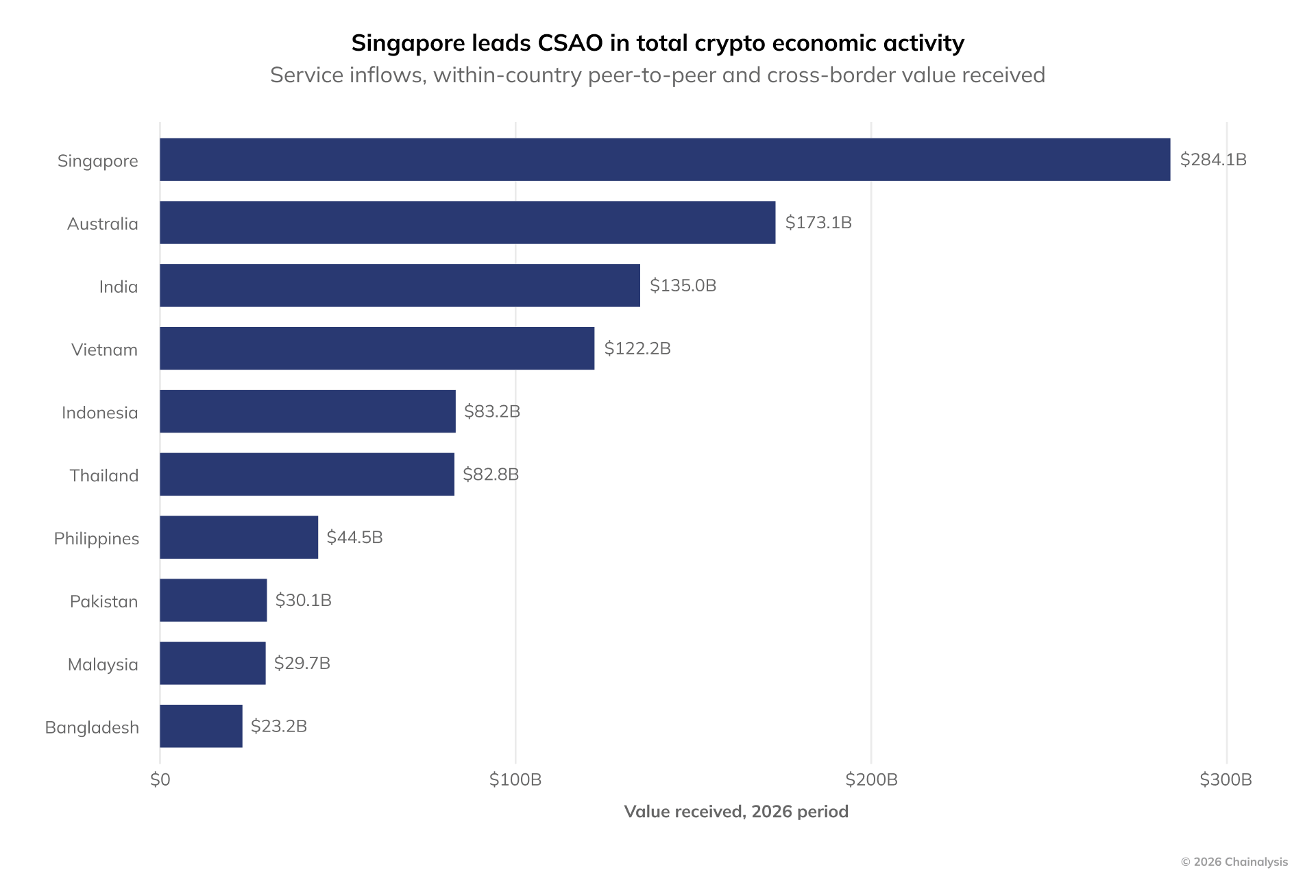
Singapore’s crypto activity rose 55.4% to $284 billion in the year ended June 2026, making it the largest crypto economy in Central and Southeast Asia and Oceania (CSAO), according to Chainalysis.
The growth was led by institutional activity, which grew 94% to $60 billion as the wider regional crypto economy fell.
The growth comes as the wider regional crypto economy contracted 6.8% during the same period. While some markets struggled, Singapore recorded growth across several parts of its crypto market, with institutions playing a major role.
Much of the institutional activity came from market makers, over-the-counter (OTC) trading firms and institutional brokerages. Chainalysis said the growth was mainly driven by existing platforms handling large volumes rather than many new services entering the market.
Institutions drive the biggest growth
Singapore’s growth was not limited to institutional platforms. According to the report, money flowing into centralized exchanges increased 30%, while flows into decentralized exchanges rose 69%. This shows that activity was growing across different parts of the market during the reporting period.
The rise in institutional activity also reflects a wider change across the CSAO region. Institutional platforms, which include market makers, prime brokers, OTC desks, custodians and institutional-only exchanges, processed $152.3 billion during the period.
This represented a 40% increase from the previous year, with institutional platforms making up 18.9% of regional crypto activity by the end of the second quarter of 2026.
Australia, the region’s second-largest crypto economy, recorded $173.1 billion in activity. Its overall activity fell 5.6%, but institutional platform activity still grew 33.3% to $39.92 billion.
Institutional demand reshapes the region
Beyond large investors and trading firms, crypto is also finding more everyday uses across the region. Stablecoins are also playing a growing role in cross-border transactions.
Chainalysis found that cross-border stablecoin activity was higher than domestic activity in every market it studied. Across CSAO, cross-border stablecoin activity was 3.2 times larger than domestic activity.
The Philippines is one example of this trend. Nichel Gaba, CEO and founder of Philippine exchange PDAX, said around 5% to 10% of inbound remittances may be settled using stablecoins. This matters because many Filipinos working overseas regularly send money back home.
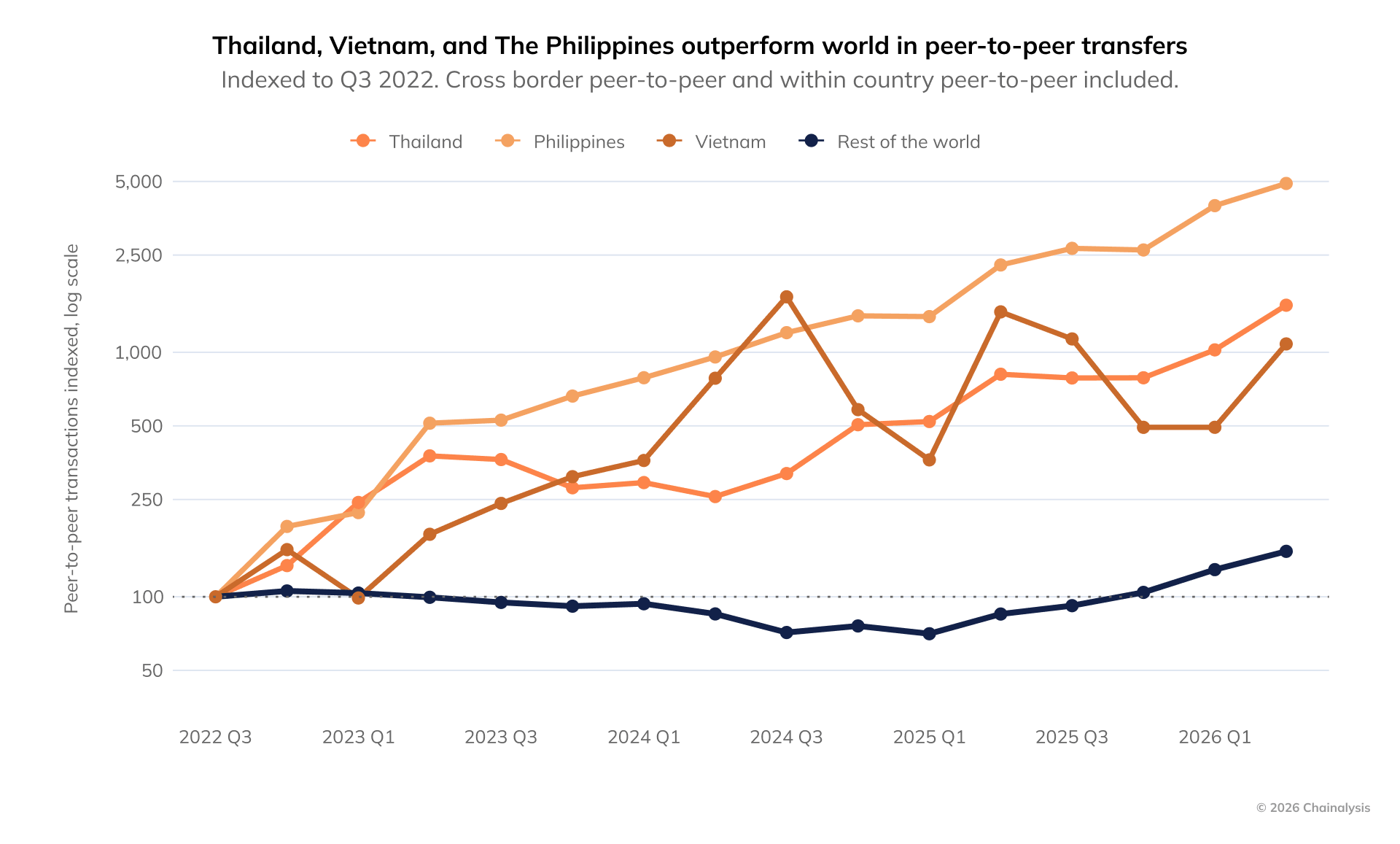
Crypto is also being used for smaller transfers in the Philippines, Thailand and Vietnam. The three countries recorded 5.4 million small-value P2P transfers below $10,000 during the period.
Together, they accounted for 14.4% of all such transfers worldwide, even though they represented only 2.5% of the global crypto economy.
Small transfers pack a bigger punch
More than four in five domestic transfers in the three countries were below $1,000, with the average transfer standing at $618.
Singapore’s crypto-market growth has also coincided with efforts to develop digital-asset infrastructure and regulatory frameworks. The country has been working on areas such as tokenization, regulated stablecoins and digital-asset settlement.
Daniel Yang, head of compliance at Singapore-based trading firm QCP Group, said the country’s crypto story has expanded “beyond trading returns to include payments, treasury management, and market infrastructure.”
The findings come from Chainalysis’ 2026 Geography of Crypto Report, covering the period from July 1, 2025, to June 30, 2026. While the wider region lost ground, Singapore’s figures show how institutional money and practical uses such as payments and settlement are becoming a bigger part of its crypto economy.
Also Read: UK FCA Opens Crypto Authorisation Applications Ahead of 2027 Regime