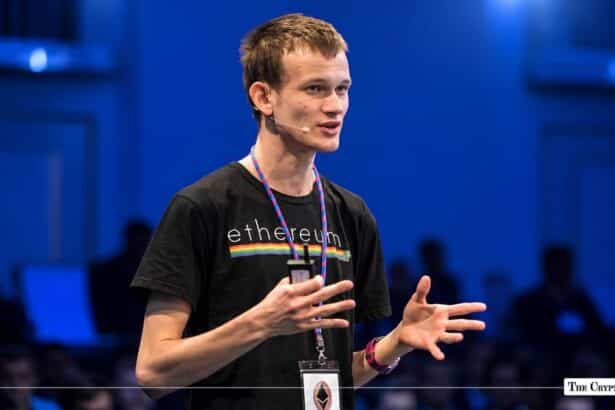
Ethereum co-founder Vitalik Buterin says the network could eventually become fundamentally different from the blockchain it is today, describing its future as a “cryptographic world computer” built around zero-knowledge proofs, decentralized computation, stronger privacy and lighter verification.
In a September 27 post titled ‘The Cryptographic World Computer,’ Buterin outlined how he expects Ethereum to evolve through 2030. He said its future architecture will differ significantly from the early blockchain model, with cryptography playing a larger role in transaction processing, block verification and data storage.
Ethereum already combines proof-of-stake consensus, general-purpose computation, zero-knowledge applications, and Layer 2 networks. Buterin expects these technologies to become more deeply integrated as the network develops.
From blocks to proofs
One of the biggest changes will be how Ethereum participants verify the network.
Traditional blockchains require nodes to download data and execute transactions themselves. Buterin expects Ethereum to increasingly rely on SNARK verification and data availability sampling, allowing participants to verify computation without independently repeating all of it.
PeerDAS has already moved Ethereum in this direction. Introduced with Fusaka, the system allows nodes to sample portions of blob data rather than downloading the entire dataset. The approach is intended to improve data capacity without proportionally increasing node requirements.
Buterin said that he sees this as part of a broader transition from downloading and re-executing blockchain data toward verifying cryptographic proofs and sampling data availability.
Hegotá marks a shift
Buterin described Hegotá, the Ethereum upgrade planned for 2027, as a potential dividing line between the network’s current architecture and its longer-term cryptographic design. “Hegota — the fork planned for next year — is likely to be Ethereum’s last ‘normal’ fork,” he wrote.
Hegotá remains in planning, with its final scope subject to change. Two proposals currently scheduled are Fork-choice Enforced Inclusion Lists (FOCIL) and Frame Transactions.
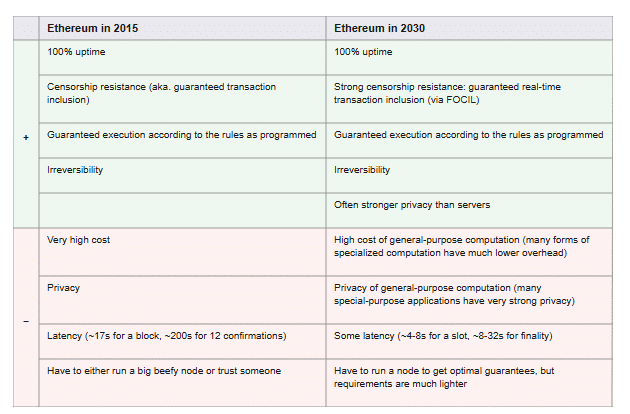
FOCIL would distribute transaction-inclusion authority among a committee of validators. Instead of giving block builders complete control over which valid transactions enter a block, validators could provide inclusion lists that builders must respect. The mechanism is designed to strengthen censorship resistance.
Frame Transactions would allow accounts to define their own transaction authorization rules rather than relying on one fixed signature structure. The design could support features such as social recovery, spending controls, sponsored gas and future quantum-resistant signatures. Buterin stated that he expects the upgrades after Hegotá to become increasingly focused on recursive STARKs, formal verification, optimized consensus, and quantum-resistant cryptography.
Parallel computation
Buterin’s vision does not involve moving every operation onto Ethereum Layer 1. Instead, computation could be divided into smaller tasks that are processed in parallel, aggregated and then verified cryptographically. Signatures and proofs could be processed before transactions reach the final block, while specialized computation could take place across decentralized infrastructure outside the main execution path.
This could also change how developers build applications. Buterin expects Ethereum’s future gas economics to favor computation that can be parallelized or aggregated rather than large workloads forced into a single serial transaction.
The blockchain would focus more heavily on ordering and recording state changes that require global consensus, while cryptographic proofs would allow it to verify work performed elsewhere. “Structuring computation lets the blockchain more effectively focus on its job,” Buterin wrote.
Privacy and quantum resistance
Privacy is another major part of the proposed architecture. Buterin’s 2030 model includes zero-knowledge proofs for transaction and account privacy, along with network-level technologies such as onion routing and mixnets. These could reduce the amount of transaction and network metadata exposed to other participants.
Ethereum is also working toward quantum resistance. Future systems may replace cryptographic components that could eventually become vulnerable to sufficiently powerful quantum computers.
Frame Transactions could allow accounts to adopt alternative signature schemes, while recursive STARKs and other cryptographic techniques could help secure verification and transaction processing.
Ethereum’s security roadmap currently targets quantum resistance across its execution, consensus and data layers by December 2029, although the roadmap remains subject to change.
Lean consensus
Ethereum’s consensus mechanism could also change further.
The network moved from proof-of-work to proof-of-stake with The Merge in 2022. Buterin now expects proof-of-stake to become more streamlined through research under the Lean Ethereum initiative.
The research includes Minimmit, a one-round consensus design aimed at simplifying and accelerating finality. It has not yet been assigned to a specific Ethereum upgrade.
Buterin’s 2030 comparison envisions slots of roughly 4 to 8 seconds and finality of around 8 to 32 seconds. These remain longer-term targets rather than confirmed specifications.
A broader role for decentralization
Buterin argues that decentralization could eventually become useful not only for security but also for performance. A decentralized network can distribute data storage and computation among many participants. Cryptographic proofs can then verify that the work was performed correctly without requiring every participant to repeat it.
This could allow Ethereum to function as a hybrid system combining blockchain consensus with cryptographic verification, privacy technologies and decentralized infrastructure operating between users and the base chain.
Buterin also pointed to indistinguishability obfuscation (iO) as a possible longer-term technology that could enable more advanced encrypted computation. However, he described it as a future possibility rather than a requirement for the architecture outlined in his essay.
Meanwhile, Ethereum’s Glamsterdam upgrade is in final testing, with ePBS, Block-Level Access Lists, and gas-pricing changes planned for the second half of 2026.
The roadmap then points toward Hegotá in 2027, while many of the deeper changes outlined by Buterin remain research and development goals.
Buterin’s broader argument is that Ethereum’s future is not simply about processing more transactions. Instead, he sees the network evolving into a system where cryptographic proofs, decentralized computation and privacy allow Ethereum to verify more work without requiring every participant to perform it directly.