
Key Highlights
- The crypto economy generated $9.4 trillion in activity despite a roughly 50% decline in total market value.
- Stablecoin activity surged, with cross-border transfers rising 77.5% to $220.3 billion.
- Brazil ranked first in crypto adoption, while Nigeria ranked third and led in domestic P2P and cross-border activity.
The global crypto economy generated $9.4 trillion in activity between July 1, 2025, and June 30, 2026, even as the wider crypto market lost about half its value, according to Chainalysis.
In its seventh Geography of Cryptocurrency report published Wednesday, the blockchain data and intelligence platform said that money movement, payments and stablecoin use helped keep crypto activity steady during one of its toughest market periods since 2022.
The data highlighted a widening gap between crypto asset prices and underlying usage during the period.
Crypto market lost half its value
Bitcoin (BTC) reached a new all-time high before losing $67,000 from its peak to its lowest point. The total crypto market cap also fell by about $2.1 trillion.
Yet, the crypto economy declined by only 1.6%, moving from $9.5 trillion to $9.4 trillion.
The decline was much smaller than what happened during the 2023 bear market. At that time, crypto economic activity fell 23%, equal to about $1.2 trillion, while the market cap dropped by only $0.3 trillion.
In the latest period, the market lost roughly seven times more value, while crypto economic activity declined by only about $0.1 trillion.
The difference becomes clearer when examining where users moved their funds. Chainalysis reported that value flowing into exchanges, DeFi platforms, lending services, and other crypto businesses fell 4.3%, from $9.3 trillion to $8.9 trillion.
These activities are more closely linked to trading and investment, so they were affected as crypto prices fell.
But direct transfers between personal wallets moved in the opposite direction. Domestic peer-to-peer activity jumped 302.9%, from $56.8 billion to $228.7 billion. Its share also increased across all eight regions tracked by Chainalysis.
Stablecoins take a bigger role
Stablecoins played a major role in that change. While domestic peer-to-peer activity across all crypto assets fell 19.7%, its stablecoin portion increased 377.7%.
Stablecoins reportedly accounted for 96% of domestic peer-to-peer activity, showing how much this part of the market has shifted toward dollar-linked digital assets.
The same pattern appeared in cross-border transfers. Stablecoin value moving between countries increased 77.5%, rising from $124.2 billion to $220.3 billion. Monthly cross-border stablecoin activity more than doubled from $11 billion in January 2025 to $24 billion by June 2026.
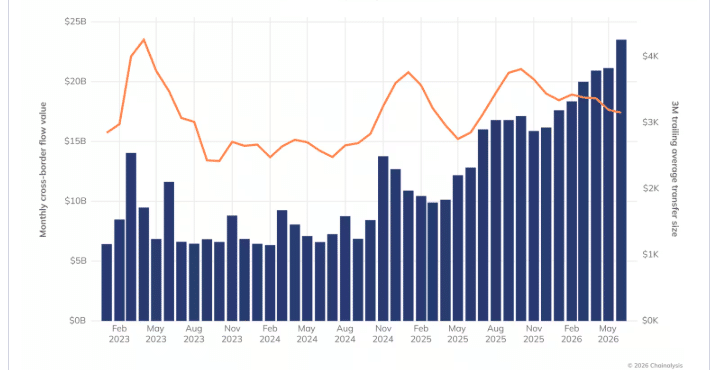
The average payment was about $3,000. Chainalysis said this size points more toward everyday uses such as paying suppliers, sending money home, or moving savings than large institutional settlements.
Philip Gradwell, vice president of economics at Tether, told Chainalysis that, “Activity has become consistent, routed through wallets in a steady rhythm rather than in bursts. That is the signature of trade and business activity, not speculation.”
Stablecoin balances hold steady
Stablecoins also remained steady while other crypto holdings fell. Global on-chain balances dropped from $0.86 trillion in September 2025 to $0.44 trillion in June 2026. Stablecoin balances, however, stayed between $98 billion and $109 billion during the nine-month market decline.
Smaller users also remained active. Transfers below $100 increased 78.4%, while transfers between $100 and $1,000 rose 58.6%. Chainalysis said these smaller transfers show that retail users continued using crypto despite the market downturn.
Brazil and Nigeria lead adoption
For its new adoption index, Chainalysis measured service flows, domestic peer-to-peer activity, cross-border transfers, and on-chain balances.
Brazil ranked first overall with a $252.5 billion crypto economy.
Nigeria ranked third and recorded the highest rankings for both domestic peer-to-peer and cross-border activity.
The findings suggest that crypto usage remained resilient even as declining asset prices reduced trading-related activity. Stablecoins, peer-to-peer transfers and cross-border payments increasingly accounted for a larger share of the activity tracked by Chainalysis.
Also Read: Bitcoin Cash (BCH) Price Jump Above $350 Explained: CME Targets October 19 Launch