Key Highlights
- Bankless co-founder David Hoffman disclosed in May that he had sold his Ethereum holdings and rotated capital into LIT, ZEC, NEAR, and VVV.
- Since the approximate period of Hoffman’s disclosed sale, LIT has surged around 368.75%, making it the strongest performer among the assets highlighted.
- ZEC gained approximately 110.41%, while NEAR advanced around 54.23% over the same period.
Bankless co-founder David Hoffman faced public scrutiny after disclosing in May that he had sold his Ethereum holdings and rotated capital into other cryptocurrencies, including LIT, ZEC, NEAR, and VVV. Performance data since that period shows substantial gains in several of those assets relative to ETH.
In an X post on September 6, DeFi researcher Ignas stated that LIT and ZEC ranked among the strongest performers after Hoffman’s public ETH sale. Chart data covering the period from early June through early September shows LITUSD advancing approximately 368.75 percent. ZECUSDT rose about 110.41 percent, while NEARUSD gained roughly 54.23 percent. Over the same timeframe, ETHUSD increased by about 8.15 percent and VVVUSD declined by approximately 5.55 percent.
The percentage moves are measured from a common baseline near the time of Hoffman’s disclosed sale. LIT’s trajectory on the three-hour Ethereum-dollar chart from Coinbase shows a sharp upward move in recent weeks, culminating near the 370 percent level. ZEC recorded a more gradual rise that accelerated later in the period. NEAR’s gain remained more moderate, while ETH stayed relatively flat and VVV traded lower overall.
Hoffman’s ETH Exit
In a detailed post published in May, Hoffman explained the decision to sell ETH. He wrote that the long-running thesis that ETH would function as money had not fully materialized.
According to Hoffman, the thesis required multiple layers of the Ethereum project, governance, L2 coordination, technical execution, and market dominance, to succeed at a high level simultaneously.
Hoffman stated that Ethereum had achieved meaningful progress and deserved its existing market capitalization, yet the window for a further market re-rating of ETH as global money appeared to be closing. He described Ethereum as a coordination game that faced structural challenges, including the linkage between L1 activity, fees and native-asset performance, competition from other chains, and the limited spillover effects from stablecoin growth onto ETH itself.
Hoffman emphasized that the sale did not reflect a bearish view of the Ethereum network or its ecosystem. He said he remained constructive on Ethereum’s architecture for applications and layer-2 networks while reallocating personal capital toward other market opportunities.
The original May post remains the primary source outlining his reasoning for reducing ETH exposure.
Chart details of the surge
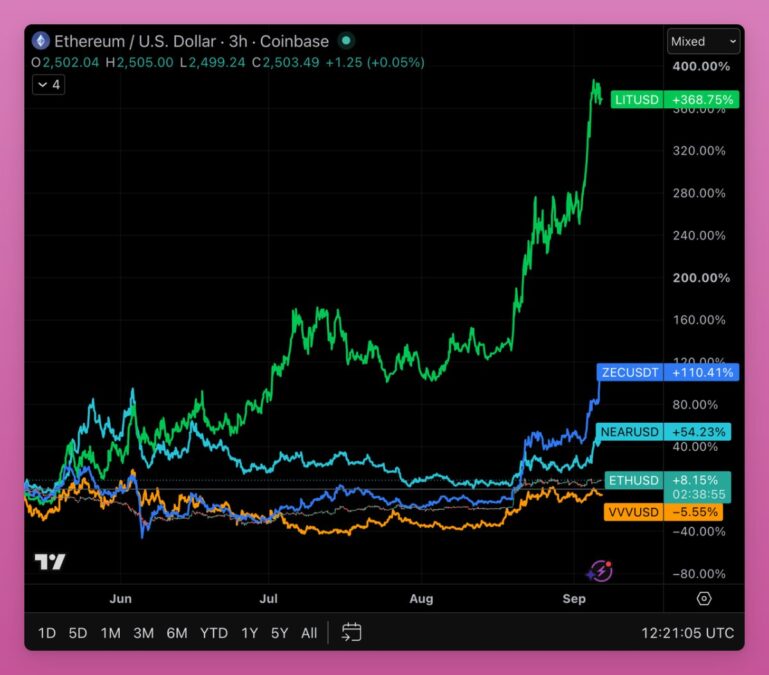
The referenced chart displays percentage change rather than absolute price levels. It uses a three-hour timeframe for the ETH-USD pair on Coinbase as the base view, with overlay lines for LITUSD, ZECUSDT, NEARUSD, and VVVUSD.
The right-hand scale runs from negative territory to above 400 percent, clearly separating the trajectories of the five assets across the June-to-September window. Timestamp data on the chart places the latest readings near 12:21 UTC on the day of capture.
The numbers cited by Ignas align closely with the chart readings: approximately 369 percent for LIT, 110 percent for ZEC, 54 percent for NEAR, 8 percent for ETH, and a modest decline for VVV. These figures reflect cumulative performance from the approximate date of the disclosed sale through early September.
Also Read: Liquid Network Pauses After ~4,000 BTC Leave Federation Wallet