
Strategy Inc., the Bitcoin treasury company formerly known as MicroStrategy, finds its dual securities narrative in sharp focus this week.
The company’s common shares trading under the ticker MSTR have staged a robust rebound, climbing to multi-month highs near $127 amid a broader recovery in Bitcoin prices. Meanwhile, the company’s flagship variable-rate preferred stock, STRC continues to trade modestly below its $100 stated amount, closing recently around $97 on August 25, as of latest market data from Yahoo Finance.
This divergence highlights the contrasting risk profiles of the two instruments and the ongoing challenges in fully stabilizing Strategy’s preferred capital structure after a turbulent June.
The contrast underscores how MSTR captures leveraged upside to Bitcoin’s price movements and the company’s massive treasury, while STRC functions as a high-yield income product engineered for relative stability near par.
Investors watching the pair see MSTR’s strength reflecting renewed confidence in Strategy’s Bitcoin holdings—now exceeding 840K BTC, as per BitcoinTreasuries data—even as STRC’s discount persists despite recent support measures.
MSTR Climbs on Bitcoin Momentum and Capital Flexibility
Data from Yahoo Finance shows that Strategy’s common stock has delivered notable gains in recent sessions, rising 3.4% on August 25 to close near $126.83 and extending a recovery that pushed it to its highest levels in two months.
The move tracks Bitcoin’s advance toward the $79,000–$80,000 range earlier in the period—as per Coingecko data—amplifying the equity’s sensitivity to the digital asset. MSTR serves as a leveraged proxy for Bitcoin exposure, with residual claims after preferred securities and debt, offering unlimited upside but also heightened volatility.
Recent company actions have supported the equity’s performance. Strategy sold hundreds of millions in common shares in mid-August, directing proceeds partly toward preferred dividends and repurchases of STRC while building its USD cash reserve.
Read: Strategy Sells $2 Billion in MSTR Shares, Repurchases $136 Million of STRC
TradingView data shows that MSTR’s 52-week range remains wide—from lows near $82 during the June Bitcoin rout to prior highs above $365—illustrating both the risks and the recovery potential inherent in the Bitcoin treasury model.
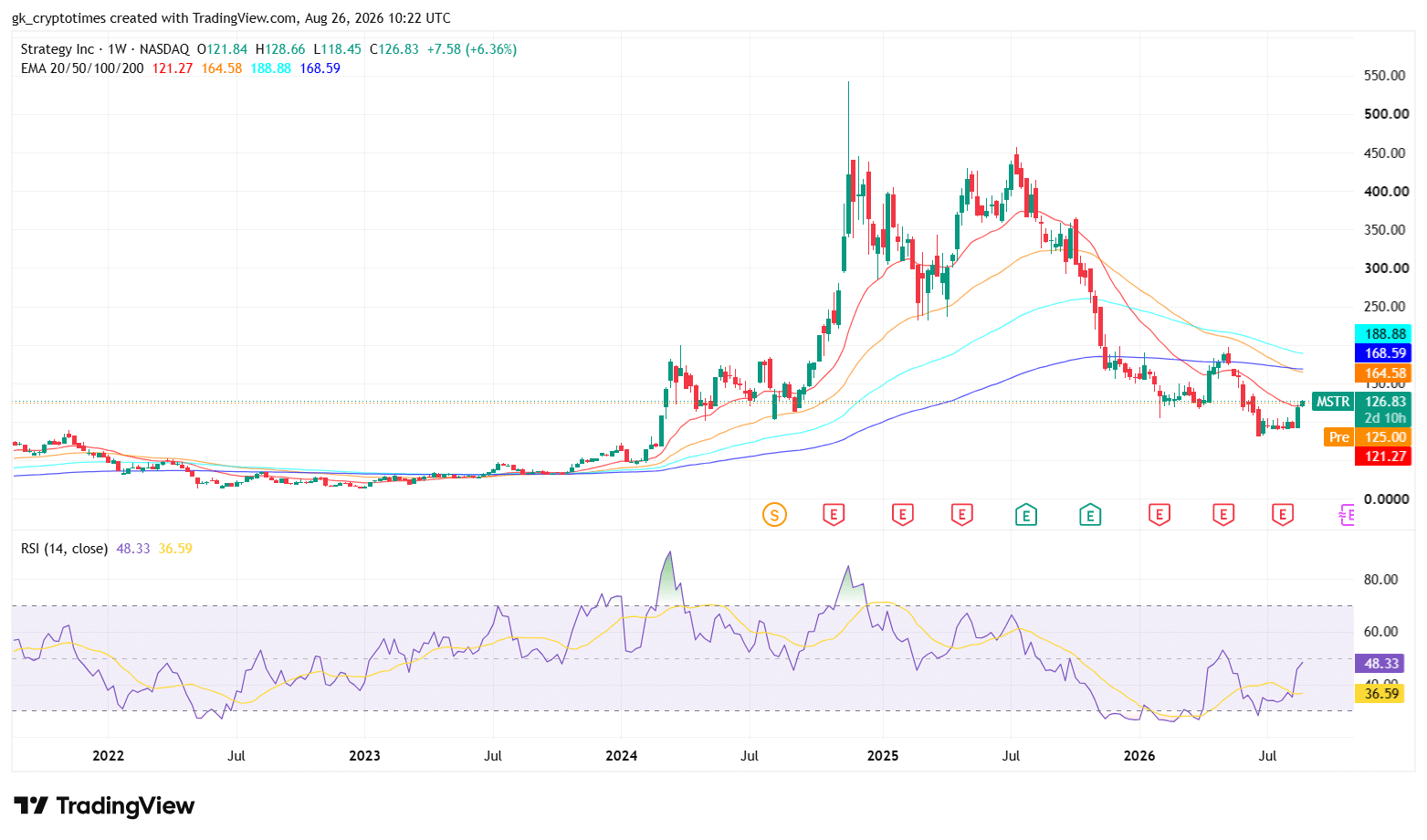
This rebound is viewed as evidence that capital markets access remains intact for the common equity, allowing Strategy to manage liquidity without immediate reliance on further Bitcoin sales.
STRC Trades at a Persistent Discount Despite Rate Hikes and Buybacks
In contrast, STRC has yet to reclaim its $100 par value target on a sustained basis. The Variable Rate Series A Perpetual Stretch Preferred Stock, launched in July 2025, currently trades near $97, delivering an effective yield slightly above its stated 12% annual rate.
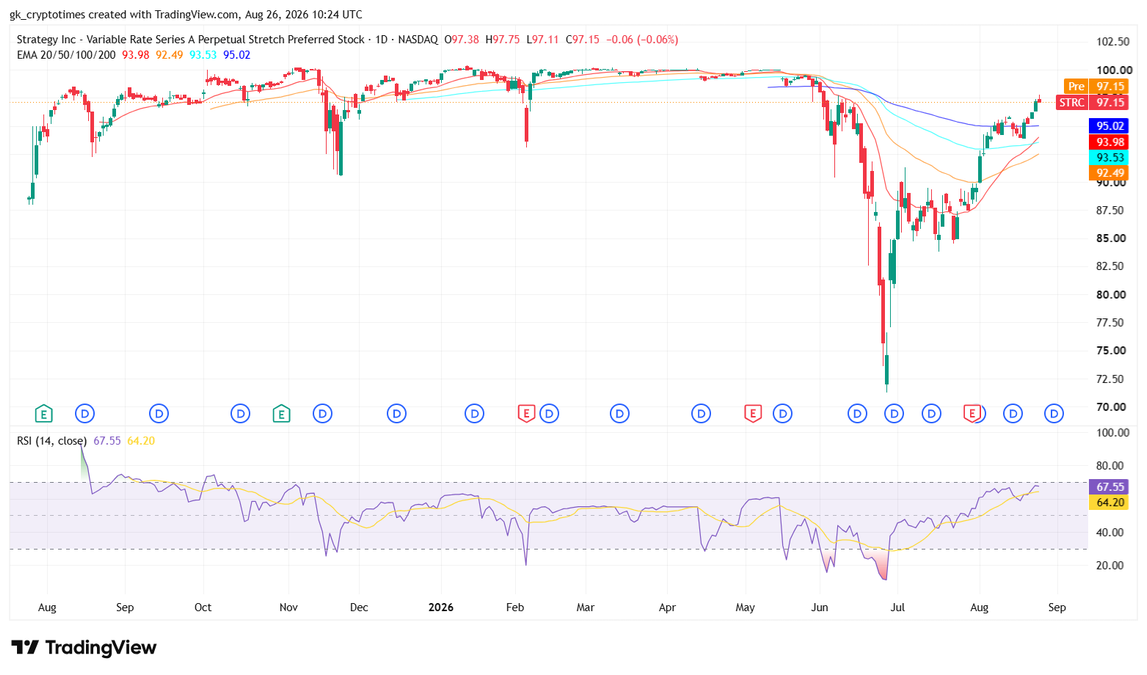
Dividends on STRC are paid semi-monthly when declared and are cumulative. Strategy adjusts the rate monthly—raising it to attract buyers when the price softens—with the explicit corporate objective of keeping the shares in a $99–$100 range over time.
STRC endured a severe test in June 2026, plunging to intraday lows near $71 as Bitcoin declined, retail holders sold, and concerns mounted over dividend coverage. That episode paused the at-the-market issuance program that had funded much of Strategy’s Bitcoin accumulation.
In response, the company adopted a Digital Credit Capital Framework in late June, increasing the STRC dividend rate to 12%, establishing a board-approved USD reserve policy, authorizing up to $1 billion in preferred securities repurchases, and creating limited Bitcoin monetization capacity for liquidity support.
These steps, combined with subsequent common-share sales and reserve builds that pushed USD liquidity higher, have driven a substantial recovery. STRC has climbed steadily through July and August, reclaiming the mid-to-high $90s. Yet the shares remain a few dollars below the engineered target, reflecting residual caution about the scale of preferred obligations—now totaling billions annually across Strategy’s suite of preferred securities—and the absence of a hard price peg.
Unlike convertible preferreds in the lineup, STRC offers no equity upside, limiting its appeal when Bitcoin and MSTR are rallying strongly.
Funding Model Faces Scrutiny as Dual Paths Diverge
The performance gap between MSTR and STRC carries implications for Strategy’s broader capital strategy. When STRC trades near or above par, the company can issue additional shares efficiently to acquire more Bitcoin without diluting common shareholders. Prolonged discounts constrain that channel, shifting reliance toward common equity raises or reserve management.
Executive Chairman Michael Saylor has emphasized that its Bitcoin holdings and growing USD reserves provide substantial coverage for preferred dividends, with recent disclosures highlighting multi-month liquidity runways.
Additionally, the retail ownership of STRC has been significant, contributing to volatility during the June sell-off. Competing Bitcoin-linked preferred products have also drawn capital at times by offering higher yields or different structures. Still, the recent rebound in both Bitcoin and MSTR, alongside active repurchase activity and rate support, has narrowed the gap.
Company materials describe STRC as perpetual variable-rate digital credit backed by the enterprise, capital markets access, reserves, and the Bitcoin treasury—without a direct claim on the coins themselves.
As of late August 2026, the narrative remains one of partial recovery. MSTR has outshone in capturing upside momentum, while STRC’s path back to consistent par trading continues to test the effectiveness of Strategy’s defensive tools. Investors will monitor upcoming dividend rate evaluations, further capital allocation updates, and Bitcoin’s trajectory for signs that the preferred can finally close the remaining gap.
The dual-security structure continues to offer differentiated exposure: leveraged growth via MSTR and high current income with senior claims via STRC, each carrying distinct risks tied to the company’s Bitcoin-centric model.
Also read: Galaxy Launches 8.99% Credit Line Backed by BTC, ETH, and SOL