Key Highlights
- Bitcoin is trading around $77,382, up nearly 7% in a day, but analysts think $80,000 will be tough to break until the Fed clearly signals it’s done raising rates.
- Whale accumulation is back, and Bitcoin has moved above its 200-day moving average.
- U.S. spot Bitcoin ETFs pulled in $1.61 billion over four straight days, with BlackRock’s IBIT leading the pack.
Bitcoin has climbed back above $75,000, but CoinShares expects the cryptocurrency to remain below $80,000 in the near term.
In a report published on August 21, the research firm said the key level could be difficult to break until the Federal Reserve clearly shows that it is moving away from further interest rate hikes.
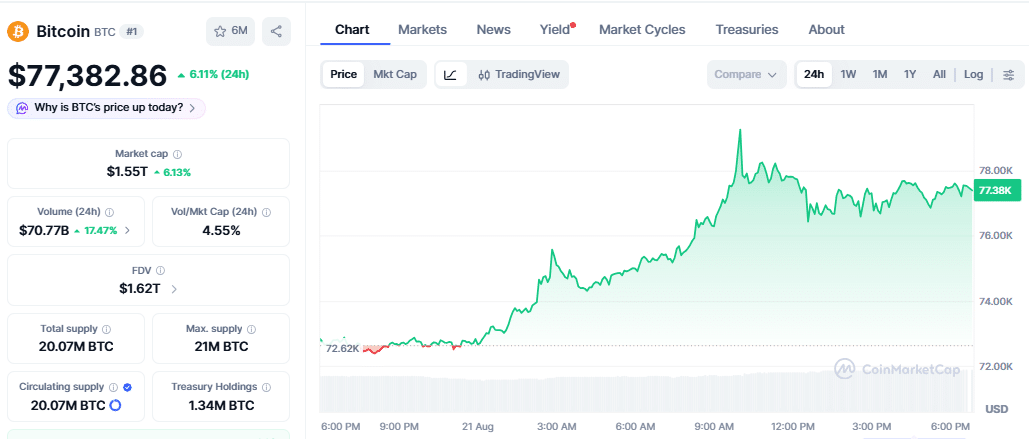
At the time of reporting, the asset is trading for $77,382, representing a 6.71% surge within the last 24 hours. This adds to around 22.92% increase in just one week, according to data from CoinMarketCap.
Why the Fed still holds the key
The rally was driven mainly by changes in the wider economy rather than new developments inside the crypto market. Soft U.S. inflation and weaker payroll data have reduced expectations for more rate hikes, giving Bitcoin room to recover.
CoinShares said Bitcoin is highly sensitive to changes in market liquidity and borrowing costs, making Fed policy especially important for its next move.
The bond market is also showing a change in expectations. Short-term U.S. Treasury yields have fallen, suggesting investors are no longer expecting the Federal Reserve to raise rates again. At the same time, longer-term yields have moved higher as concerns about the U.S. government’s financial position grow.
CoinShares said this mix of lower expectations for Fed tightening and rising concerns about government debt has helped Bitcoin. It also warned that efforts by the Treasury to support the longer-term bond market may only provide temporary relief. According to the firm, such moves could push more government debt toward shorter maturities and make borrowing costs more sensitive to future Fed decisions. ‘
A weaker dollar adds another twist
The dollar is another part of the story. CoinShares said the market has viewed Treasury intervention as an effort to hold down bond yields, which has weakened the dollar. A weaker dollar can make imported goods more expensive and add to inflation pressure, potentially making it harder for the Fed to cut rates.
While the macro picture remains important, Bitcoin’s own market structure has also improved. CoinShares said whales have stopped selling and started accumulating again. However, the firm said the buying is not yet large enough to point to an immediate and lasting breakout. Bitcoin has also moved clearly above its 200-day moving average, a level CoinShares said has often been linked with stronger rallies.
Money is also returning to digital asset investment products as they attracted $2.2 billion in inflows this week, the biggest weekly inflow of 2026. Bitcoin products made up about $1.6 billion of that amount, pushing total Bitcoin-related flows for the year back into positive territory.
All eyes on Jackson hole
The next big test could come from Jackson Hole, where investors will watch for fresh comments on U.S. monetary policy.
CoinShares said comments from Fed policymaker Kevin Warsh could help Bitcoin break above $80,000 if they confirm the less restrictive policy direction markets are beginning to expect.
Meanwhile, Binance Head of APAC SB Seker said Bitcoin’s move back above $75,000 was a sign of renewed participation after a period of volatility and uncertainty. In a comment shared with The Crypto Times, he pointed to stronger institutional involvement, clearer regulation and better market infrastructure as signs of a maturing digital asset market.
“What is particularly encouraging is how the digital asset ecosystem continues to evolve, with institutional involvement, greater regulatory clarity and stronger market infrastructure shaping a more mature market. “ he said.
Seker also said the next phase of adoption will not depend only on Bitcoin’s price. He highlighted stablecoins, tokenisation and blockchain-based financial infrastructure as areas gaining attention across the industry.
ETF inflows keep piling up
Moreover, the demand from U.S. spot Bitcoin exchange-traded funds is also giving the rally more support. According to The Crypto Times, the funds recorded $606.29 million in net inflows on August 20, following $517.19 million on August 19, $189.30 million on August 18 and $297.56 million on August 17.
That means U.S. spot Bitcoin ETFs pulled in about $1.61 billion across four straight trading sessions. Thursday’s $606.29 million inflow was the biggest of the four days and made the current week the strongest for U.S. spot Bitcoin ETF inflows in 2026, according to the supplied report.
BlackRock’s iShares Bitcoin Trust led Thursday’s buying with $502.99 million, taking about 83% of the day’s total. Fidelity’s FBTC added $64.74 million, while Bitwise’s BITB received $26.39 million.
Ark & 21Shares’ ARKB recorded $12.15 million and Invesco’s BTCO attracted $3.61 million. VanEck’s HODL was the only fund with an outflow, losing $3.59 million.
Also Read: Michael Saylor’s Strategy Sees Bitcoin Stack Turn Profitable Again As BTC Soars to $78K