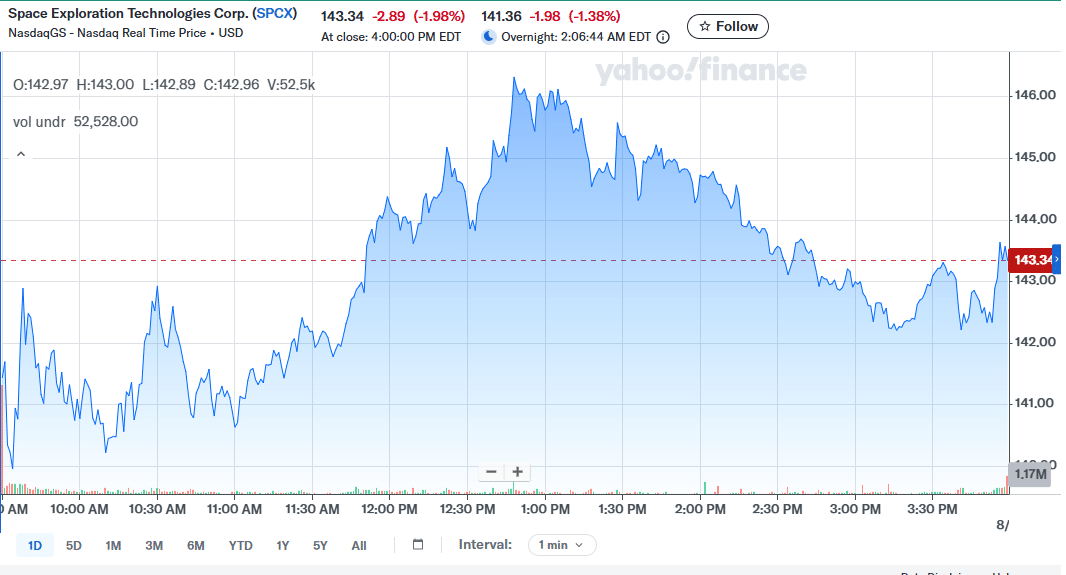
Space Exploration Technologies (Nasdaq: SPCX) is trading just above its $135 IPO price and just below its recent highs as it approaches the next milestone in a supply overhang that has shadowed the stock since its June debut. As of the latest session, SPCX had eased about 1.98% to close near $143.34, slipping a further 1.42% to around $141.31 in overnight trading, per market data as of 06:15 UTC August 19. The modest pullback comes directly ahead of August 20, when roughly 319 million additional shares held by early employees and investors become eligible to trade.
For a stock whose entire post-IPO story has been a tug-of-war between extraordinary demand and a wall of unlocking insider supply, the timing matters. Understanding why requires looking at how SpaceX’s lockup is structured, and at what happened when a much bigger tranche hit the market two weeks ago.
How SpaceX’s Lockup Is Structured
Most newly public companies have a single lockup expiration, typically 180 days after the IPO, when insiders’ shares all become tradable at once. SpaceX’s is different: rather than one cliff, its restricted shares release in a series of staggered tranches tied to both earnings windows and fixed-day milestones, spread out over months. That structure was designed to soften the impact of a very large insider base becoming free to sell.
The schedule works roughly as follows, based on the terms in SpaceX’s IPO prospectus. The first and largest tranche was triggered by the company’s debut quarterly earnings, reported August 4: two days later, on August 6, up to about 911.5 million shares, 20% of the 180-day restricted block, became eligible to sell. The next release is the August 20 tranche of up to 319 million shares, a fixed-day (“day 70”) milestone. Further staggered releases follow, with the 180-day block fully expiring on December 8, 2026. Separately, CEO Elon Musk’s roughly 6.4 billion shares are locked for a full year, until June 2027, with no early-release provisions.
One feature is also a price-based trigger that has so far not fired. An additional block of roughly 455.8 million shares was set to release early only if SPCX closed at least 30% above its $135 IPO price, above about $175.50, on five of the ten trading days around earnings. The stock did not reach that level, so those shares stayed locked and rolled forward into the December expiry. That detail cuts both ways: it means less supply hit in August, but also that a large block still waits in the wings.
Why the First Test Went Better Than Expected
The most important context for the August 20 unlock is what happened on August 6, when more than four times as many shares became eligible. Wall Street analysts cited by Bloomberg had estimated that the roughly 911 million-share unlock, worth on the order of $120 billion at the time, and more than the roughly 639 million shares sold in the IPO itself, would swamp the stock. Short interest had built up so heavily ahead of the event that, by some measures, notional short interest in SPCX had surpassed that of Musk’s Tesla.
Instead, the stock rose about 6% on the day of the unlock and then rallied hard, climbing more than 26% off its lockup-week low over the following sessions to reclaim and close above its $135 IPO price on August 10, the first time it had done so since mid-July. The key insight analysts offered is a crucial one for interpreting any lockup: a share becoming eligible to sell is not the same as a share actually being sold. As Mizuho noted, most of the newly eligible shares probably were not going to trade regardless of the headline unlock number, because many long-term insiders simply chose to hold. As IPO expert Jay Ritter of the University of Florida has put it, lockup expirations usually pressure a stock, but “not always,” and when there is less selling than expected, prices can even rise.
What the August 20 Unlock Could Mean
Against that backdrop, the August 20 tranche looks less daunting on its face: at up to 319 million shares, it is roughly a third the size of the block the market already absorbed. If the same dynamic holds, most eligible holders declining to sell, the impact could again be muted. The stock’s slight pullback ahead of the date may itself reflect some traders positioning cautiously for the added supply, a common pattern around known unlock events.
But it would be a mistake to treat the first unlock’s benign outcome as a guarantee. Each successive tranche adds more freely floating stock, and the cumulative effect of releases running through December and beyond steadily enlarges the tradable supply. Sentiment can shift, particularly for a stock as volatile and momentum-driven as SPCX has been. And there is a newer factor that can influence movement: SpaceX closed an acquisition of AI-coding company Anysphere (Cursor) on August 14, issuing roughly 389 million new Class A shares, a large increase in share count that, while separate from the lockup schedule and subject to its own resale-registration timing, adds to the broader supply picture over time.
The Valuation and Sentiment Backdrop
The supply story plays out against a stock that remains richly valued and heavily debated. Even after its pullback from post-IPO highs, SPCX trades at a substantial multiple of revenue, and its valuation leans heavily on future execution, particularly Starship milestones and the AI ambitions Musk has increasingly emphasized. That leaves the analyst community sharply divided.
On the bullish side, following the company’s second-quarter earnings beat, Citi reiterated a buy and raised its 2026 and 2027 estimates while holding a $200 price target, and Morgan Stanley’s Adam Jonas characterized the early-August dip as “an opportunity”; the average 12-month analyst target has sat well above the current price. On the cautious side, the sheer scale of insider supply still to be released, the premium valuation, and SPCX’s history of violent swings all counsel against complacency.
Why This Matters for Crypto
For a crypto audience, SpaceX’s supply story carries an extra dimension that has nothing to do with rockets. A Crypto Times review of 30 of SpaceX’s major disclosed institutional shareholders found that about 80%, i.e. 24 of the 30, have documented crypto exposure, ranging from direct Bitcoin and Ether holdings to crypto ETFs, exchange investments, stablecoin infrastructure, and blockchain venture bets. The list includes Andreessen Horowitz (which runs a16z crypto), ARK Invest (which operates a spot Bitcoin ETF and has bought crypto-treasury companies), Peter Thiel’s Founders Fund (which has purchased crypto directly), and Wall Street names such as Goldman Sachs, Invesco, and T. Rowe Price that have launched or hold crypto investment products.
That overlap is relevant to the lockup because these are precisely the kinds of holders whose shares unlock over the coming months. It does not imply any mechanical link between SpaceX selling and crypto markets, the exposure is broad and indirect, and the review itself stressed that the 80% figure reflects general digital-asset involvement rather than direct crypto ownership by every firm. But it underscores how intertwined the institutional bases of the two markets have become. The relationship also runs the other way: crypto exchanges including Kraken, Bybit, Coinbase, and Binance launched tokenized SPCX products and perpetual futures around the IPO, giving crypto traders synthetic exposure to the very stock now working through its supply overhang, though those tokenized products do not confer actual share ownership.
SpaceX’s August 20 unlock is best understood not as a single make-or-break event but as the next step in a months-long process of the market digesting an enormous insider share base. The encouraging sign for bulls is that the far larger August 6 tranche was absorbed without the feared collapse, and the stock emerged above its IPO price, evidence that eligible supply and actual selling are very different things. The caution for everyone is that the supply story is far from over: more tranches are coming, a price-triggered block still waits, and a large acquisition has added new shares.
How SPCX trades through August 20 and the releases that follow will say a great deal about whether demand for one of the most closely watched IPOs in years can keep pace with a steadily growing float. This analysis makes no prediction about the stock’s direction and is not investment advice.
Also Read: IREN Stock Falls 6.5% Even After Delivering Its First AI Data Center to Microsoft