Key Highlights
- Uniswap’s UNI gained 7.21% in 24 hours to trade near $4.11, recovering from intraday lows despite lower trading volume.
- Fee-switch expansion, UNI buybacks and burns, and increased whale accumulation helped support bullish sentiment.
- Despite the rally, UNI remains over 90% below its all-time high, and weakening volume suggests the recovery could face pressure if broader market momentum fades.
Uniswap’s UNI token traded at $4.11 on Wednesday, gaining 7.21% over the prior 24 hours according to CoinMarketCap data. The token recovered from a session low near $3.80 to a high around $4.11, with the 24-hour chart showing a steady upward trajectory that accelerated in the later hours.
According to CoinMarketCap data, UNI was up 2.94% over the past week, reflecting a modest recovery after volatile trading earlier in August.
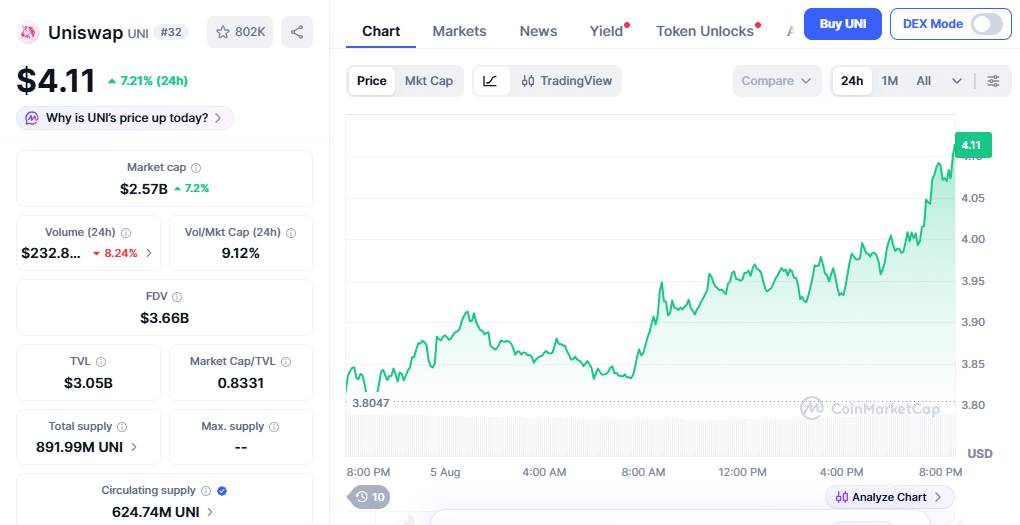
Market capitalization stood at approximately $2.57 billion, with fully diluted valuation near $3.66–$3.67 billion. 24-hour trading volume registered roughly $232.8 million, down about 8% from the previous day, while the volume-to-market-cap ratio held at 9.12%.
Price recovers from recent weakness
Uniswap’s total value locked (TVL) remained around $3.05 billion, producing a market-cap-to-TVL ratio of 0.8331. Circulating supply was listed at 624.74 million UNI out of a total supply of 891.99 million.
During the session, UNI climbed steadily from the $3.80-$3.85 range, forming a series of higher lows before closing near its intraday high. The one-week chart displayed a broader range that had previously tested levels above $4.40 before retreating into the low $3.80s, with the latest recovery reclaiming the $4.00 area.
Despite the recent recovery, UNI remains approximately 90.95% below its all-time high of $44.97, reached in May 2021, while trading roughly 871% above its all-time low of $0.419 recorded in September 2020.
Catalysts driving today’s surge
Several concurrent factors appear linked to the recent price movement.
Uniswap has expanded its governance-approved fee-switch mechanism to additional v4 pools and blockchain networks, including activity related to Robinhood Chain. The initiative directs a larger share of protocol fees toward UNI buybacks and token burns.
CryptoQuant data also showed elevated whale activity, with Binance outflows of UNI reaching their fastest pace in five years and average top daily withdrawals exceeding 7,200 tokens.
Meanwhile, network metrics reported by Dune Analytics indicated increases in new addresses and large transfers around late July and early August, coinciding with the fee-switch rollout.
Despite the 7% rise, UNI continues to trade more than 90% below its 2021 peak, and the latest move unfolded on falling volume.
While fee-switch revenue, buybacks, and whale accumulation have supported sentiment, the token remains exposed to broader crypto market conditions and competition from other decentralized exchanges.
Also Read: TeraWulf Bets on AI as HPC Drives Majority of Revenue in Q2 2026