Key Highlights
- TeraWulf reported $44.8 million in Q2 revenue, with 71% ($31.9 million) generated from high-performance computing (HPC), highlighting its transition toward AI infrastructure.
- Bitcoin mining is becoming a smaller part of TeraWulf’s business, as the company reallocates capital toward AI data centers.
- The company expanded its AI business through long-term agreements with Anthropic and Fluidstack.
TeraWulf Inc. (Nasdaq: WULF), a digital infrastructure and energy company, traded modestly higher on Wednesday, with shares last changing hands near $19.04, up about 0.85%.
The stock gained after the company reported second-quarter results highlighting accelerating computing revenue and a series of AI-related deals instead of focusing on Bitcoin mining.
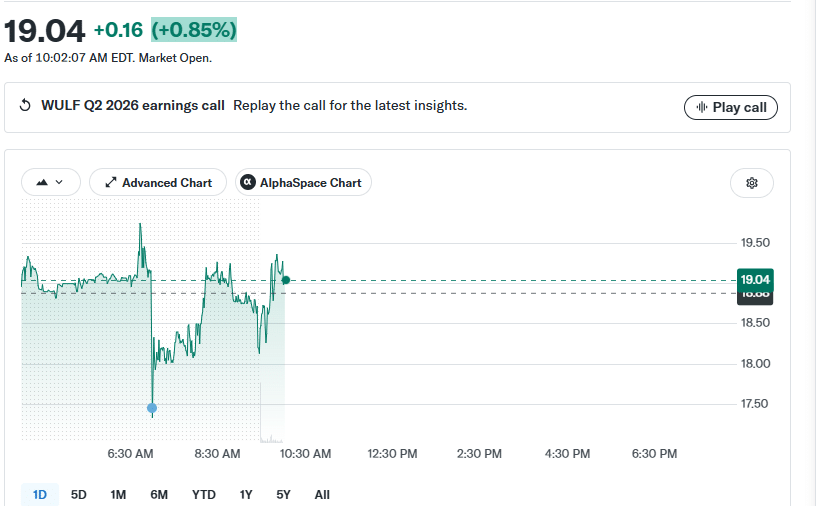
According to data from Yahoo Finance, the stock opened at $18.44 and moved in a day’s range of $18.05–$19.42 on roughly 6.8 million shares, remaining well below its 52-week high near $29.84 while sitting far above the low of $4.67.
The company’s market capitalization stood at about $9.4 billion, while its beta of 4.29 continued to reflect elevated volatility as investors assess its transition away from Bitcoin mining.
TeraWulf reports $44.8 million in total revenue
According to the official filing, TeraWulf reported $44.8 million in total revenue for the quarter ended June 30, 2026. Of that, $31.9 million, or approximately 71%, came from HPC lease revenue. The company closed the period with about $3 billion in cash and restricted cash.
At Lake Mariner, revenue-generating critical IT capacity stood at 81 MW as of quarter-end; the subsequent delivery of CB-3 in early July raised that figure to 102 MW and activated $600 million in Google credit support tied to Fluidstack’s lease obligations.
The first CB-4 data hall has entered commissioning, with phased delivery and rent commencement expected in the second half of 2026, while CB-5 remains targeted for early 2027. Management reiterated cost guidance of $8–10 million per critical IT megawatt. The firm also acquired the Muskie Data Campus in Eastern Kentucky, locking in electric service agreements for up to 1 GW with Kentucky Power Company.
Terawulf expands AI partnerships
In Q2, TeraWulf signed a 20-year lease with Anthropic covering roughly 401 MW at the Justified Data Campus, representing about $19 billion in contracted revenue over the initial term and up to $33 billion if both five-year extension options are exercised.
Separately, the company agreed to sell its entire 50.1% stake in the Abernathy Joint Venture for approximately $530 million in cash and secured FERC authorization for the proposed Morgantown generating station acquisition, advancing the planned up-to-1 GW Chesapeake Data Campus.
CEO Paul Prager described the quarter as a shift “from platform formation to scaled execution.” “As access to power becomes the defining constraint on AI infrastructure development, we believe our ability to combine energy expertise, infrastructure control, and execution at scale will become increasingly valuable,” he said.
Demand for AI shifts the focus from digital infrastructure
TeraWulf built its early reputation on zero-carbon Bitcoin mining, leveraging hydroelectric and other low-emission power sources at sites like Lake Mariner to differentiate itself in an energy-intensive industry. Bitcoin mining provided cash flow and operational know-how, but the demand for AI training and inference compute in recent days has pushed the company to shift its focus towards it.
TeraWulf is now directing more capital and capacity toward HPC customers, including Fluidstack and Anthropic, while monetizing non-core assets such as Abernathy to fund larger AI infrastructure projects.
Although the company’s revenue mix increasingly reflects AI infrastructure, the transition also introduces execution risk. The long-term success of the strategy will depend on the company’s ability to deliver projects on schedule and sustain demand for AI computing capacity.
Also Read: Circle Stock (CRCL) Drops After Q2 Results Despite Strong USDC Growth