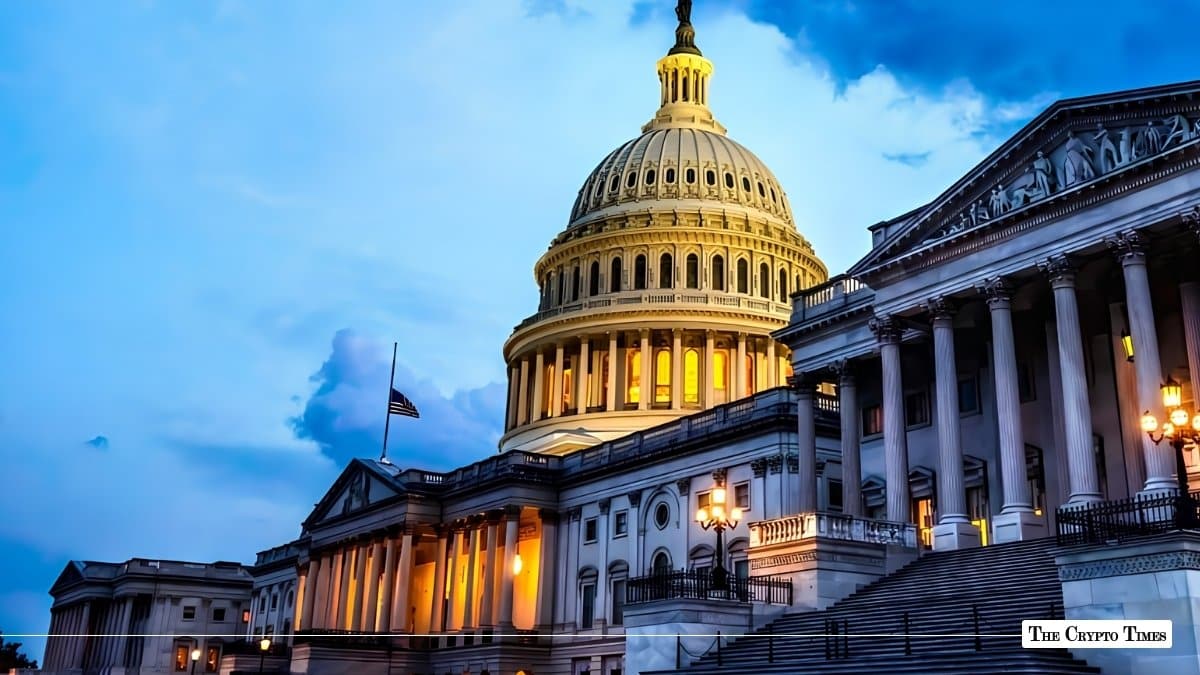
The CLARITY Act’s path to a Senate vote before the August recess narrowed sharply over the weekend. According to the official floor schedule published by Senate Democratic leadership, the chamber will convene at 3:00 p.m. on Monday, August 3, and its one scheduled roll-call vote, at approximately 5:30 p.m., is a cloture motion on a continuing resolution to fund the government (H.R. 6500), not the crypto market-structure bill. The Digital Asset Market CLARITY Act does not appear anywhere on Monday’s agenda.
With the Senate set to depart for its recess after the first week of August, that absence leaves a window of roughly 72 hours for the bill to gain floor traction; and, as of the published schedule, no cloture motion had been filed to start the multi-day process a floor vote would require.
What the Schedule Shows
The primary document is unambiguous about Monday’s business. Per the leadership schedule, after the Senate convenes and moves through leader remarks and a period of morning business, its scheduled vote is the motion to invoke cloture on the motion to proceed to the continuing resolution vehicle, a measure aimed at keeping the government funded. No floor time is formally allocated to the CLARITY Act.
That matters procedurally. Advancing a bill over a potential filibuster requires invoking cloture, a process that unfolds over several days, including an intervening period before the vote and time for debate afterward. With none of those steps initiated for the CLARITY Act and the recess days away, the calendar itself, rather than any single political statement, is what now constrains the bill’s near-term prospects.
Where the Bill Stands
The CLARITY Act, formally H.R. 3633, would divide U.S. oversight of digital assets between the Securities and Exchange Commission (SEC) and the Commodity Futures Trading Commission (CFTC), a long-sought clarification for the industry, and also touches stablecoins and decentralized finance. It passed the House 294–134 in July 2025 and was advanced by the Senate Banking Committee 15–9 in May 2026, but it has since stalled in the full Senate. It sits on the Senate Legislative Calendar with no cloture motion filed and no floor time set aside.
The arithmetic remains the core obstacle. Republicans hold 53 seats, but overcoming a filibuster requires 60 votes, meaning the bill needs support from roughly seven Democrats. Senators Ruben Gallego (D-AZ) and Angela Alsobrooks (D-MD), the two Democrats who voted the bill out of committee, have tied their floor support to strong conflict-of-interest rules, making their votes central to any path forward.
The Ethics Fight Still at the Center
The reason the bill has not moved is the same ethics provision that has dogged it for weeks: language addressing conflicts of interest tied to President Donald Trump’s crypto businesses. A bipartisan compromise developed by Senators Thom Tillis (R-NC) and Gallego, which would let state attorneys general, not only the Justice Department, enforce a ban on federal officials issuing or sponsoring tokens, is under White House review, as The Crypto Times reported. Democrats have argued the earlier, White House-backed language left enforcement too weak, while Republicans and the administration have described their proposal as historically strong. The compromise text has not been publicly released.
Leadership Signals and the Clock
Senate Majority Leader John Thune has said he would like to at least begin consideration of the bill before the break, a formulation that, in itself, signals expectations have moved away from full passage this week, while acknowledging the chamber may lack time to complete debate, amendments, and a cloture vote before members leave. White House crypto adviser Patrick Witt has pushed back on the more pessimistic read, saying the first week of August still holds potential, and Treasury Secretary Scott Bessent has publicly urged the Senate to act before recess.
Prediction markets reflect the uncertainty. Polymarket’s odds of the CLARITY Act being signed into law in 2026 have fallen to roughly the high-20s to low-30s percent range in recent days, down from a February peak around 82%, though those figures are volatile and have swung with each development. They are a gauge of trader sentiment, not a forecast by The Crypto Times.
What a Missed Window Would Mean
If the bill does not gain floor traction before recess, it would most likely carry over to a September session, pushing the effort into an autumn calendar increasingly crowded by the November midterms. Analysts cited in prior coverage have warned that a slip of that kind risks delaying the legislation further, potentially into 2027. It would also leave U.S. crypto oversight resting on administrative measures, such as existing SEC and CFTC guidance, rather than statute, an arrangement that a future administration could revise. None of that is predetermined by Monday’s schedule alone; the coming days, and whether negotiators can convert the ethics compromise into filed floor action, will decide it.
Also Read: Strategy’s Michael Saylor Backs CLARITY Act Ahead of Senate Recess