Key Highlights
- Grayscale has urged Senate leaders to schedule a floor vote on the CLARITY Act before the August recess.
- The asset manager said prolonged regulatory uncertainty is driving crypto businesses and capital overseas.
- The company argued the bill would establish clearer jurisdiction between the SEC and CFTC.
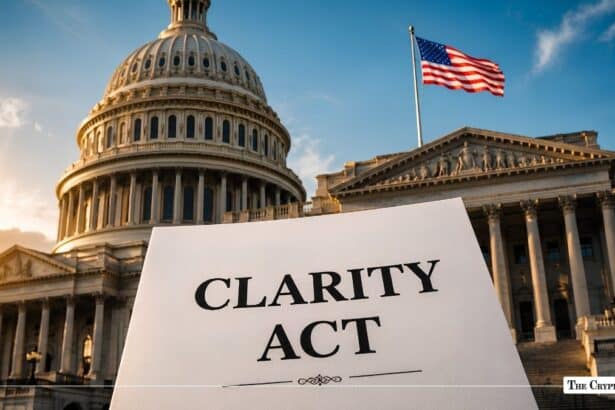
Pressure is continuing to build on the U.S. Senate to move forward with the Digital Asset Market Clarity (CLARITY) Act, with Grayscale Investments becoming the latest major industry participant to call for a floor vote before lawmakers leave Washington for their August recess.
In an X post, Grayscale shared a letter sent by its Chief Legal Officer Craig Salm to Senate Majority Leader John Thune and Minority Leader Chuck Schumer, urging that the absence of a clear federal framework continues to create uncertainty for the digital asset industry and risks weakening the United States’ position in global crypto markets.
The request comes as lawmakers continue negotiating the final details of the legislation before deciding whether to bring it to the Senate floor.
Grayscale warns of competitive risks
Grayscale said the lack of comprehensive digital asset legislation has forced the industry to operate under an inconsistent regulatory environment that has often relied on enforcement actions rather than clearly defined rules.
According to the firm, while recent regulatory guidance has provided some direction, the CLARITY Act would establish the statutory framework that many companies have been seeking.
The company argued that the legislation would create a clearer division of regulatory responsibilities between the Commodity Futures Trading Commission (CFTC) and the Securities and Exchange Commission (SEC), providing greater certainty for businesses, developers, and investors.
Capital could continue moving overseas
Grayscale also framed the debate as one of international competitiveness, warning that uncertainty is encouraging companies to expand in jurisdictions that have already adopted comprehensive digital asset regulations.
The company specifically pointed to countries such as Singapore and the United Arab Emirates, which have introduced dedicated crypto regulatory frameworks in recent years.
“Every day without clarity is a day of talent, innovation, and, most importantly, capital flow to jurisdictions such as Singapore, Abu Dhabi, and others that have already established coherent frameworks.”
According to Grayscale, businesses deciding where to build are increasingly making decisions based on regulatory predictability.
ETF market also in focus
Beyond crypto companies, Grayscale argued that the legislation would also support continued innovation in regulated digital asset investment products.
The company, which manages one of the world’s largest digital asset investment platforms, said legal certainty would strengthen the development of exchange-traded funds (ETFs), exchange-traded products (ETPs), and other regulated investment vehicles for U.S. investors.
Grayscale noted that its products are held by hundreds of thousands of investors and said clearer market structure rules would help preserve the competitiveness of U.S. capital markets.
Calls for Senate action continue to grow
Grayscale’s appeal adds to a growing list of organizations urging lawmakers to advance the CLARITY Act before the August recess.
Earlier this week, the American Bankers Association (ABA) reiterated its support for the legislation while requesting targeted revisions related to stablecoin yield provisions. Separately, the Major Cities Chiefs Association endorsed the latest Senate draft after lawmakers added new provisions expanding cooperation between digital asset firms and state and local law enforcement.
The latest endorsements suggest that, despite ongoing debate over specific provisions, support for moving the bill forward continues to broaden across different sectors.
Senate calendar remains tight
Whether the Senate will consider the CLARITY Act before the August recess remains uncertain.
Lawmakers continue negotiating issues including stablecoin rules, market oversight, ethics provisions, and jurisdictional authority, while the Senate also faces a crowded legislative agenda.
In his letter, Salm argued that the legislation has already undergone extensive bipartisan negotiations and is now ready for Senate consideration.
As Congress approaches its summer recess, the coming days are expected to determine whether the Senate moves ahead with what could become the most significant U.S. crypto market structure legislation to date.
Also Read: Senator Lummis Defends CLARITY Act Over Trump Divestment Rule