
In a notable shift, BlackRock clients have recently net sold Bitcoin ETF shares while directing capital into Ethereum products, prompting questions about a possible institutional rotation between the two leading cryptocurrencies.
Blockchain intelligence firm Arkham Intelligence reported on July 29, 2026, that BlackRock’s clients have net sold approximately $60 million of the firm’s flagship iShares Bitcoin Trust (IBIT) ETF so far this week while simultaneously purchasing more than $20 million worth of Ethereum exposure through BlackRock’s related products. The findings explicitly raised the question of whether institutions are rotating into ETH.
Arkham’s data serves as the primary lens for this development. The firm tracks BlackRock-linked addresses and entity flows, showing routine movements involving Coinbase Prime alongside the ETF activity.
As of the report, BlackRock’s tracked portfolio held roughly 736K BTC valued at about $47.5 billion and 2.9 million ETH worth approximately $5.57 billion, for a combined on-chain crypto footprint near $53 billion. Bitcoin remains by far the dominant holding, yet the short-term flow divergence has drawn attention across crypto markets.
Recent Flow Data and the Scale of Client Activity
Arkham’s weekly snapshot aligns with the ETF data provider and tracker SoSoValue, which shows that IBIT recorded net outflows of roughly $8.8 million on July 27 and $54.8 million on July 28, producing a cumulative figure close to the $60 million cited by Arkham for the early part of the week.
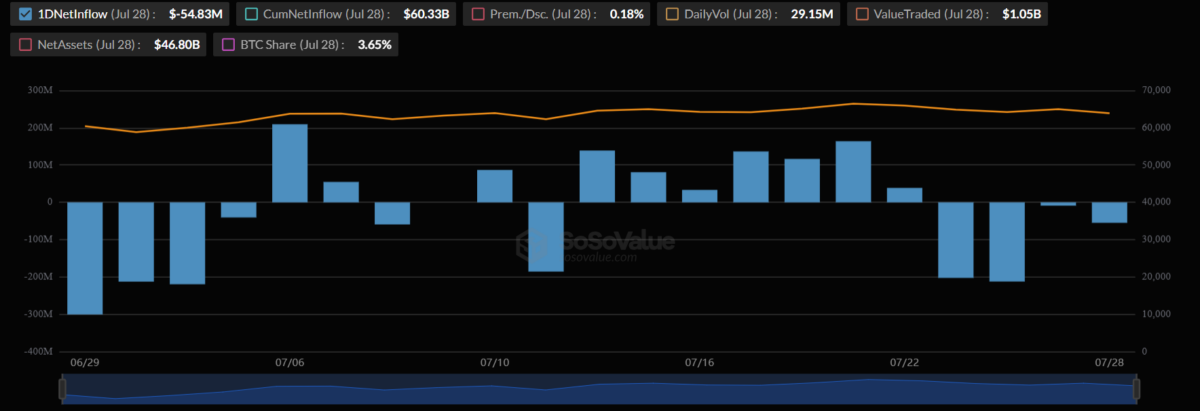
These redemptions occur through the standard creation-and-redemption mechanism of spot ETFs: when clients sell shares, authorized participants redeem them and the issuer sells underlying Bitcoin to meet the demand.
In contrast, BlackRock’s Ethereum products, primarily the iShares Ethereum Trust (ETHA) and its staking-oriented counterpart, posted positive activity. On July 27 alone, ETHA attracted about $11.75 million in net inflows, helping the broader U.S. spot Ethereum ETF complex record roughly $9.2–9.3 million in net gains that day.
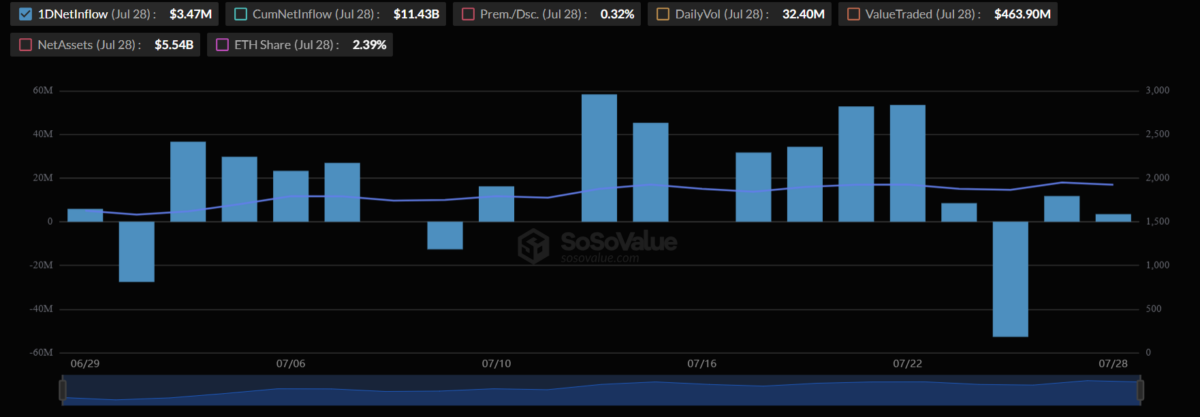
Looking at the preceding five trading days ending around July 24, BlackRock’s ETH-related funds drew a combined net inflow near $99 million while IBIT experienced approximately $95.5 million in outflows. This pattern of Ethereum products outperforming Bitcoin ones on a flow basis has appeared in several recent windows.
On-Chain Holdings Provide Longer-Term Perspective
Beyond the weekly numbers, Arkham’s entity explorer reveals the absolute scale of BlackRock’s crypto exposure. The roughly 736K BTC position represents one of the largest institutional Bitcoin holdings linked to ETFs, while the 2.9 million ETH stack, though smaller in dollar terms, has grown meaningfully over prior periods.
These holdings did not appear overnight. Spot Bitcoin ETFs launched in early 2024 and Ethereum products followed later that year; BlackRock quickly captured the majority of volume and assets under management in both categories.
The current flow divergence does not erase Bitcoin’s overwhelming share of the portfolio. It highlights that client capital can shift between the two assets within the same issuer’s product suite with relative ease.
The net effect this week, per Arkham, has been a modest reduction in Bitcoin exposure paired with an increase in Ethereum exposure among BlackRock’s ETF clients.
Read: Ethereum Turns 11: Can Morgan Stanley’s ETF Push ETH Price Past $2,000?
Possible Drivers Behind the Observed Rotation
The central question posed by Arkham, “Are institutions rotating into ETH?”, remains open, yet several contextual factors help explain why such a shift could occur now. U.S. spot Bitcoin ETFs experienced heavy outflows in June 2026, followed by a recovery streak of inflows earlier in July that later reversed into renewed redemptions.
Ethereum ETFs, by comparison, have displayed more consistent weekly net inflows in recent periods, frequently led by BlackRock’s products. Ethereum’s staking yield provides a structural difference unavailable to Bitcoin holders in the same form.
Institutional allocators seeking income alongside price exposure may find the combination of spot ETF convenience and native staking more attractive in certain market environments.
Relative valuation metrics, perceptions of Ethereum’s utility in tokenization and decentralized applications, and simple portfolio rebalancing after Bitcoin’s stronger cumulative inflows over the multi-year ETF era may also play roles.
Also read: Bitcoin Price Prediction for August 2026: Can BTC Hold $60K or Face Another Drop?