
The mid-sized Bitcoin wallets holding between 10 and 10,000 BTC, often described as key stakeholders or “sharks,” have added approximately 19,696 BTC over an eight-day period ending around July 27, 2026.
On-chain data from analytics platform Santiment shows that this cohort of wallets typically represents sophisticated investors, funds, and larger individual holders rather than the very largest whales or small retail participants. Their coordinated accumulation stands out against a backdrop of cooler activity among the smallest retail wallets.
Santiment’s metrics highlight that wallets in the 10–10K BTC range have been net buyers while micro-retail demand (sub-0.01 BTC wallets) has shown reduced urgency in dip-buying. The platform notes this combination is often constructive: larger holders are adding supply to stronger hands, retail noise is fading, and ETF-related demand appears to be returning.
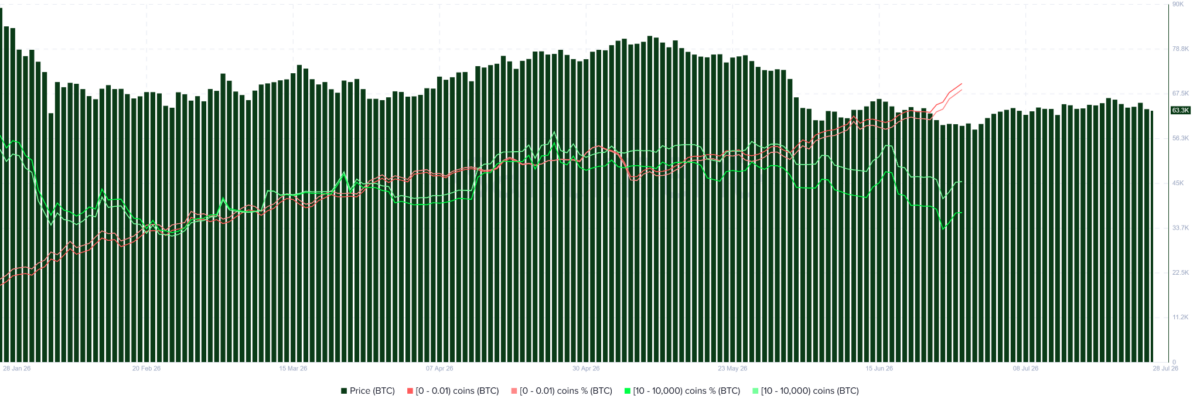
These mid-tier wallets collectively control a substantial portion of Bitcoin’s circulating supply. Historical Santiment tracking has shown this group holding well over half of all BTC at various points, making shifts in their behavior a closely watched signal for market direction. The recent 19,696 BTC addition represents a meaningful transfer of coins away from weaker or more reactive holders.
Historically, such accumulations have acted as a potential stabilizer during periods of price consolidation or mild declines. It suggests conviction among participants with the capital and time horizon to weather short-term volatility.
Bitcoin’s Recent Price Trajectory
Bitcoin is trading near $63,200–$63,400 as of July 28, 2026, after a modest daily decline of roughly 3.25% from the prior session. This latest dip brings an inflated trading volume of $27.66 billion for the past 24 hours with Bitcoin’s market capitalization sitting at $1.27 trillion.
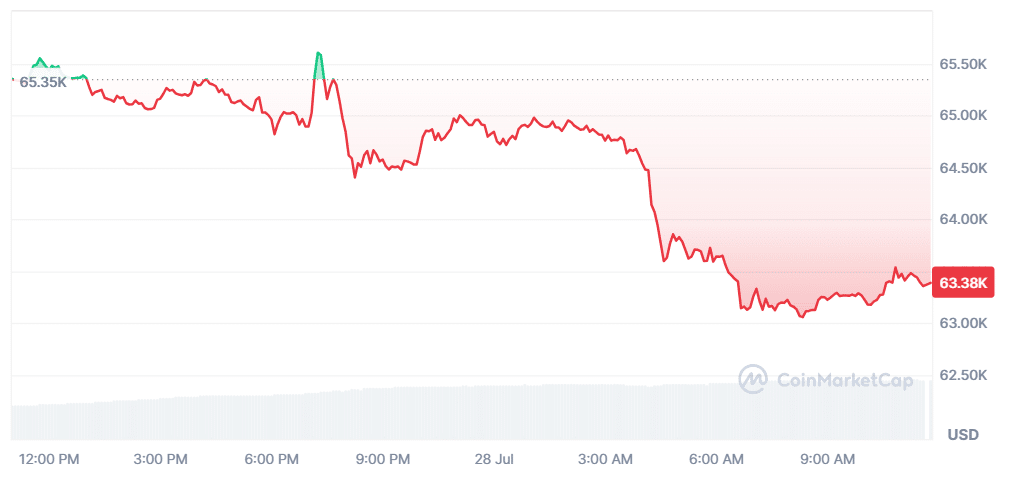
The 2026 trajectory has been largely corrective. After the late-2025 peak, Bitcoin entered a multi-month downtrend, bottoming near $57,700–$58,000 in June and early July 2026. A recovery followed, lifting prices back into the mid-$60,000s by mid-to-late July, with recent sessions seeing highs above $66,000 before the current pullback.
Over the past week, Bitcoin has declined around 4%, while the one-month change remains relatively flat to slightly negative. Year-to-date performance shows a drop of roughly 29%, and the one-year change sits near –46% from levels above $120,000 a year earlier. The 52-week range spans roughly $57,750 to $126,200.
This price action reflects a classic post-cycle consolidation: elevated volatility has given way to range-bound trading as the market digests prior gains and navigates broader macroeconomic and liquidity conditions.
Implications for Market Sentiment
The divergence between accumulating mid-sized wallets and cooling retail activity often precedes periods of reduced selling pressure. When coins move into stronger hands, the available free float can tighten, potentially supporting prices if demand from ETFs or other institutional channels continues.
While on-chain buying alone does not guarantee immediate upside, the shift toward key stakeholders reduces the risk of aggressive retail-driven capitulation.
Bitcoin’s circulating supply continues to approach its 21 million hard cap, with over 95% already mined. In this environment, sustained buying by the 10–10K BTC cohort reinforces the narrative of gradual supply concentration among longer-term holders.
Also read: What Stress Testing on Strategy Inc.’s MSTR-STRC Reveals