Strategy Inc. (NASDAQ: MSTR), the world’s largest corporate Bitcoin holder, announced on July 27, 2026, that it sold 5,429,160 Class A common shares through its at-the-market (ATM) program for net proceeds of $544.5 million during the week of July 20–26.
The company simultaneously executed its first preferred stock repurchase under a newly authorized program, buying back 288,930 shares of its Variable Rate Series A Perpetual Stretch Preferred Stock (STRC) for an aggregate $25 million.
These actions helped lift the firm’s dedicated U.S. dollar reserve by $525 million to $3.75 billion as of July 26, providing approximately 2.1 years of coverage for preferred dividends and interest obligations. Notably, the firm’s Bitcoin holdings remained unchanged at 843,775 BTC.
The update comes just days before Strategy’s scheduled Q2 2026 earnings call on July 30, where management is expected to provide further color on capital allocation, Bitcoin strategy, and financial performance.
The Latest Capital Moves in Detail
According to the company’s Form 8-K filing, no preferred securities were sold during the period, and the bulk of the activity centered on common stock issuance and the targeted STRC repurchase.
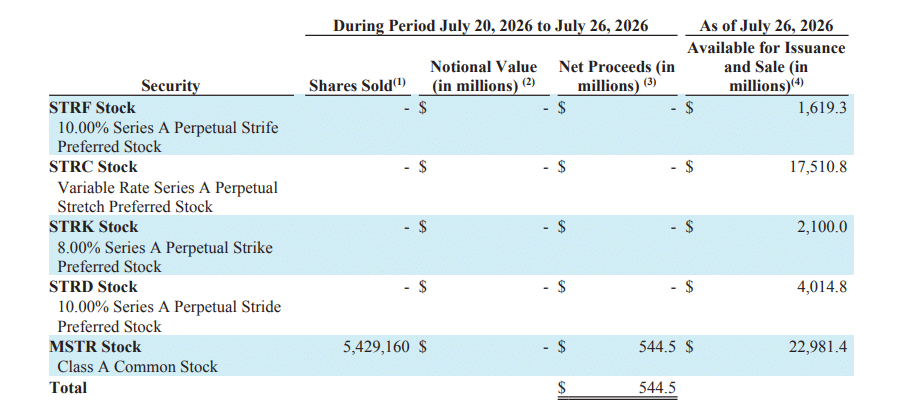
Remaining capacity under the MSTR ATM program stood at roughly $22.98 billion after the sales. The Digital Credit Securities repurchase program retained about $975 million of its original $1 billion authorization following the $25 million STRC transaction.
The Bitcoin reserve continues to sit at 843,775 coins, acquired at an average cost of approximately $75,476 per BTC for a total cost basis near $63.7 billion. At recent market prices, the holdings remain underwater relative to cost, a factor that has shaped recent decision-making.
Why the Shift Toward Cash Reserves and Buybacks Instead of Pure Bitcoin Buying
For years, Strategy operated a one-way “flywheel” of issuing equity and preferred securities primarily to accumulate more Bitcoin. That approach evolved significantly in late June 2026 with the adoption of the Digital Credit Capital Framework. The framework prioritizes liquidity, credit quality, and active capital management alongside long-term Bitcoin exposure.
Bitcoin’s price volatility in 2026 left the treasury position with substantial unrealized losses. At the same time, Strategy carries substantial annual obligations, roughly $1.76 billion in preferred dividends and interest, that require reliable cash coverage.
While the company kept staking BTC throughout years, this pure accumulation without a robust cash buffer risked forcing Bitcoin sales or heavy equity issuance at inopportune moments during market downturns.
The board therefore established a formal USD Reserve policy that rings-fences cash exclusively for preferred dividends and interest payments, with a minimum requirement of 12 months of coverage. Proceeds from recent ATM sales have been directed almost entirely into building this reserve rather than buying additional Bitcoin. Management has also authorized a BTC Monetization Program allowing limited Bitcoin sales (up to $1.25 billion for reserve building, plus additional amounts for dividends or buybacks) when such sales are judged more advantageous than issuing equity.
This marked a deliberate move from passive holding and continuous accumulation toward two-way capital flexibility: issuing securities when conditions are favorable and repurchasing or using cash when accretive.
Executive Chairman Michael Saylor has repeatedly emphasized that Bitcoin remains the primary treasury reserve asset, while noting that “Digital Credit requires liquidity, discipline, and active capital management.” CEO Phong Le described the evolution as shifting from one-way capital issuance to active management that can create shareholder value by buying back securities when they trade at discounts.
With this shift, the company is now no longer treating every capital raise as an automatic Bitcoin purchase opportunity. Instead, it is fortifying its balance sheet against volatility and ensuring it can service preferred obligations without compromising the core Bitcoin position.
Read: Strategy’s Cash Reserve Shift Reveals Weaknesses in Leveraged Bitcoin Balance Sheet
Why Specifically Buy Back STRC Preferred Shares
STRC, the Variable Rate Series A Perpetual Stretch Preferred Stock, has been a key funding vehicle for Strategy’s Bitcoin strategy. It is designed to trade near its $100 stated (par) value through adjustable monthly dividend rates.
When STRC fell significantly below par earlier in 2026, hitting record lows near $75 amid Bitcoin weakness and broader market pressure, issuing new shares became less attractive, and the high dividend rate (raised to 12% alongside reserve boost to $2.55 billion) increased the ongoing cash burden.
The Digital Credit repurchase program explicitly prioritizes STRC as the initial focus when management determines that buybacks are accretive. Purchasing shares at a meaningful discount to the $100 stated amount reduces the total notional outstanding, lowers future expected dividend payments, strengthens overall credit quality, and supports the market price of the preferred securities. The $25 million repurchase of 288,930 shares represents the first concrete use of this tool and signals willingness to act when discounts appear attractive.
By retiring preferred shares bought below par, Strategy can improve the economics of its capital structure for common shareholders over time while demonstrating support for the preferred holders who provide critical funding flexibility. Neither the preferred nor the common stock repurchase programs draw from the USD Reserve; they are funded separately, including potentially through Bitcoin monetization if management chooses.
Selling of MSTR Shares Raises Concerns Over Further Stock Dilution
However, the repeated large-scale ATM sales of Class A common stock have drawn increasing scrutiny from investors concerned about dilution. Selling more than 5.4 million shares in a single week, following earlier multi-million-share offerings in prior weeks, continues to expand the share count.
Shares outstanding have risen substantially over the past year as Strategy has raised tens of billions through equity issuance to fund its Bitcoin strategy and, more recently, its cash reserves.
Critics argue that continuous dilution reduces existing shareholders’ ownership percentage and can pressure the stock price, particularly when the proceeds are not immediately converted into additional Bitcoin that increases Bitcoin-per-share metrics. Some market participants have voiced frustration on social platforms that the company is diluting common equity to fund cash reserves and preferred buybacks rather than expanding the Bitcoin treasury.
Read: Swedbank Boosts MSTR Stake as Strategy’s Bitcoin Treasury Faces Growing Scrutiny
While ATM sales above the net asset value of Bitcoin holdings can still be accretive on a Bitcoin-per-share basis in certain conditions, prolonged issuance without corresponding accumulation has heightened sensitivity around capital structure decisions.
Strategy maintains that remaining ATM capacity is substantial and that the flexibility to issue when equity is attractively priced remains a core advantage. The parallel authorization of a $1 billion common stock repurchase program is intended, in part, to provide a counterbalance—allowing the company to support the stock when it trades at discounts to intrinsic value. Whether and when that program is activated will be closely watched.
Looking Ahead to the July 30 Earnings Call
The timing of this week’s update is notable. Strategy is scheduled to report second-quarter results and host a business update call on Thursday, July 30, at 5:00 p.m. ET. Investors will be listening for management commentary on the pace of future ATM activity, the trajectory of the USD Reserve, any plans for additional preferred or common buybacks, the conditions under which Bitcoin purchases might resume, and the broader health of the software business that still generates operating cash flow.
Questions are also likely around the sustainability of the high STRC dividend rate, the company’s view on Bitcoin market conditions, and how the Digital Credit Capital Framework is performing in practice after its first full month of operation.
Broader Implications for Strategy’s Bitcoin Treasury Model
Strategy’s recent actions illustrate a maturation of the pure “Bitcoin treasury” model. After years of aggressive accumulation that made it the largest public corporate holder of Bitcoin (still roughly 4% of the eventual 21 million supply cap), the firm is now balancing growth of the stack with rigorous liquidity management and opportunistic capital structure optimization.
The emphasis on a multi-year cash runway for preferred obligations reduces the risk of forced selling in a prolonged downturn, while the buyback tools give management levers to enhance value when securities trade at discounts.
Whether this more balanced approach reassures or disappoints Bitcoin-maximalist shareholders remains to be seen. For now, the company has demonstrated it can raise substantial capital, expand its cash buffer to $3.75 billion, execute accretive preferred repurchases, and still keep its core Bitcoin reserve completely intact. All eyes turn to the July 30 earnings call for the next chapter in Strategy’s evolving capital playbook.
Also Read: Crypto Week Ahead: FOMC, Coinbase & Strategy Earnings, Zcash Upgrade