
Ethereum has delivered a sharp rebound of more than 4% in the past 24 hours, trading near $1,960 as of 4:00 PM IST on July 27, 2026. The move arrives shortly after technical warnings that the asset was testing a critical multi-year ascending trendline, and it coincides with fresh commentary highlighting early signs of potential outperformance against Bitcoin.
On July 20, ETH was pressing the same multi-year support line that has held through prior cycle lows since 2022. The weekly chart showed a rising channel with historical bounce points, an intermediate reference near $4,800, and a longer-term upper projection toward $10,000.
Technical Rebound Holds Key Support
Instead of breaking lower, price action stabilized and then accelerated higher. From levels around $1,870–$1,900 near the time of the original warning, Ethereum recorded a 4.28% daily advance on July 26, climbing above $1,950, with further gains carrying the asset near $1,960–$1,965 into July 27. Trackers showed trailing 24-hour gains in the 4.3–4.6% range at points during the session.
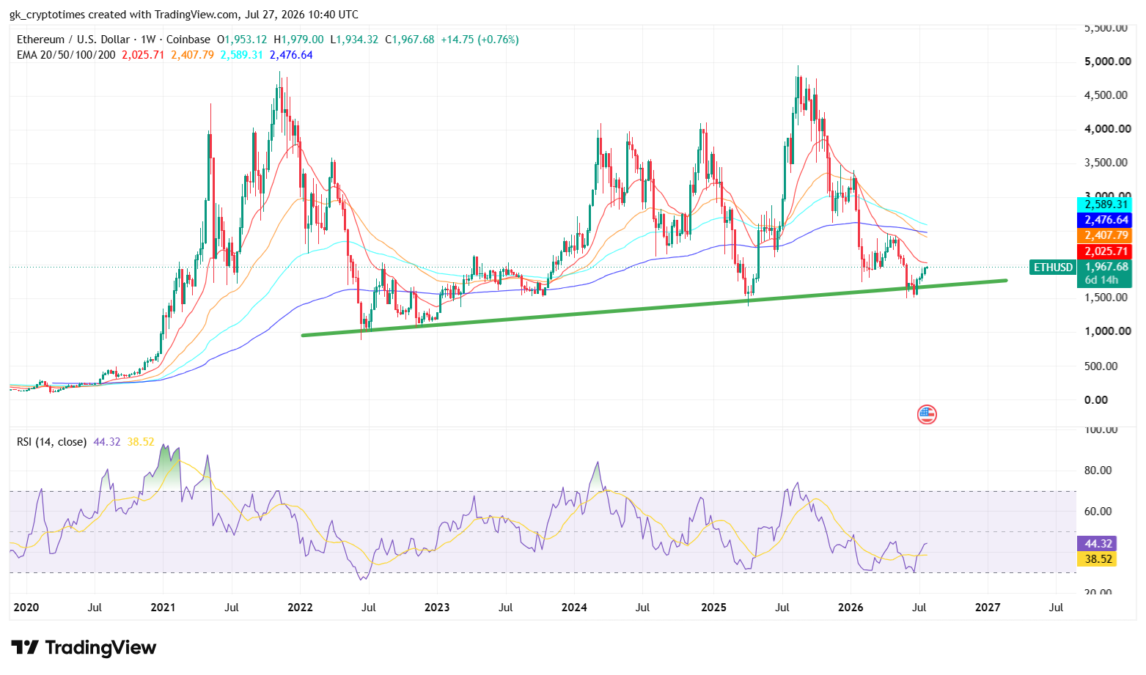
This defense of the multi-year ascending support, drawn from the June 2022 bottom and connecting subsequent higher lows, keeps the broader rising-channel structure intact.
A sustained hold preserves the technical pathway toward higher cycle targets, including the $10,000 zone outlined earlier. Although a weekly close below the line would have opened deeper correction risks toward $1,500–$1,600 or lower.
Competing short-term patterns, such as a rising wedge from the June lows near $1,510, had carried downside risk near $1,830–$1,850, but the latest strength has deferred those concerns for now.
Relative Strength and Institutional Flows
Additional context from market observers points to improving relative performance versus Bitcoin. In a post published early on July 27, @Tanaka_L2 argued that ETH could outperform BTC from current levels, citing the ETH/BTC pair’s break above a multi-month descending channel that had controlled relative strength for much of the past year.
The ratio has climbed toward 0.030, marking the first meaningful sign of regained strength even if a full trend reversal is not yet confirmed.
Supporting this view, data from SoSoValue shows that US spot Ethereum ETFs recorded renewed inflows, with approximately $104 million in net inflows during the week of July 20–24, led by BlackRock’s ETHA product. This continues a streak of positive institutional flows after periods of more mixed activity. Tanaka noted that institutions appear to be building dedicated ETH exposure rather than treating it purely as a secondary Bitcoin trade.
Prominent industry figures have reinforced a constructive longer-term case amid the near-term technical bounce. Tom Lee, Fundstrat co-founder and BitMine chairman, has repeatedly outlined multi-tier targets in July, including near-term technical upside toward $2,200–$2,239, intermediate scenarios of $7,000–$9,000 or $12,000–$22,000 depending on Bitcoin’s path and ETH/BTC ratio recovery, and an ambitious long-term vision of $250,000 tied to Ethereum’s potential as “productive money” and settlement infrastructure for AI agents and tokenization.
While the dominant high-profile commentary leans bullish on structural adoption and technical defense of key support, more measured notes persist. Some cycle-oriented analysts have flagged the possibility of moderate correction risk or seasonal weakness later in the summer, and on-chain data providers such as CryptoQuant have cautioned that sustained organic capital and stablecoin inflows will be needed to maintain momentum.
Overall, the combination of the multi-year trendline hold, ETH/BTC channel breakout, renewed ETF demand, and high-profile accumulation and target commentary from figures like Lee and Hayes has shifted the immediate narrative from breakdown risk toward a more constructive recovery setup, though confirmation will depend on weekly closes and broader market conditions.
Read: Ethereum (ETH) Price Trades 17% Below Realized Price — On-Chain Data Signals Caution
Longer-Term Structural Arguments
Beyond near-term charts and flows, the case for Ethereum rests on its role as settlement infrastructure. Tanaka highlighted three core value drivers: ETH as the staking asset securing the network, a primary collateral asset across DeFi, and a potential reserve or settlement layer for stablecoins, real-world assets (RWAs), and tokenized finance.
The biggest acknowledged risk remains value accrual from Layer-2 activity. Yet if stablecoin, RWA, and institutional usage continue expanding on Ethereum, demand for holding ETH could exceed what current fee revenue alone implies. At present valuations, some holders see more asymmetric upside potential for ETH relative to Bitcoin’s digital-scarcity narrative, even while maintaining positions in both.
Crypto markets stay volatile, and multi-year supports can still fail under shifting liquidity or macro pressure. Intermediate resistances near the 200-period moving averages and prior highs must still be cleared for a confirmed medium-term reversal.
For the moment, the combination of the multi-year trendline defense, the roughly 4% rebound, the ETH/BTC channel break, and renewed ETF inflows has shifted sentiment from breakdown risk toward constructive recovery signals. Weekly closes and sustained relative strength will determine whether this marks the early stages of broader rotation or a temporary bounce.
Also read: Robinhood Chain Beats Ethereum, Solana to Become No. 1 RWA Network