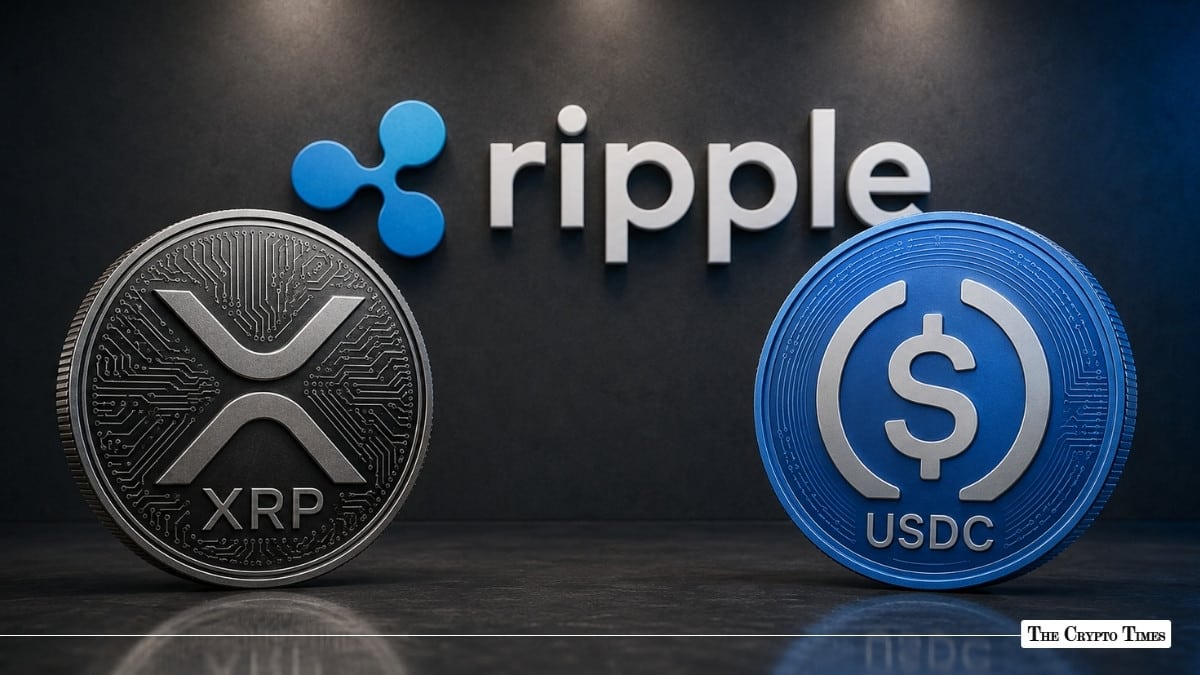
Ripple’s launch of Ripple Mint this week was reported mostly as a product story: APIs, webhooks and multichain access for institutions using Ripple USD. Read as a competitive move, it is something sharper. The name is borrowed from Circle Mint, the incumbent’s own institutional minting product, and it arrives at the precise moment Circle’s business model is under the most serious pressure of its public life.
Whether the same launch does anything for XRP is a separate question; and a much less settled one.
Circle’s exposed flank
To understand why Ripple’s timing matters, look at what Wall Street said about Circle this month. Mizuho Securities downgraded Circle Internet Group from Neutral to Underperform and cut its price target from $85 to $50. The reasoning had nothing to do with USDC losing users. It concerned how Circle makes money.
Circle operates what analysts call a float-capture model: it collects the full income earned on the Treasuries backing USDC and retains a blended share of roughly 38%, paying the remainder to distribution partners. By far the largest of those partners is Coinbase, which receives approximately half of USDC’s reserve income, under a revenue-sharing agreement expected to renew in August. That arrangement was manageable when there was no alternative.
Then Open USD arrived with the opposite structure, keeping only a small management fee and routing nearly all reserve income to its distributors. Mizuho’s argument was that this resets the market price of distribution across the industry: Circle does not need to lose a single customer to lose margin, because its partners can now demand more simply by pointing at the alternative. The bank raised its 2027 distribution-cost forecast from 64% to 73% of revenue and cut its adjusted EBITDA estimate from roughly $1.09 billion to $699 million.
Circle’s vulnerability, in other words, is not adoption. It is that it does not control its own distribution.
Ripple’s structural difference
This is where Ripple Mint becomes more interesting than a feature announcement. Ripple is not primarily a stablecoin issuer that sells through partners. It runs cross-border payments, digital asset custody, prime brokerage and treasury management as businesses in their own right. RLUSD is not a product Ripple hands to a distributor in exchange for most of the float income, it is a component inside a stack Ripple already sells to institutions directly.
Mint extends that logic. By giving institutions API and webhook access to mint, redeem and reconcile RLUSD inside their own systems, Ripple is embedding the token in customer infrastructure rather than renting shelf space from an exchange. There is no equivalent of the Coinbase agreement to renegotiate, because there is no intermediary standing between issuer and institution.
That does not make Ripple’s economics automatically superior, building and staffing an enterprise sales and infrastructure business is expensive, and Circle’s partner model bought it enormous scale quickly. But it does mean Ripple is structurally insulated from the specific problem now compressing Circle’s margins.
The regulatory position reinforces it. RLUSD is issued by Standard Custody & Trust Company, a New York Department of Financial Services-chartered trust company. In Europe, Ripple Payments Europe holds full MiCA authorization from Luxembourg’s CSSF alongside an electronic money institution license, placing it on ESMA’s register among a licensed cohort that has grown to 294 firms. For an institution choosing which dollar token to wire into its payment rails, NYDFS supervision plus EEA passporting is a combination few issuers can match.
The scale reality
None of this means RLUSD is challenging USDC for market position. It is not, and it would be misleading to suggest otherwise.
USDC remains one of the two dominant dollar tokens in a stablecoin market worth roughly $310 billion. RLUSD is a fraction of that size. Circle also holds advantages Ripple cannot replicate quickly: years of accumulated integrations, deep exchange liquidity, and a national trust bank charter approved this month through First National Digital Currency Bank.
The accurate framing is that Ripple is competing for a segment, institutions that want programmable issuance, direct redemption and a regulated issuer with European coverage, rather than attempting to displace USDC wholesale. In a market where issuance is becoming commoditized, winning the integration layer for a slice of institutional flow is a realistic goal. Overtaking Circle is not, at least not on this timeline.
Now the XRP question
The second half of Ripple’s announcement is the part XRP holders care about, and it deserves more scrutiny than it has received.
Ripple says RLUSD’s multichain expansion, onto Base, Optimism, Ink and Unichain, is anchored by the XRPL EVM Sidechain, a design intended to let RLUSD participate in EVM composability while still routing value and activity back to XRP Ledger infrastructure. The company states that XRP will increasingly serve as a complementary asset for liquidity, settlement, swaps, collateral and payments across supported chains.
There is real evidence on the supportive side. More than half of RLUSD’s circulating supply has migrated onto the XRP Ledger, with cumulative XRPL trading volume for the token passing $2.5 billion since launch. In June, Mastercard selected RLUSD and the XRP Ledger for its AI-agent payments initiative — a mandate that puts XRPL infrastructure inside a major card network’s settlement design.
But the skeptical case is straightforward, and it is the same argument the industry has been having about Ethereum all year. XRP is not the fee token on Base, Optimism, Ink or Unichain. RLUSD activity on those networks pays fees in their native economics, not to XRPL. The sidechain provides a bridge and a connection point; it does not automatically convert activity elsewhere into demand for XRP.
That is precisely the tension explored in the Robinhood Chain paradox, where enormous ecosystem success coexisted with almost no economic value flowing to the settlement layer beneath it. Ethereum co-founder Joe Lubin has argued that scale eventually compounds into base-asset demand; critics counter that the settlement layer is being priced at marginal cost while applications capture the economics.
Ripple’s position is the bullish version of that argument, applied to XRP. It may prove correct — the XRPL supply migration and the Mastercard mandate are genuine data points in its favor, and they are more than most Layer 1s can show. But “RLUSD is succeeding” and “XRP is capturing that success” are two claims, not one, and only the first is currently demonstrated.
What to watch
Three measurable signals will settle both halves of this over the coming quarters.
On the Circle side: the August Coinbase renewal. If Coinbase extracts a larger share of USDC reserve income, Mizuho’s thesis is validated and the case for Ripple’s owned-distribution model strengthens considerably.
On the RLUSD side: whether Mint converts into named institutional customers, and whether RLUSD supply growth continues rather than plateauing after the multichain expansion.
On the XRP side: whether the share of RLUSD activity settling through XRPL and the XRPL EVM Sidechain rises as the token spreads to more chains, or falls. That ratio, not the announcement, is the actual test of Ripple’s value-accrual claim. On-chain data will answer it, and it will answer it publicly.
Also Read: Ripple Launches Ripple Mint to Expand RLUSD for Institutions