
US spot Bitcoin exchange-traded funds (ETFs) have recorded a notable four-day streak of net inflows from July 14 to July 17, 2026, totaling several hundred million dollars. This development comes as Bitcoin (BTC) trades near $64,000, testing resistance levels while broader market sentiment remains cautious.
Although the inflows mark a shift from earlier prolonged outflows, analysts caution that it is too early to interpret them as a definitive catalyst for a sustained price rally.
The streak follows an eight-week period of significant redemptions that drained roughly $8 billion from the products earlier in the summer. Total assets under management (AUM) for US spot Bitcoin ETFs stand around $77.74 billion, holding approximately 1.21 million BTC. Cumulative inflows since the ETFs’ launch exceed $51 billion, but recent volatility underscores the uneven nature of institutional demand.
Daily ETF Breakdown and Leadership
BlackRock’s iShares Bitcoin Trust (IBIT) drove much of the recent positive momentum. On July 14, total net inflows reached $181 million, with IBIT contributing $139 million. Flows moderated but remained positive on subsequent days: approximately $108 million on July 15 (IBIT: $81 million), $79 million on July 16 (IBIT: $33 million, supported by Fidelity’s FBTC and Bitwise’s BITB), and $132 million on July 17 (IBIT: $137 million). Smaller funds showed modest or flat activity, while Grayscale’s GBTC and Fidelity’s FBTC occasionally posted outflows, highlighting rotation among products.
This pattern echoes earlier July activity, such as the strong $266 million inflow on July 6, but contrasts with a sharp $425 million outflow on July 13.
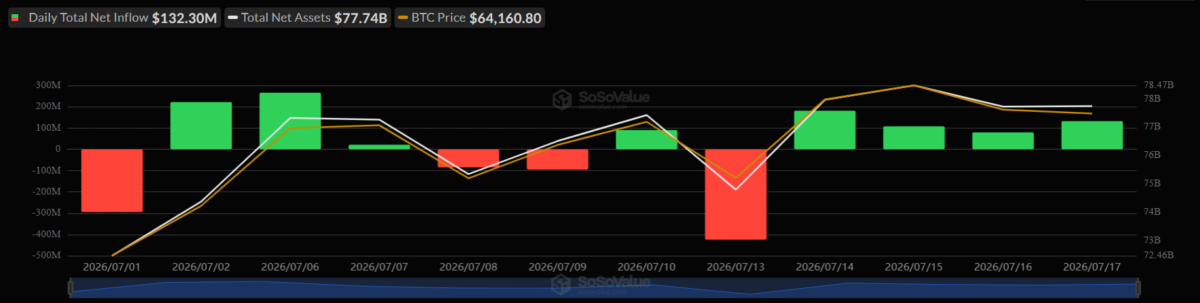
The four-day run represents the most consistent buying since mid-July, yet weekly aggregates for the period ending around July 10–11 showed a more modest $197 million net gain, ending an eight-week negative streak.
Broader Context and Offsetting Factors
Despite the positive days, longer-term trends reveal ongoing pressure. Many funds report negative 30-day flows, and year-to-date figures for the category remain in outflow territory.
Grayscale products, in particular, have seen persistent redemptions linked to higher fees, partially offset by inflows into lower-cost alternatives like Grayscale’s Bitcoin Mini Trust. Participation remains concentrated, with IBIT accounting for a disproportionate share of gains.
External influences, including macroeconomic data releases and geopolitical developments, have contributed to choppy trading. Bitcoin’s price recovered from sub-$60,000 levels in early July but has hovered in the low-to-mid $63,000–$65,000 range, flirting with but not decisively breaking higher resistance.
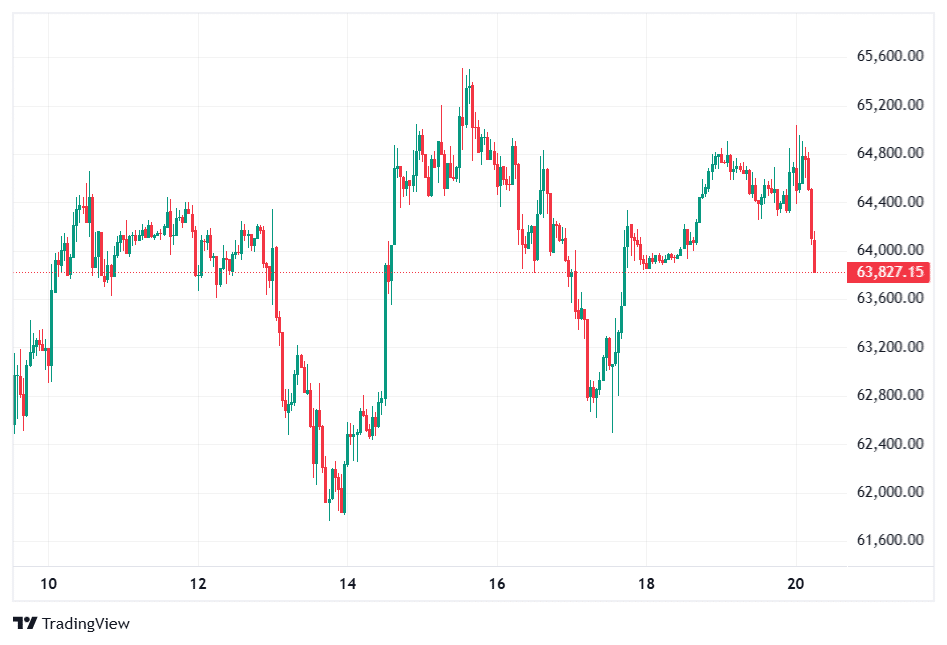
While ETF inflows provide a tailwind by absorbing supply, they have not yet translated into broad-based momentum across all products.
Comparison to Historical Patterns
Past inflow streaks have occasionally preceded price strength, particularly when supported by improving on-chain metrics or rising spot demand. However, similar short-term reversals earlier in 2026 sometimes faded amid renewed selling.
The current episode recovers only a fraction of prior losses, and sustained inflows over multiple weeks would be needed to signal a more structural shift in institutional appetite. Market observers note that ETF activity serves as a useful sentiment gauge but does not operate in isolation from Bitcoin’s spot market liquidity or macro factors.
Price Implications and Market Outlook
Bitcoin’s recent trading near $64,000 reflects a balance between supportive flows and lingering caution. The asset has shown resilience, holding above key technical support despite volatility. Positive ETF inflows can reduce selling pressure by channeling capital into on-exchange purchases, potentially aiding short-term upside if the streak continues.
That said, several caveats temper optimism. First, the inflows are modest relative to the scale of earlier redemptions and the overall AUM. Second, concentration in a few dominant funds raises questions about broader conviction. Third, Bitcoin’s price action remains range-bound, with $65,000 acting as notable resistance. A clean breakout would likely require additional catalysts, such as favorable economic data or increased retail/on-chain participation.
For now, the four-day inflow streak from July 14–17 represents a constructive development in an otherwise challenging period for Bitcoin ETFs. It highlights returning institutional interest, particularly through leading products like IBIT, and aligns with Bitcoin’s attempts to stabilize above $63,000–$64,000. However, framing it as a definitive setup for the next major leg higher would be premature.
Also read: Crypto Loses Over $20M in a Week as Ostium, Across, Cascade Get Hacked