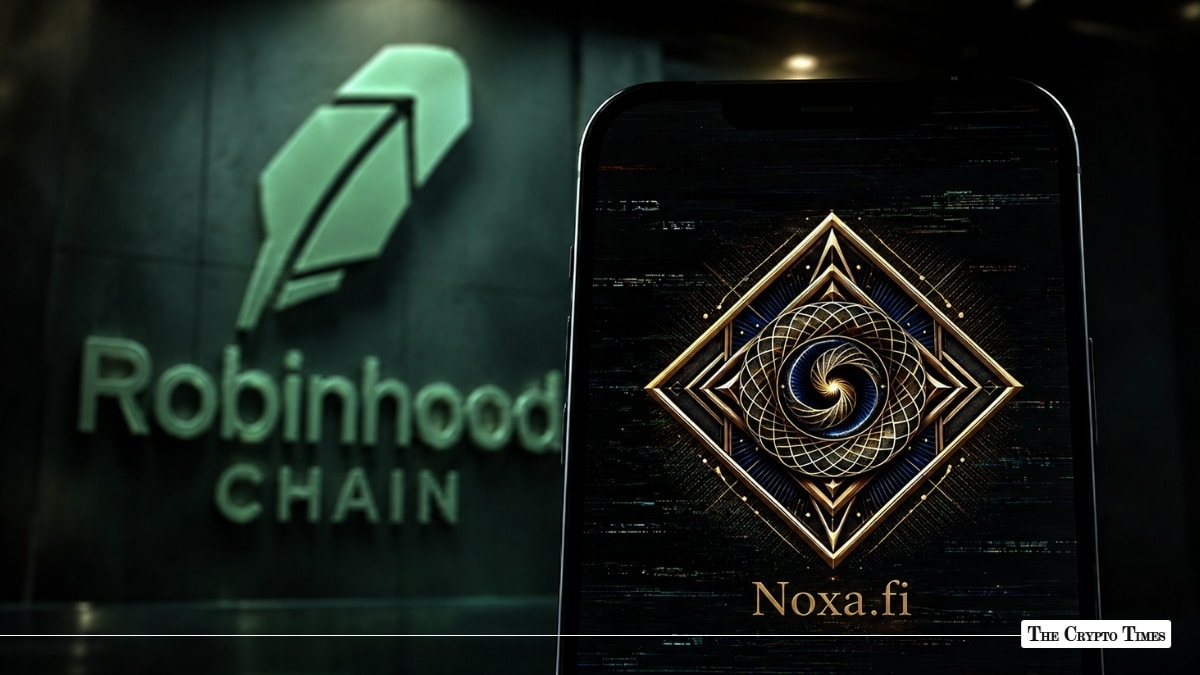
NOXA, the launchpad responsible for roughly three-quarters of all token deployments on Robinhood Chain, stopped accepting new launches on July 11 and has since lost control of its own domains, leaving the network’s memecoin economy without the infrastructure that built it.
How It Unfolded
The sequence took less than a week. On July 11, with trading in Robinhood Chain’s flagship memecoin CASHCAT at peak volume, NOXA announced it would stop accepting new token launches, citing bots spamming and copying new tokens every hour, low-quality token floods, and infrastructure straining under traffic.
Two days later the website went dark entirely, serving maintenance pages and 503 errors. The team attributed the outage to a Cloudflare issue and said funds remained safe on-chain.
By July 14 the platform had resurfaced as a stripped-back page carrying the message “People loved the cat, it has been liberated,” alongside an announcement that 100% of ongoing trading fees would go to token creators rather than the platform. It also burned 40% of its own token supply.
Then the domains went. In a post on July 16, NOXA said that after its domains were taken down, its registrar “had apparently resold them or taken over them, still unclear,” adding that it is “not in control of the original domains anymore” and that the only working interface is currently hosted on ENS.
The Concentration Problem
The scale of what stopped is the reason it mattered. NOXA had deployed more than 60,000 tokens and captured roughly 75% of all token deployments on Robinhood Chain, pulling 267,642 unique wallets onto a network that had only gone live on July 1.
It collected close to $12 million in cumulative fees in about two weeks, according to DefiLlama figures, with some trackers putting the total nearer $14.5 million. For five consecutive days, its daily protocol fees exceeded those of Pump.fun, the Solana launchpad that has served as the category’s benchmark.
That performance made NOXA the engine behind Robinhood Chain’s early numbers rather than a participant in them. The chain crossed $4 billion in cumulative DEX volume in under two weeks, and Dune data showed 19,586 new memecoins created on Robinhood Chain on July 13 alone, second only to Solana’s 23,096.
When the launchpad producing most of that flow stopped, the ecosystem’s tokens fell with it. CASHCAT dropped more than 33% in a single 24-hour period and has since lost close to three-quarters of its peak value, with other ecosystem tokens following.
The Soft Rug Accusation and What the Chain Shows
Traders reacted by accusing the team of a “soft “rug”—walking away from a profitable platform without formally stealing anything. The suspicion was straightforward: a platform generating millions in weekly revenue does not usually stop voluntarily.
The on-chain record complicates that reading. NOXA’s contracts deploy each new token with single-sided liquidity into a Uniswap V3 pool at the 1% fee tier, with the liquidity position permanently locked in a locker contract. That structure means the team cannot withdraw pooled liquidity, which is the mechanism behind a conventional rug pull.
Creator fee claims have continued to function, CASHCAT still trades on Uniswap with its liquidity locked, and no evidence has emerged of funds being removed from the platform’s smart contracts. A community post-mortem circulated after the shutdown found no direct evidence supporting the revenue-split dispute rumored to have caused it.
The available facts are consistent with a team halting a platform it could no longer operate rather than one extracting value on the way out — the redirection of all fees to creators cuts against an exit-scam reading. What was lost was not custody of funds but the interface: discovery, deployment and the attention that sustained the tokens.
The Successors Have Their Own Problems
The more troubling signal is what happened next. Rival launchpads moved quickly to absorb NOXA’s flow, and two of the most prominent immediately ran into trouble of their own.
Vlad.fun, a launchpad named after Robinhood chief executive Vlad Tenev, announced days later that it was pausing operations after discovering what it described as “a serious internal integrity issue at launch involving members of our team,” adding that its legal team was involved.
Pons, a rival that had existed for two days before becoming the chain’s leading launchpad, spent that same period responding to reports of a front-end token-approval bug. Other platforms, including flap.sh, trensh.today, and bankr, have picked up share.
The pattern is that Robinhood Chain’s token-creation layer has produced three separate failures in roughly a week—an infrastructure collapse, a self-declared internal integrity problem, and a front-end vulnerability—across the three platforms that have held the top position.
What It Means for the Chain
Robinhood built the network for tokenized real-world assets, which currently account for roughly $12.66 million in market capitalization on the chain. At its peak, CASHCAT alone was worth more than twelve times that figure, and NOXA was the mechanism converting that speculation into network activity.
That leaves an uncomfortable dependency. A permissionless chain cannot control which applications succeed on it, and Robinhood has no direct role in NOXA’s operation or failure. But the metrics that established Robinhood Chain as a credible network—transaction counts, active addresses, and DEX volume—were substantially produced by a single third-party application that has now lost its domains.
Whether the chain’s activity recovers depends on whether a successor stabilizes before the attention that drove the initial run moves elsewhere. On the evidence of the past week, no replacement has yet demonstrated it can hold the position without breaking.
Also read: The Robinhood Chain Paradox: Built for Tokenized Stocks, Dominated by Memecoins