As the 2026 FIFA World Cup final approaches on July 19 at MetLife Stadium in New Jersey, prediction market giant Polymarket is seeing intense activity around the decisive match.
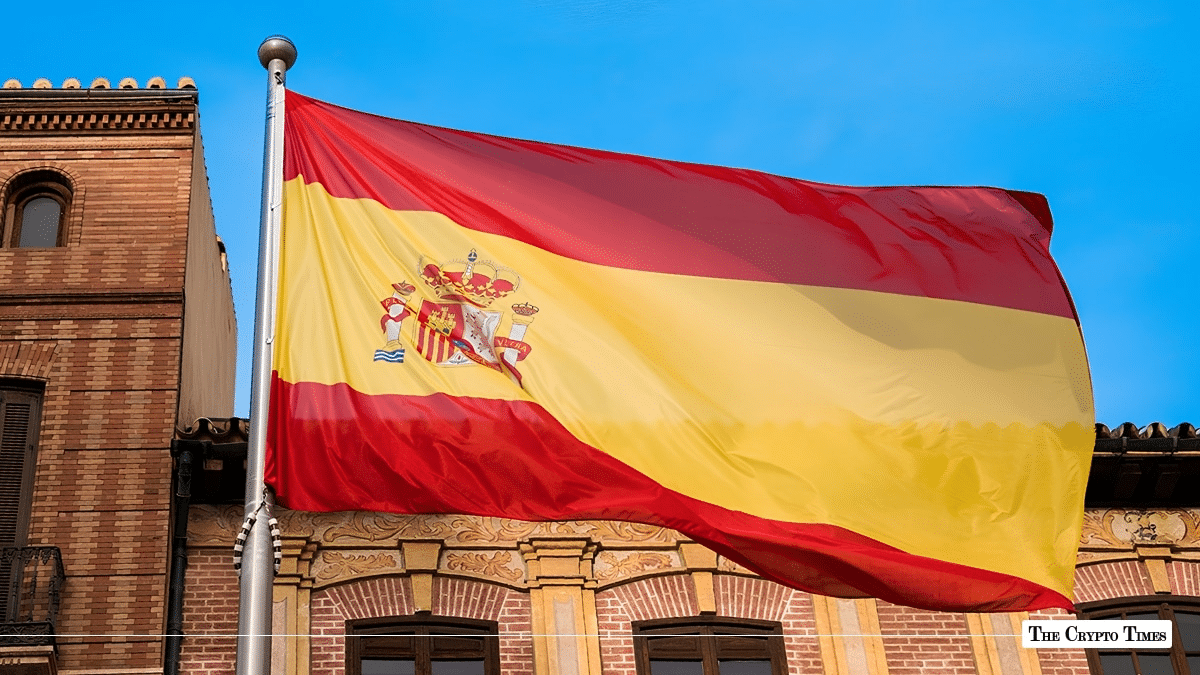
With Spain and Argentina emerging as the finalists in a historic first-ever clash between the two powerhouses, traders are positioning themselves on outcomes ranging from the exact matchup to the ultimate champion. This frenzy underscores how decentralized prediction platforms have become a global barometer for major sporting events.
The dedicated “World Cup: Finals Exact Matchup” market, launched in early July, has already amassed approximately $363,000 in total trading volume. Spain vs. Argentina is currently priced at or near 100¢, reflecting near-certainty among participants following the semifinals. Other combinations, such as France vs. Argentina or Spain vs. England, have seen meaningful but smaller volumes in the tens of thousands.
Complementing this, the broader “World Cup: Nation to Reach Final” suite of markets has generated roughly $13–14 million in cumulative volume since opening in April. Individual team contracts within this category show heavy interest, with top contenders drawing hundreds of thousands in trades each. Liquidity remains robust, allowing for large positions even as the field narrows dramatically.
Overall Tournament Winner Market Hits Historic Heights
The flagship “2026 FIFA World Cup Winner” market stands out as Polymarket’s biggest-ever sports event contract. It has surpassed $4.2 billion in lifetime trading volume, eclipsing the 2024 U.S. presidential election winner market and setting a new benchmark for single-event prediction trading. Recent 24-hour volumes have hovered around $20–30 million, with Spain favored at around 59% and Argentina at roughly 40% in the latest pricing.
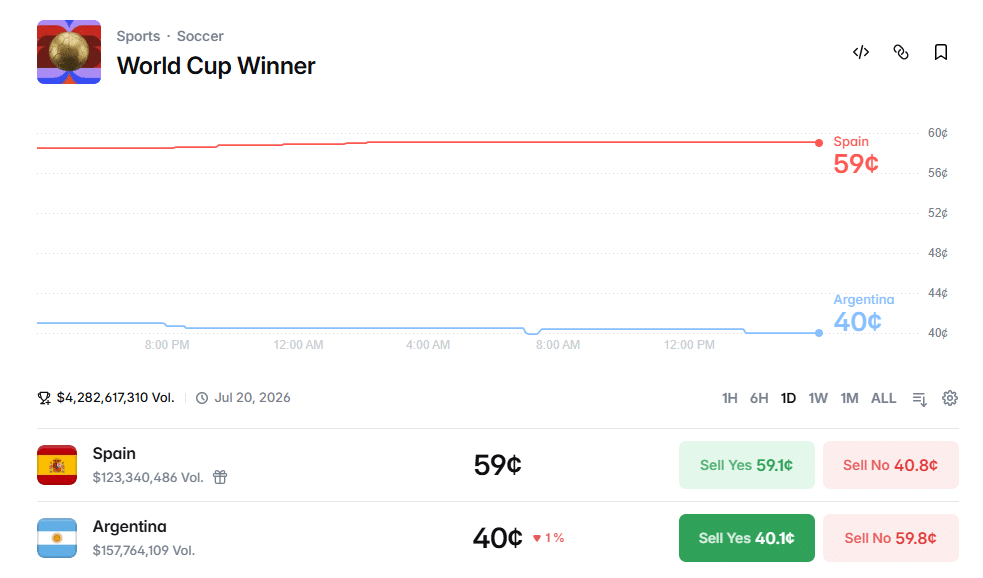
Both these teams have amassed a cumulative volume of $123 million and $157 million respectively.
This massive capital inflow highlights several trends. First, the expanded 48-team format and high-stakes knockouts created sustained volatility that kept traders engaged from group stage through semifinals. Second, Polymarket’s transparent, decentralized structure attracted both retail enthusiasts and sophisticated bettors seeking an edge over traditional sportsbooks. Third, the platform’s integration of real-time odds based on crowd wisdom has proven remarkably accurate, often aligning closely with expert consensus and on-field developments.
Analysts note that the final itself represents the highest-conviction, lowest-uncertainty moment of the tournament. As uncertainty collapses into a binary (or near-binary) outcome, liquidity concentrates and prices tighten. Related prop markets—covering exact scores, player performances, and even broadcast appearances—are also drawing fresh capital in the lead-up to kickoff.
The surge in FIFA-related trading has contributed to broader platform records. Polymarket’s international exchange posted over $10.8 billion in monthly volume during June alone, largely fueled by World Cup enthusiasm. Industry observers suggest this event validates prediction markets as a legitimate parallel to conventional wagering, offering global access, low fees, and rapid settlement via blockchain.
With kickoff just hours away, activity is expected to spike further. Traders will closely monitor any last-minute news on team news, weather, or officiating. Regardless of the result, the 2026 World Cup has already cemented Polymarket’s status as a premier destination for high-stakes sports forecasting. The final outcome will not only crown a champion on the pitch but also validate—or challenge—the collective intelligence of millions in trading volume.
Also read: France Escalates to ISP Block After Polymarket Ban Fails to Stop Traffic