Key Highlights
- Rep. Tim Moore said regulatory uncertainty under the previous administration pushed crypto companies overseas.
- Blockchain firms told lawmakers the CLARITY Act is essential for infrastructure projects, not just crypto exchanges.
- Helium Mobile cited its SEC lawsuit as an example of why developers need clearer legal definitions.
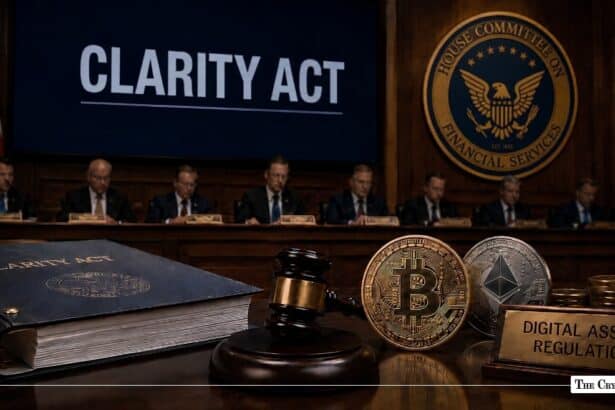
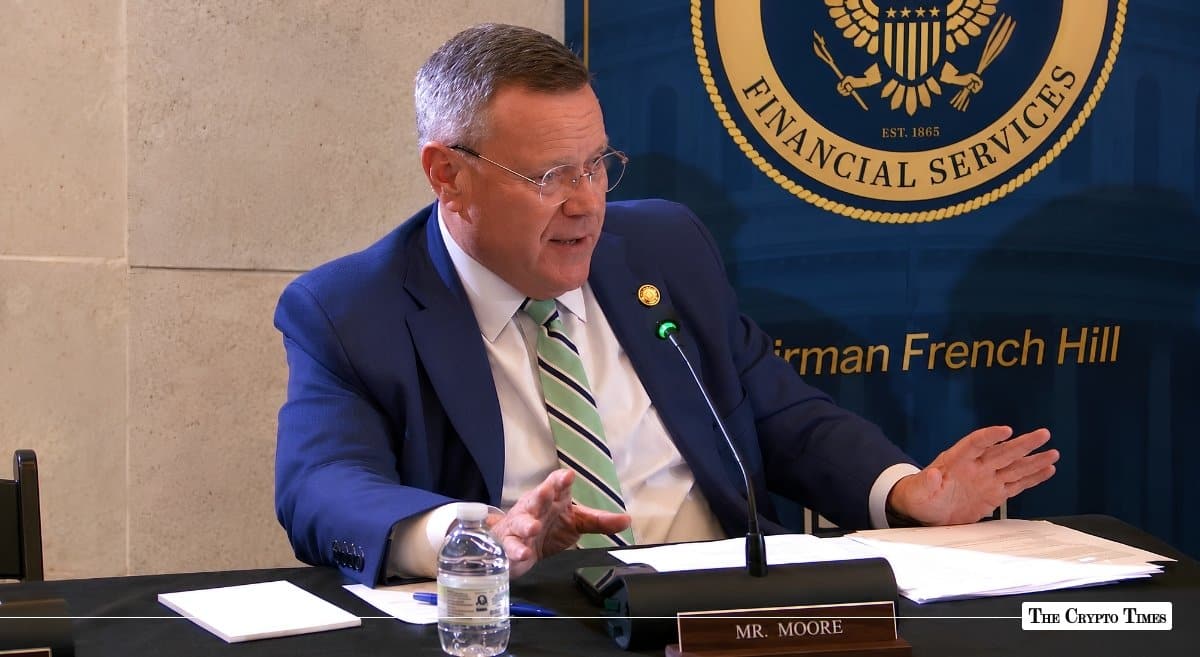
U.S. Representative Tim Moore said Congress must move quickly to advance the CLARITY Act, arguing that years of regulatory uncertainty have already pushed blockchain companies outside the United States.
Speaking during a House Financial Services Committee hearing on digital assets on Friday, Moore said crypto has become too widely adopted to continue operating without clear federal rules.
“Roughly a third of all Americans either own or use digital assets in some manner. So this isn’t some fleeting thing that’s going to go away,” Moore said.
While acknowledging that emerging technologies carry risks, Moore argued that lawmakers are attempting to regulate the industry rather than suppress it.
“So there’s inherent risk in certain technologies, but the guidelines and the proposals and the law that’s being worked on with respect to, of course, the GENIUS Act and then CLARITY are designed to do that,” he said.
He added that the lack of clear rules during the previous administration made it understandable why many crypto companies chose to expand abroad.
Infrastructure projects need legal certainty
During the hearing, Sarah Aberg, Chief Legal Officer at Nova Labs, the company behind Helium Mobile, argued that the CLARITY Act is equally important for blockchain infrastructure developers. She pointed to the SEC’s lawsuit against Nova Labs as an example of how existing securities laws have been applied to decentralized network projects.
According to Aberg, regulators alleged that Helium’s wireless hotspots, and even users who voluntarily contributed network mapping data in exchange for tokens, constituted unregistered securities offerings. “We’re trying to build infrastructure. We’re not trying to raise capital through selling tokens,” she said.
Aberg explained that Nova Labs never conducted public token sales and argued that blockchain networks using tokens to operate functional systems should instead fall under the Commodity Futures Trading Commission (CFTC).
She stressed that the legislation is not intended to eliminate oversight. “I don’t think CLARITY is a call for deregulation. I think it’s a call for the right regulation by the right regulator,” Aberg said.
According to Aberg, blockchain companies need legislation passed by Congress rather than regulatory interpretations that can shift with leadership changes. “We need the certainty of legislation codified into law that cannot be changed at the whim of whoever happens to be sitting at the SEC or the White House.”
Industry warns US risks falling behind
Aberg also warned lawmakers that several jurisdictions have already established clearer digital asset frameworks, making them increasingly attractive to blockchain companies.
She cited the European Union, Singapore, Hong Kong, the United Kingdom, and the United Arab Emirates as markets actively competing for blockchain innovation through regulatory clarity.
Former CFTC Chairman Tim Massad echoed that concern, arguing that crypto markets have evolved beyond existing regulations and require Congress to establish a modern framework. “I think the key lesson is… recognizing there’s something novel here and that the markets are developing in a way that requires some kind of regulation,” Massad said.
He also defended preserving decentralized finance within future legislation, saying permissionless networks remain one of blockchain’s core innovations.
French Hill calls CLARITY the missing piece
Moore’s comments came just hours after House Financial Services Chairman French Hill described the CLARITY Act as the final component needed to complete the United States’ digital asset regulatory framework.
Hill said the GENIUS Act establishes rules for stablecoins, but broader legislation is still needed to define how digital asset markets should be regulated. His remarks signal growing pressure from House leadership to advance market structure legislation alongside the stablecoin framework.
Crypto industry awaits Senate action
With the GENIUS Act now providing a federal framework for payment stablecoins, industry participants increasingly see the CLARITY Act as the legislation that will determine whether the broader U.S. digital asset industry receives the regulatory certainty it has sought for years.
The hearing highlighted growing bipartisan recognition that the debate is no longer about whether blockchain technology will continue developing, but whether the United States can provide clear enough rules to keep that innovation at home rather than watching it migrate to overseas jurisdictions.
Also Read: Ex-CFTC Commissioner Says CLARITY Act Could Prevent Another FTX