Elon Musk’s Space Exploration Technologies Corp. (SPCX) is set to be added to the Nasdaq-100 index before the opening bell on Tuesday, July 7, 2026, according to an official Nasdaq press release.
The inclusion is historic on two counts. First, SpaceX is the first company ever added under Nasdaq’s new fast-track rule, which permits certain IPOs to join the index after just 15 trading days rather than the standard seasoning period. Second, the addition happens without any existing member being dropped, meaning the Nasdaq-100 will temporarily hold more than 100 constituents.
SpaceX debuted on Nasdaq on June 12, 2026, pricing 555.6 million shares at $135 in the largest IPO in history, raising roughly $75 billion. The stock opened at $150, closed its first session at $160.95, and touched an all-time high of $225.64 on June 16.
S&P Global, by contrast, has confirmed it will wait at least a year before considering SPCX for the S&P 500.
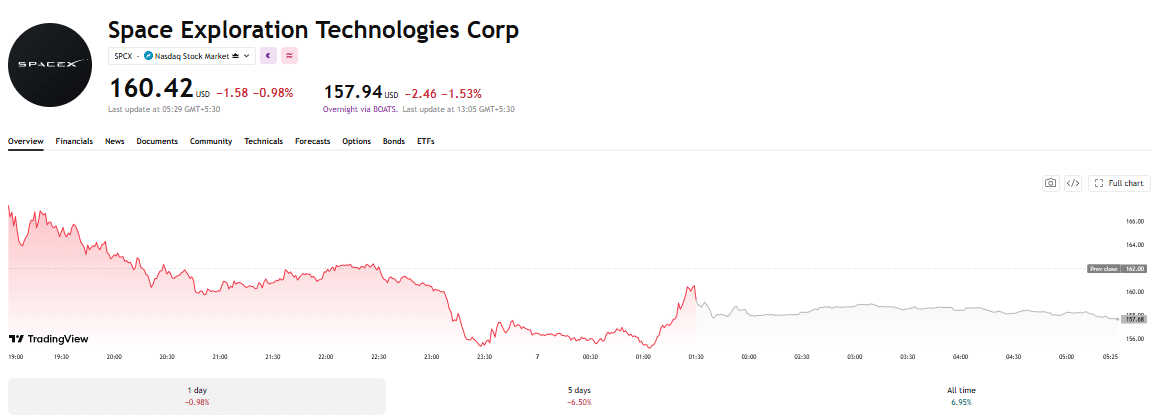
Heading into inclusion day, SPCX last traded at $160.42, down 0.98% from the previous close of $162.00, with overnight BOATS pricing indicating a further decline to $157.94 (down 1.53%).
The stock is down 6.50% over the past 5 days and remains roughly 29% below its all-time high, with a market capitalization of around $2.11 trillion and a public float of only 3% to 5% of total outstanding shares.
Also Read: How to Buy SpaceX Stock (SPCX) on Crypto Exchanges: Tokenized Shares and Perpetuals
The 18,712 BTC That Now Sits Inside the Nasdaq-100
Per SpaceX’s SEC filings (Form S-1 and Form 8-K), the company holds 18,712 BTC on its balance sheet, acquired at a total cost basis of approximately $661 million, or roughly $35,300 per coin. The position was marked at a fair value of $1.293 billion as of March 31, 2026, and is currently worth approximately $1.2 billion at Bitcoin prices near $62,000 to $64,000.
The holdings are custodied through third-party regulated custodians, which is why on-chain analytics firms had underestimated the position at around 8,285 BTC. SpaceX ranks between 7th and 11th globally among corporate Bitcoin holders, and the position has been unchanged since the end of 2024, with no new buys or sales.
SpaceX has now become the fourth Nasdaq-100 component to hold Bitcoin on its balance sheet, joining Strategy (MSTR), Tesla (TSLA), and another treasury holder.
Under the FASB accounting rules that took effect in 2024, corporate Bitcoin holdings must be marked to market every reporting period. That means every $10,000 move in the BTC price translates to roughly $187 million in unrealized gain or loss on SpaceX’s income statement. In practice, SPCX now carries partial characteristics of a Bitcoin proxy stock, without being a Bitcoin ETF.
Why Millions Are About to Own Bitcoin Exposure Without Choosing To
More than $800 billion is benchmarked to the Nasdaq-100, sitting behind the Invesco QQQ Trust (QQQ) and a long list of 401(k), IRA, pension, and retirement funds. The moment SPCX enters the index, every one of these funds is required to hold it in proportion.
J.P. Morgan estimates the mechanical demand from QQQ alone at approximately $4.3 billion, with total Nasdaq-100 and Russell tracker demand landing in the $22 billion to $27 billion range, according to ETF.com estimates. Much of that buying is expected to concentrate at the close on July 6, ahead of the effective date.
Because SpaceX enters the index at a weighting of less than 1% despite its $2 trillion-plus market cap (due to the index’s modified weighting method), the passive flow will not dominate the index itself. But it will hit SPCX hard given the thin float.
Every retirement saver, index-fund investor, and pension participant whose portfolio tracks the Nasdaq-100 will indirectly own a share of 18,712 BTC starting Tuesday, whether they wanted crypto exposure or not.
The Historical Warning: Index Inclusion Often Marks the Top
Multiple market analysts have flagged a critical caution: history shows Nasdaq-100 inclusions frequently coincide with cycle peaks, not new legs higher.
The clearest parallel is Strategy (MSTR), the largest publicly traded Bitcoin holder. Strategy officially joined the Nasdaq-100 on December 23, 2024. By then, the stock had already peaked near $543 in November 2024 with Bitcoin trading around $100,000. Today, MSTR trades around $100, a roughly 80% correction from its peak. Palantir Technologies (PLTR), added on the same date, has similarly pulled back sharply from its late-2025 highs by mid-2026.
SPCX is already down about 28% from its all-time high before inclusion has even taken effect.
The Lockup Cliff Approaching August 6
There is a second overhang that traders need to price in. Per Axios, the first meaningful lockup release begins after the quarter ending June 30, 2026, with as many as 912 million shares potentially becoming eligible to trade over time.
The first tranche unlocks around SpaceX’s earnings report on August 6, 2026, when approximately 20% of insider shares become saleable. An additional 10% unlocks if SPCX trades 30% above its $135 IPO price for 5 of any 10 consecutive trading days, with further staggered tranches through December 2026.
Between now and August 6, the float remains nearly static, which is exactly what amplifies the impact of forced index buying. After that date, that dynamic reverses.
Crypto Markets Have Already Been Trading SpaceX Around the Clock
The digital asset industry did not wait for Nasdaq to run the SpaceX trade. Before July 7, SPCX exposure was already available across four distinct crypto instruments: Solana-native tokens backed 1:1 by shares in regulated custody from Backpack Securities, 1:1 trackers on Ethereum and Solana from Ondo Finance, xStocks tracker certificates distributed by Kraken parent Payward across Bybit and other exchanges, and SPCX perpetual futures on Coinbase and Hyperliquid, where the SPCX-USDC perp was trading around $172 to $176 in the days after IPO.
The stress test hit before the stock did. Binance Wallet’s tokenized subscription campaign raised $557 million from 27,689 wallet addresses, one of the largest tokenized offerings ever. The xStocks provider then received a smaller pre-IPO share allocation than expected, and Binance, Bybit, and Bitget were forced to refund customers in full, with Binance distributing a $1 million consolation allocation via bStocks.
When SPCX slid below its $150 opening level in late June, leveraged longs paid up. More than $50 million in SPCX perpetual liquidations occurred over 48 hours, briefly ranking the contract behind only Bitcoin and Ethereum among crypto derivatives.
The Bottom Line
SpaceX’s Nasdaq-100 entry on July 7 is a genuine structural event, not just an index-committee headline. Millions of passive investors are about to hold a slice of one of the largest corporate Bitcoin treasuries on Wall Street without ever placing that trade themselves. The $4.3 billion in forced buying into a stock with a 3% to 5% public float should provide near-term support.
But history is clear that Nasdaq-100 inclusions often mark the celebration, not the launch. With SPCX already down 28% from its highs and the August 6 lockup release approaching, the days after Tuesday will decide whether index demand can absorb the coming supply or whether the SpaceX trade follows the MSTR playbook. For crypto, SPCX is now a live proxy for Bitcoin sentiment on Wall Street.
Also Read: MSTR Opens 4.5% Lower on Nasdaq After Strategy Sells Bitcoin