
Bitcoin has staged a notable recovery, surging above the $63,000 mark in early July trading and reversing losses accumulated at the end of June. As of July 7, 2026, BTC was trading around $63,200–$64,000, up approximately 2% over the past 24 hours amid renewed market optimism.
The rebound comes after Bitcoin dipped near or below key support levels in late June, reflecting broader market caution influenced by macroeconomic factors, including tariff concerns and equity market volatility.
A key catalyst for the positive momentum has been institutional demand through U.S. spot Bitcoin ETFs. On July 6, these products recorded approximately $266 million in net inflows, marking a strong start to the week and signaling a potential shift in investor appetite following earlier outflows.
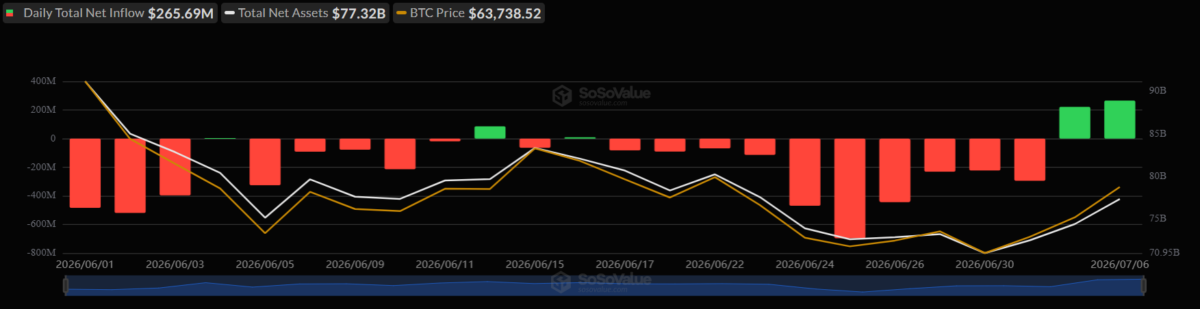
BlackRock’s iShares Bitcoin Trust (IBIT) led the charge with roughly $209 million in inflows — its first notable positive day after an 11-day streak of net selling. Fidelity’s FBTC and other funds contributed, with combined daily flows reaching about $265.7 million. Cumulative net inflows for U.S. spot BTC ETFs now exceed $51 billion since launch.
Market observers interpret the ETF resurgence as evidence of institutional re-engagement, particularly as Bitcoin holds above critical moving averages. Broader crypto market sentiment has improved modestly, with total market capitalization stabilizing. Ethereum ETFs also saw modest gains of around $29 million on the same day.
Monday’s Sharp Volatility After Strategy’s Major Bitcoin Sale
Monday, July 6, brought significant intraday volatility to Bitcoin following a major announcement from Strategy (formerly MicroStrategy). The company, led by Executive Chairman Michael Saylor, disclosed it had sold 3,588 BTC for approximately $216 million — its largest Bitcoin liquidation in history. The proceeds were used to fund dividends on its preferred securities and support corporate liquidity under a new “Digital Credit Capital Framework” announced in late June.
The news triggered an immediate negative reaction. Bitcoin dropped below the $62,000 level in the hours following the announcement, trading as low as the low-$61,000s amid heightened selling pressure and liquidations. Strategy shares also fell initially before stabilizing.
However, the dip proved short-lived. Bitcoin swiftly recovered, climbing back above $62,000 and into the $63,000 zone by Tuesday morning. Analysts noted that while the sale marked a notable shift from Strategy’s long-standing “never sell” stance, the company still holds a massive treasury of roughly 843,775 BTC. The swift rebound was supported by short covering, bargain hunting, and the positive ETF inflows reported the same day.
Technical Analysis: Reclaiming Key Levels After Recent Lows
From a technical perspective, Bitcoin has shown resilience after testing multi-month lows. The cryptocurrency briefly approached the $58,000 zone in early July — its weakest level in over 21 months — before staging a strong rebound.
Key support now sits in the $61,000–$62,000 area, which held during Monday’s volatility and acted as a springboard for the recovery. Resistance levels to watch include $64,000–$65,000, followed by $67,000. A sustained break above $65,000 could open the door for a move toward $68,000–$70,000 in the near term.
On the daily chart, Bitcoin has reclaimed the 50-day and 100-day moving averages in recent sessions, a bullish technical signal. Momentum indicators such as the Relative Strength Index (RSI) have moved out of oversold territory, though they remain neutral rather than strongly bullish.
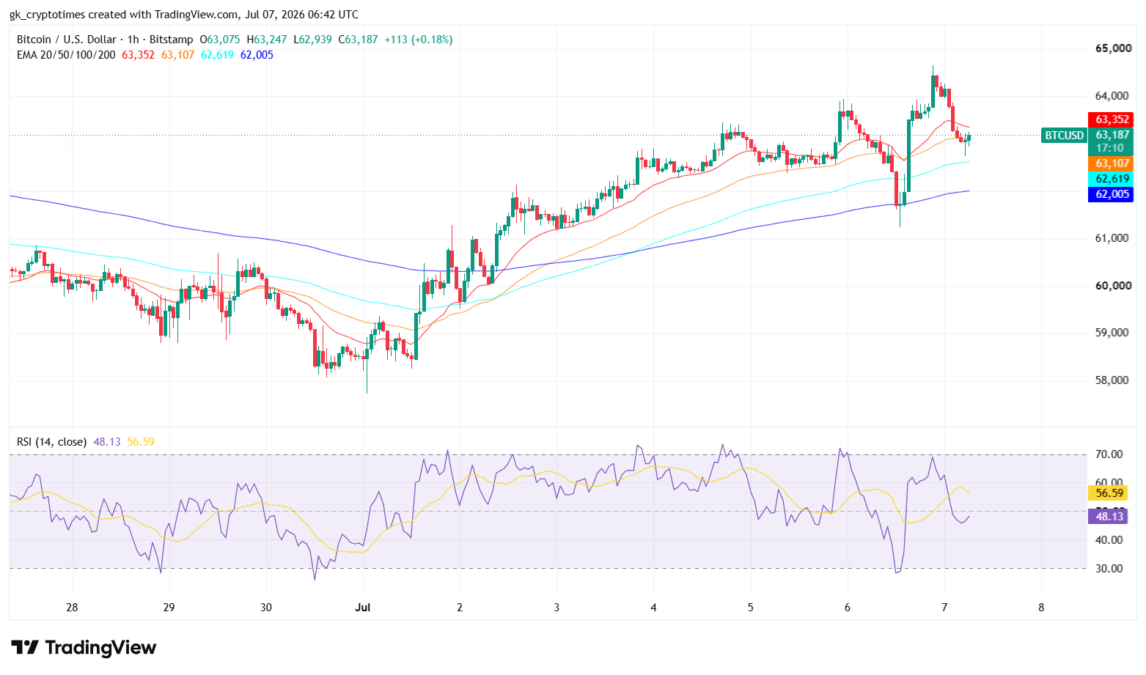
Trading volume has picked up during the rebound, particularly on green candles, suggesting genuine buying interest rather than a dead-cat bounce. The interplay between price action and on-chain metrics shows accumulation by long-term holders, while ETF flows provide additional confirmation of institutional interest returning at these levels.
Broader Market Updates and Outlook
The broader cryptocurrency market has mirrored Bitcoin’s volatility but shows signs of stabilization. Total crypto market capitalization has begun to recover modestly after shedding value earlier in 2026. Ethereum (ETH) has traded in tandem with Bitcoin, hovering around the $1,700–$1,800 range with modest gains alongside the spot ETH ETF inflows.
Other major assets, including Solana, XRP, and BNB, have seen mixed performance, with some altcoins showing relative strength as capital rotates within the sector. Macro factors remain influential: ongoing uncertainty around U.S. tariffs, interest rate expectations, and equity market movements continue to affect risk assets, including crypto.
Despite Bitcoin remaining well below its 2025 all-time high near $126,000, the recent ETF inflows and swift recovery from Monday’s dip offer encouraging signals. Analysts are divided on the near-term path. Some expect consolidation between $61,000 and $65,000 as the market digests Strategy’s evolving capital strategy and awaits further macroeconomic clarity. Bullish voices, however, point to sustained institutional buying and potential positive regulatory developments as catalysts for a move toward $70,000 in the coming weeks.
As Bitcoin demonstrates resilience above $63,000, the interplay between price action, institutional flows via ETFs, and corporate treasury decisions underscores its maturing role in global finance. While challenges from macroeconomic headwinds and shifting corporate strategies persist, early July data provides cautious optimism for bulls hoping this marks the beginning of a broader summer recovery.
Also read: BonkDAO Hit by $20M Treasury Drain in Governance Attack, BONK Slides