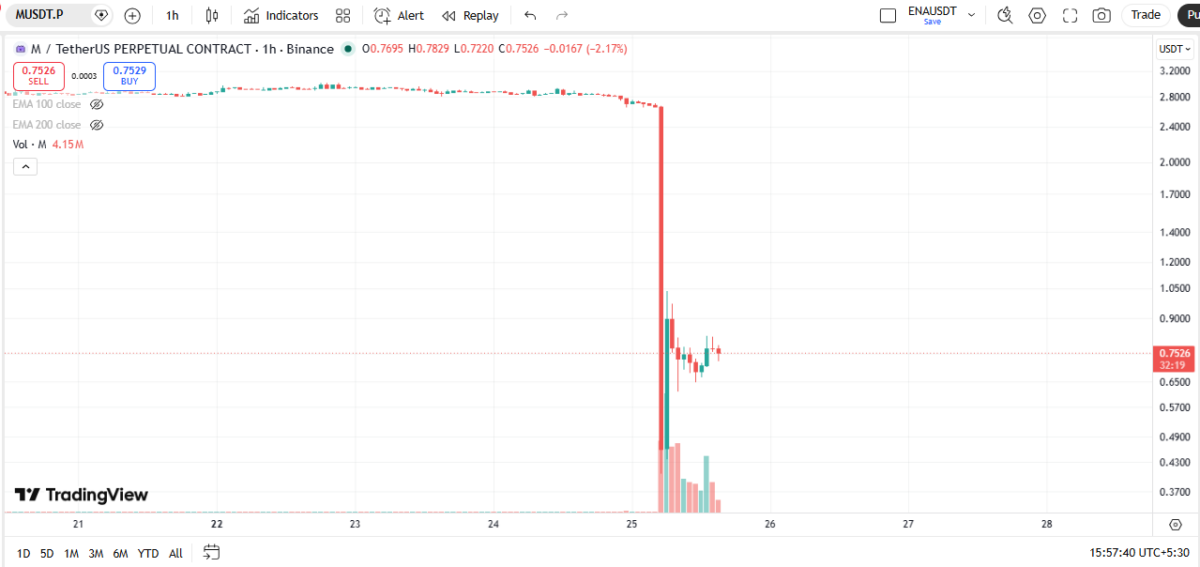
The native token of MemeCore, a Layer-1 marketed for a “Meme 2.0 economy,” collapsed more than 75% across major centralized exchanges on June 25, and the investigator who had questioned the project for months said the crash was the red flags catching up with it.
A vertical drop, and a familiar warning
The fall was steep and fast. $M dropped from recent levels near $2.80 to intraday lows around $0.51–$0.60 before a partial recovery toward $0.69, cutting its fully diluted valuation from roughly $14 billion to about $3.8 billion within hours and knocking it out of the top 25 tokens by market capitalization. No hack, smart-contract exploit, or project announcement has been identified as the trigger.
Into that vacuum stepped ZachXBT, who addressed the crash on his Investigations Telegram channel. He wrote that he, along with analysts Mlm and Wazz, had “previously highlighted a number of red flags on X about MemeCore with inorganic supply concentration and deceptive practices by its team to boost user numbers.” His framing was pointed: this was not a bolt from the blue, but the predictable unwinding of problems that were visible all along. The post drew hundreds of reactions within hours, a measure of how much the warnings had circulated before the drop.
The on-chain emptiness beneath a $14 billion token
The core of ZachXBT’s argument is the gap between the token’s exchange valuation and its activity on-chain. He cited Arkham Intelligence data showing not a single on-chain transfer above $50,000 on BNB Smart Chain in more than two weeks and Dexscreener figures indicating total decentralized-exchange liquidity on BSC below $100,000.
For a token that carried a multibillion-dollar valuation, those are strikingly thin numbers, and they point to a structural conclusion: both the earlier rally and the sudden collapse were driven overwhelmingly by trading on centralized platforms rather than organic demand or on-chain use.
When almost nothing moves on the blockchain itself, the price becomes a function of a handful of venues and a concentrated holder base, a setup in which a valuation can stay elevated until selling pressure from insiders appears, then fall with little beneath it to cushion the drop.
ZachXBT had made a related point in April, when, with the token at elevated levels, he questioned how it reached top-tier rankings while data indicated more than 90% of supply sat with insiders or a small cluster of wallets.
The question ZachXBT put to the exchanges
The sharpest part of his post was aimed not at the project but at its venues. ZachXBT said “the community needs answers from Binance & Bybit about why M was listed for perps and why Kraken & Bitget listed M spot,” arguing that “these highly manipulated tokens continue to give our industry a bad reputation and extract from retail.” $M had been listed for spot trading on Kraken and Bitget in July 2025, followed by perpetual-futures listings on Binance and Bybit — and it was in those perp markets that the crash triggered significant liquidations.
That criticism lands on an unresolved industry tension: exchange listings confer legitimacy and provide price-discovery venues that can dwarf what a token’s on-chain liquidity would support, which is precisely what makes due-diligence standards for low-float, heavily concentrated tokens contentious.
The pattern is not unique to MemeCore; ZachXBT noted parallels to tokens like RAVE, which rallied sharply before steep collapses once concentrated holders began selling. None of the named exchanges, nor the MemeCore team, had issued a detailed public response as of publication.
It is worth keeping the boundaries of the claim clear. The supply-concentration and “deceptive practices” characterizations are ZachXBT’s assessments, supported by the third-party data he cites, and the MemeCore team has continued to promote its vision of long-term infrastructure for meme culture. No regulator or court has made findings, and no exploit has been alleged. What is not in dispute is the shape of the move: a token valued in the billions, with almost no on-chain footprint, that lost three-quarters of its value in a single session, and an investigator saying, with the receipts, that he had seen it coming.
Also Read: ATM Token Exploit Drains $243K Through Hidden Swap Loophole