Prominent blockchain investigator ZachXBT has once again waded into the memecoin fray, this time directing pointed questions at MemeCore and its native $M token.
On April 20, 2026, the onchain sleuth responded sarcastically to the project’s boast of appearing on a Grayscale chart, posting: “Officially recognized on @ZachXBT. We’re just getting started.” He attached screenshots showing $M’s roughly $6 billion market capitalization—briefly landing it near the top 20 tokens—and included the asset on his list of what he considers manipulated tokens.
The investigator’s core objection remains focused on extreme insider concentration, just as highlighted in the recent RaveDAO episode. His findings suggest insiders and early holders control over 90% of the supply, with a relatively thin circulating float against a total supply of around 5.35 billion tokens.
ZachXBT pressed for any single fundamental metric that could justify the lofty fully diluted valuation, echoing concerns he has voiced about low-float, high-FDV projects prone to sharp reversals.
RaveDAO’s spectacular collapse provides stark context
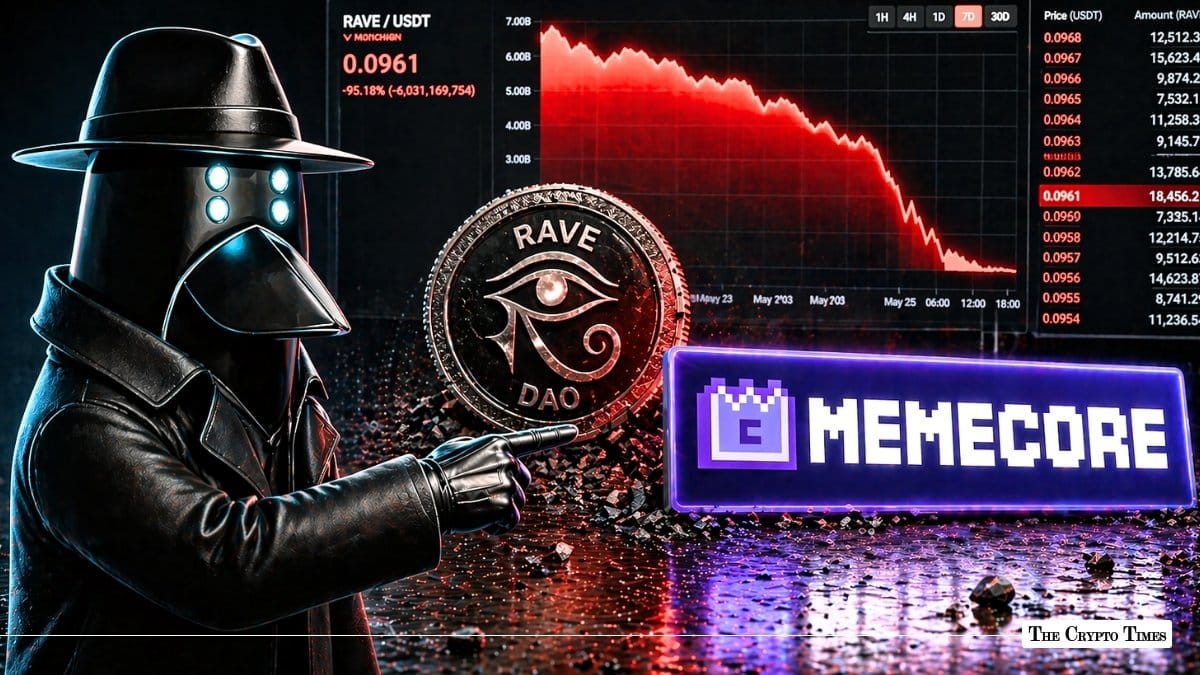
The timing of ZachXBT’s MemeCore comments carries extra weight following the dramatic implosion of RaveDAO’s $RAVE token just days earlier. RaveDAO, marketed as a Web3 music and festival platform tying EDM events to blockchain participation, had exploded from under $0.25 to peaks near $28 in roughly one week—an eye-watering surge of up to 11,000% that briefly pushed its market cap above $6.7 billion.
ZachXBT’s allegations centered on insiders allegedly controlling more than 90% of the supply, with wallets linked to the team or deployer moving large volumes onto exchanges like Binance, Bitget, and Gate.io right before the peak.
He offered escalating bounties—starting at $10,000 and rising to $25,000—for whistleblower evidence. Major exchanges responded swiftly, with Bitget confirming an investigation within hours while Binance’s leadership pledged to examine market misconduct, and Gate.io signaled active review.
The fallout in RaveDAO was swift and brutal as $RAVE price plunged more than 95% within 24 hours, falling from highs around $26–$28 to below $1.50 and later trading near $0.50 in some reports, erasing roughly $6.7 billion in market value.
The dramatic decline brought heavy liquidations, with over $40 million reported in futures positions wiped out. RaveDAO denied wrongdoing, attributing the move to market dynamics, but confidence evaporated as on-chain flows and supply concentration came under intense scrutiny.
MemeCore’s defense and ecosystem pitch
MemeCore presents itself as the first Layer-1 blockchain built for “Meme 2.0”—an ecosystem focused on tokenized meme trading, on-chain farming, and speculation via platforms like MemeX and MemeMax.
The project points to technical upgrades, including a hard fork that drastically reduced gas fees, account abstraction improvements, and ongoing network activity as evidence of genuine utility beyond pure hype.
In the wake of attention the project is receiving amid points, MemeCore launched a community giveaway program, just like nothing.
Supporters highlight daily trading volumes often in the tens of millions, community engagement, and the token’s resilience through market rotations. $M has experienced sharp rallies, including recent moves toward $3.80–$4 levels with market caps climbing above $6 billion at peaks, placing it as 21st largest crypto asset by market capitalization.
Defenders frame ZachXBT’s remarks as selective FUD, arguing the project continues to build and that criticism can be “monetized” through heightened visibility.
Patterns ZachXBT continues to flag
ZachXBT has made clear he is not a trader and does not short these assets, citing manipulation risks that can punish bearish positions. He reiterated that he sells any unsolicited tokens sent to his public donation wallets and has never launched or promoted a memecoin. His recent posts have drawn pushback from influencers—particularly in certain regional circles—who promote similar high-concentration projects.
The investigator’s broader thesis is straightforward: tokens with thin circulating supply, heavy insider holdings, and reliance on centralized exchange volume often exhibit price action that benefits early holders at the expense of later entrants.
He has flagged comparable setups before, and the rapid RaveDAO unwind serves as a live example of how sentiment can shift once concentrated supply dynamics enter the spotlight.
Community divide and market realities
ZachXBT’s mock sparked sharp reactions and splitted in both, favors and against. MemeCore holders posted on-chain activity metrics and farming screenshots, emphasizing long-term conviction in their native chain over short-term noise.
Some leaned into the controversy, joking that ZachXBT’s attention provides free marketing. Critics, meanwhile, saw echoes of classic low-float setups where retail FOMO meets eventual selling pressure.
As of April 20, $M traded at $3.43 with modest volatility amid the discussion, while volumes remained elevated around $30 million—as of CoinMarketCap data.
The episode underscores persistent tensions in the memecoin sector: narratives can drive explosive gains, but concentrated ownership and leverage create fragile structures vulnerable to rapid unwinds.
ZachXBT’s intervention with MemeCore arrives against the fresh wreckage of RaveDAO, where billions vanished in hours after similar red flags surfaced.
Whether MemeCore withstands the scrutiny or follows a comparable path will depend on its ability to demonstrate organic usage beyond hype, manage supply releases transparently, and maintain liquidity without relying solely on momentum.
Also read: LayerZero Blames KelpDAO Team for Exploit, Links to DPRK’s Lazarus Group