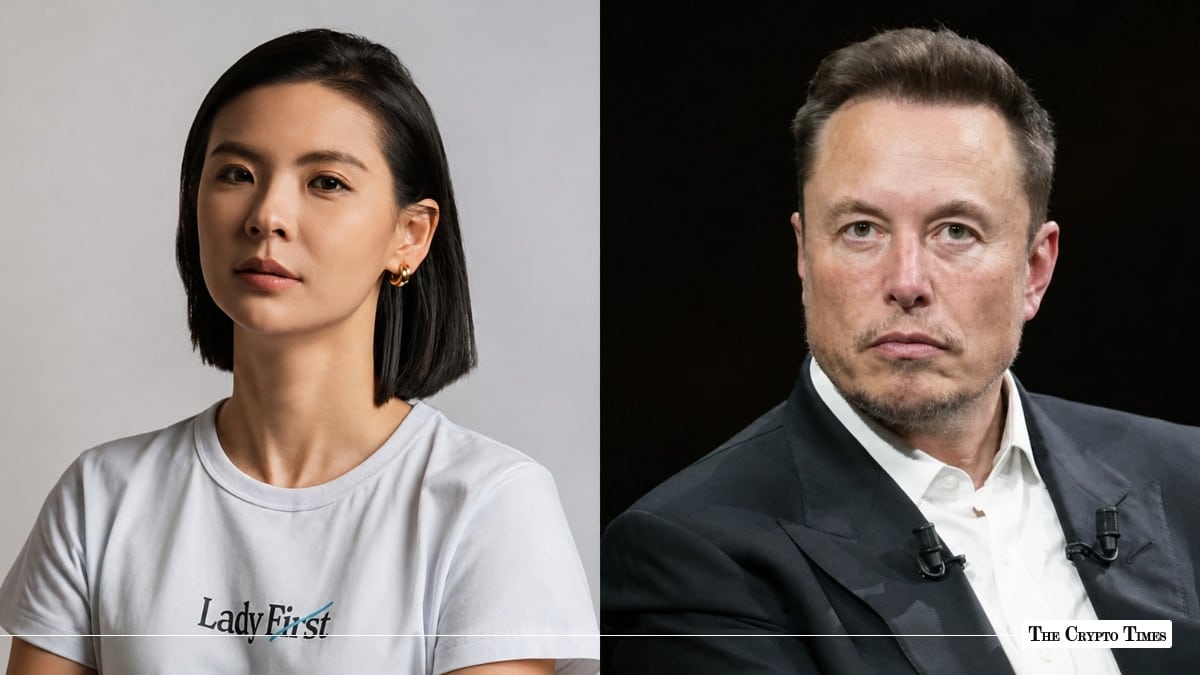
A public disagreement between Bitget CEO Gracy Chen and crypto investor Bruce J has drawn attention across the digital asset industry after both parties exchanged remarks over Republic Ventures, SpaceX-related investments, and the nature of partnership agreements involving private market offerings.
The dispute unfolded on social media platform X, where Chen defended Bitget’s relationship with Republic and challenged suggestions that others had secured access through channels that might conflict with the exchange’s partnership arrangement.
Corporate alliances versus individual LP quotas
The disagreement traces back to Bitget’s aggressive push into tokenized Real World Assets (RWAs) and private equity. In April 2026, Bitget launched its IPO Prime initiative alongside Republic, debuting preSPAX, a digital asset proxy structured to track the post-IPO performance of Elon Musk’s SpaceX
When public commentary suggested that independent players were securing direct SpaceX allocations through identical pipelines, Chen issued a firm public clarification stating, “From start to finish, let me clarify that there is indeed an official collaboration between Bitget and Republic, complete with an exclusivity period.”
Chen emphasized that individual investors remain free to participate in Republic products if they meet eligibility requirements. “An individual securing a quota as an LP and an official collaboration between two companies are two entirely different things,” she added.
According to Chen, maintaining transparency with users remains a priority, while also encouraging greater public clarification regarding recent questions raised within the community.
Bruce J pushes back
Bruce J responded by disputing the characterization of Republic-related access and highlighting his own involvement as a limited partner in Republic Ventures. “I am an LP at Republic Ventures,” he wrote, adding that the investment structures involved were separate from Bitget’s claimed partnership arrangement.
Bruce also pointed to his participation in a SpaceX investment made in 2020, saying he recently received an updated release schedule related to that allocation.
He argued that secondary market networks and venture fund structures naturally provide multiple parallel access points for accredited investors, entirely independent of centralized exchange products.
“The capital markets are vast,” he wrote. “People who truly get things done are focused on results and returns.”
Growing demand for SpaceX exposure
The dispute reflects a broader trend within the crypto industry as exchanges, investment firms, and tokenization platforms increasingly seek ways to provide exposure to private companies such as SpaceX.
Over the past year, several crypto platforms have explored tokenized private equity products, venture fund partnerships, and secondary market offerings tied to some of the world’s most sought-after private technology companies.
As investor demand continues to grow, access to SpaceX-related opportunities has become a valuable competitive advantage for firms looking to attract users and capital.
AI and SpaceX are competing with crypto for capital
The disagreement comes just days after Chen publicly argued that cryptocurrency fundraising is facing growing competition from artificial intelligence companies and private technology firms.
According to Chen, crypto’s recent struggles are not primarily the result of weak market conditions but rather the increasing amount of institutional capital being redirected toward AI ventures and private companies such as SpaceX.
As exchanges look to differentiate their product suites, securing exclusive access to mega-unicorns like SpaceX has become a major competitive advantage. The public debate between Chen and Bruce J shows that as traditional venture capital and public blockchain networks converge, defining the exact boundaries of “exclusive access” will remain a key point of friction for the industry.
Also read: Cardano’s Hoskinson Defends 1,096 BTC Allocation as Early Audit Dispute Grows