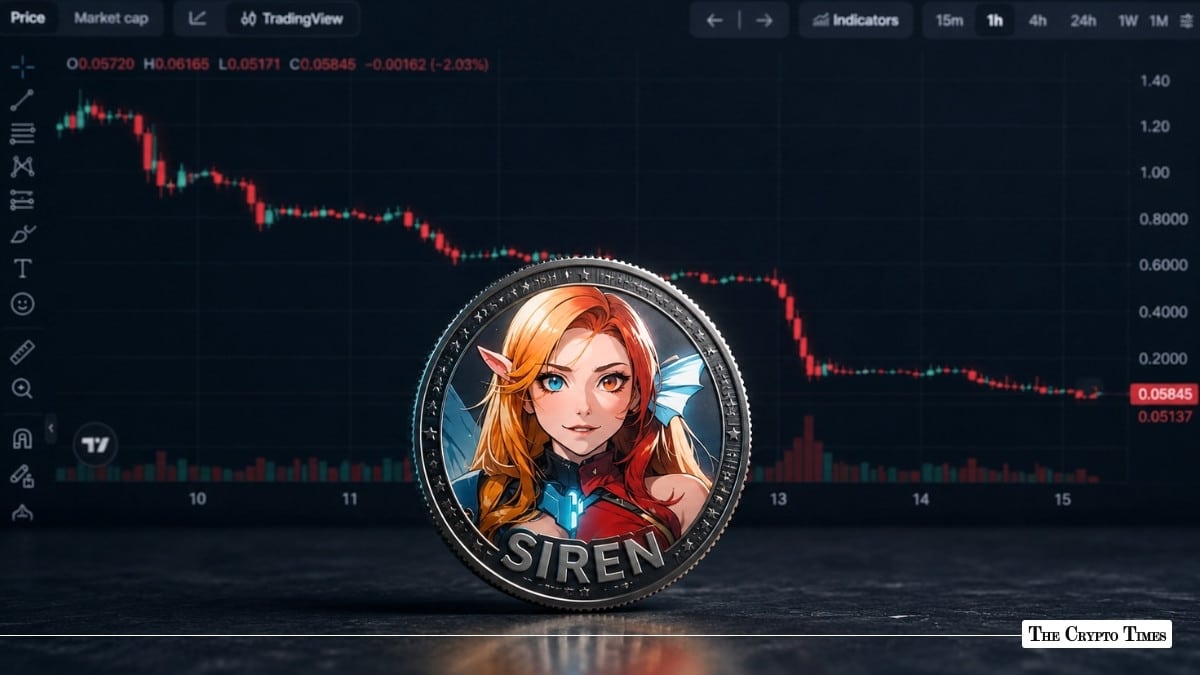
A single whale has obliterated the SIREN token by selling 670 million tokens, roughly 92% of the total circulating supply, over just two days, pocketing $64.8 million in USDT and leaving thousands of retail holders with devastating losses.
The BNB Chain-based AI meme token, which once carried a market capitalization north of $1.7 billion earlier this year, has been reduced to a shell of itself.
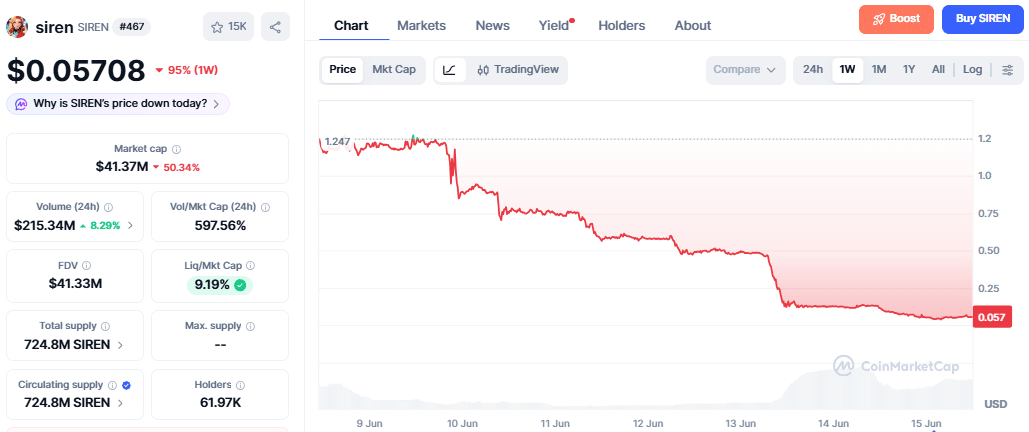
At the time of writing, SIREN is trading near $0.053, down over 95% on the weekly chart and roughly 54% in the last 24 hours alone. The token’s market cap has cratered to approximately $38 million with just 61,970 holders remaining on record.
The whale that ate the market
The catastrophic unraveling was first flagged by on-chain intelligence platform Lookonchain on June 14, when they reported that the dominant SIREN whale had received 28 million USDT from on-chain token sales within a 24-hour window. Of that amount, 25.7 million USDT had already been deposited to centralized exchanges Bitget and Bybit. At that point, the whale still held 478 million SIREN tokens, prompting Lookonchain to warn bluntly: “The dump isn’t over yet.”
By the following day, Lookonchain published an updated post revealing the full scale of the damage. The whale had sold a staggering 670 million SIREN tokens across two days, collecting a total of 64.8 million USDT. Wallet data tracked through Arkham Intelligence showed that 25.7 million USDT had been moved to exchanges while 39.1 million USDT remained sitting on-chain.
The selling volume was nothing short of extraordinary. SIREN recorded 24-hour trading volume of over $224 million, a figure that represented more than five times the token’s entire market capitalization. That kind of turnover ratio, sitting at 5.12x, is a textbook sign of panic selling and a complete liquidity collapse.
A pattern that keeps repeating
This is not the first time SIREN has been through this cycle. The token has experienced multiple violent pump and dump episodes since its emergence in early 2026. It surged roughly 6,800% during one rally in March before crashing over 90% in under a week. A second rally brought prices back above $1 before the latest round of whale distribution began.
On-chain analyst EmberCN had previously flagged extreme supply concentration as the core risk, noting that whale-controlled wallets held at least 94% of the token’s supply at various points. A BitMart research note similarly warned about a single address cluster that moved approximately 484.6 million SIREN tokens through Hedgey Finance, accounting for nearly half the total supply.
Independent researchers went further, describing a wallet cluster that allegedly controlled about 88.5% of the entire supply, with accumulation happening near the $0.045 level while retail buyers entered during euphoric peaks around $3.80.
Broader market stands in contrast
What makes the SIREN collapse especially striking is that it occurred against a positive broader market backdrop. Bitcoin was up approximately 2% during the same period, and the total crypto market capitalization had gained nearly 1.9%. The SIREN sell-off was entirely an internal liquidity event, not something driven by macroeconomic conditions, regulatory news, or a security breach.
Open interest in SIREN futures had already fallen nearly 40% to $28 million during the initial leg of the crash on June 13, when over $2.4 million in long positions were liquidated across global exchanges. The derivatives market was overwhelmingly bearish, with substantial liquidation clusters sitting just below spot price, meaning each new leg down triggered additional forced selling in a vicious feedback loop.
What comes next
The immediate question is whether the selling pressure has run its course. The whale’s on-chain wallet, as tracked by Arkham, showed a remaining portfolio valued around $39.7 million at the time of the latest Lookonchain update. If further deposits to exchanges follow, more downside is likely.
Technically, the $0.055 level is the first area to watch for any kind of stabilization. If buyers step in there and daily volume drops below the $50 million mark, it could signal that the panic phase is exhausting itself. A failure to hold that level, however, could open the door to a retest of the $0.045 region, which happens to be the same zone where the whale originally accumulated.
SIREN, which markets itself as an AI-powered DEX and trading agent under the SirenAI brand, still lists its core products, including the decentralized exchange and AI trading agent, as “coming soon.” The gap between marketing narrative and actual product delivery, combined with the extreme supply concentration, has left retail participants exposed to exactly the kind of event that played out this week.
For now, the chart tells a clear story: when one wallet cluster controls the overwhelming majority of a token’s float, the market is not really a market at all. It is simply the holder’s decision to sell.
Also Read: Why is Bitcoin Price Up Today?