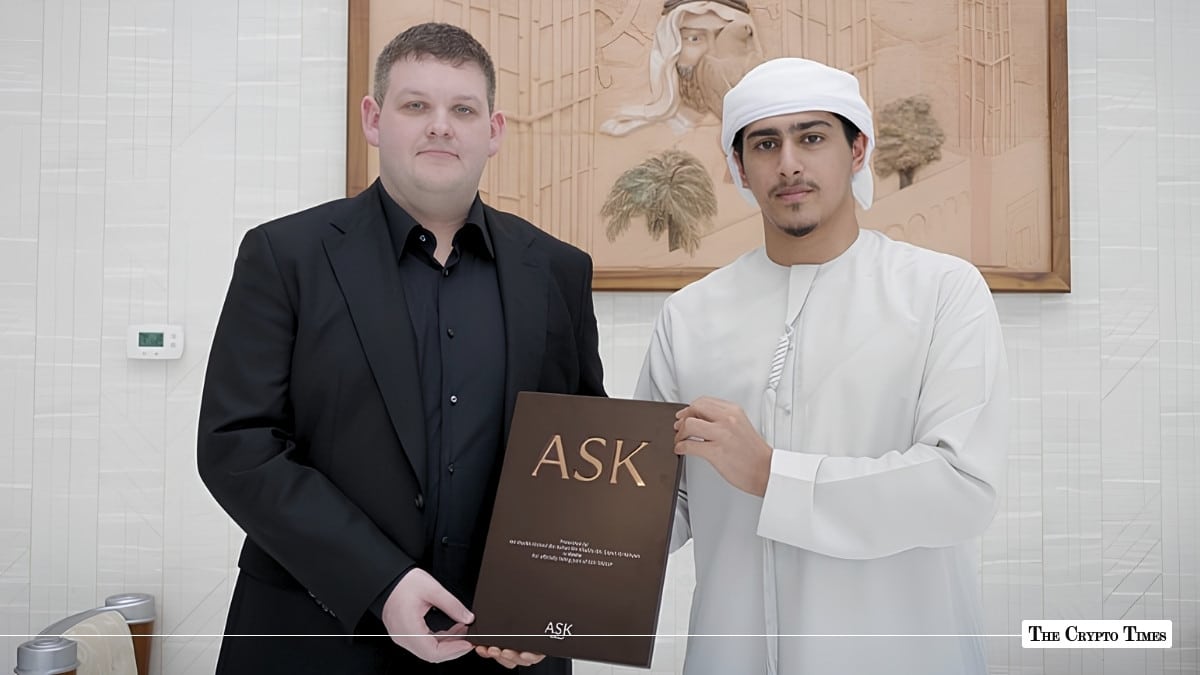
Keeta Network, the Eric Schmidt-backed layer-1 blockchain, has announced a joint venture with UAE-based ASK Group to tokenize tens of billions of dollars in Gulf commodities and modernize cross-border payments across the Gulf Cooperation Council, marking one of the more ambitious real-world asset plans tied to the network to date.
The partnership was disclosed in a nine-part thread posted by Keeta and confirmed in a reply from ASK Group, a UAE investment group led by Sheikh Ahmed bin Sultan bin Khalifa bin Zayed Al Nahyan, a member of Abu Dhabi’s ruling family.
A Tokenized Commodities Exchange, Targeted for 2027
The centerpiece is a planned Keeta-powered public exchange for tokenized Gulf commodities, with an initial target of 2027. Both parties stressed the timeline is conditional on regulatory approvals and the build-out of custody and operational infrastructure.
Under the structure described, ASK Group will hold exclusive rights to facilitate and execute Keeta’s presence across the UAE, the wider Middle East and Africa region, and India. Keeta CEO Ty Schenk framed the arrangement as a bid to move assets that “have traded the same way for decades” onto newer infrastructure, while ASK Group tied the deal to the UAE’s ambitions in digital finance and real-world asset tokenization.
ASK Group’s Role and Royal Backing
ASK Group is led by Sheikh Ahmed bin Sultan bin Khalifa bin Zayed Al Nahyan, a member of Abu Dhabi’s ruling family. Under the arrangement, the group will hold exclusive rights to facilitate and execute Keeta’s presence across the UAE, the wider MEA region, and India.
“As a global financial center, the UAE is determined to lead the world as we enter this new era,” said His Highness Sheikh Ahmed bin Sultan bin Khalifa bin Zayed Al Nahyan. “This partnership is a long-term commitment to building the infrastructure that will define how trillions of dollars in real-world assets move.”
Keeta CEO Ty Schenk said ASK Group “brings an incredible level of access, scale, and institutional credibility” to the partnership, framing the deal as an effort to move long-traditional asset classes onto modern infrastructure. ASK Group, for its part, pointed to Keeta’s leadership under Schenk and the early backing it has received from Eric Schmidt, who participated in Keeta’s $17 million funding round in 2023.
Cross-Border Payments and the India Corridor
Beyond commodities, the partners are positioning Keeta’s infrastructure as a payments layer for the region. The announcement highlighted the UAE’s status as one of the world’s largest remittance-origination markets, noting that the UAE–India corridor alone moves roughly $20 billion annually, and said Keeta would be used to modernize payments in South Asia, Africa, and Southeast Asia.
How Commodity Tokenization Is Supposed to Work
The technical premise is to represent physical commodities—a barrel of oil, an ounce of gold, a kilogram of silver—as digital tokens on Keeta, with the network handling settlement, fractional ownership, and on-chain proof of reserves. In theory, that would let a retail investor or an institutional fund hold direct, tradable exposure to a specific physical asset around the clock, rather than through futures or ETFs.
The hard part is not the token. It is everything underneath it: verified custody of the underlying barrels and bullion, auditable reserve attestations, and a regulatory wrapper that lets those tokens trade legally across borders. Proof of reserves only holds if an independent, ongoing audit links each token to a real, unencumbered asset—which is precisely the infrastructure the announcement concedes does not yet exist.
The Schmidt Connection, in Context
ASK Group cited the involvement of former Google CEO Eric Schmidt as part of Keeta’s credibility. That backing is real but indirect: Schmidt participated in Keeta’s $17 million funding round in 2023 through his Steel Perlot vehicle, making him an early investor in the network — not a party to this UAE joint venture. Keeta launched its mainnet in September 2025; its KTA token trades on Base and was listed by Coinbase later that year; and the project has marketed throughput figures of up to 10 million transactions per second, well above the roughly 47,000 TPS that independent testing has confirmed.
A Plan, Not Yet a Business
For now, the initiative is a statement of intent. The exchange is years out on the partners’ own timeline, hinges on regulatory clearance in one of the world’s most actively developing crypto jurisdictions, and was announced without the independent verification that would normally accompany a deal of this stated scale. The “tens of billions” in commodities and the trillion-dollar market framing describe the size of the opportunity, not committed capital or assets under management.
What is verifiable is the direction of travel: a credible-enough L1 with institutional backing and a UAE group with ruling-family ties publicly committing to a multi-year RWA build. Whether that translates into a functioning exchange by 2027 — or remains an announcement — is the open question.
Also Read: Bybit Launches Tokenized SpaceX Offering, but Investors Won’t Own Actual Shares