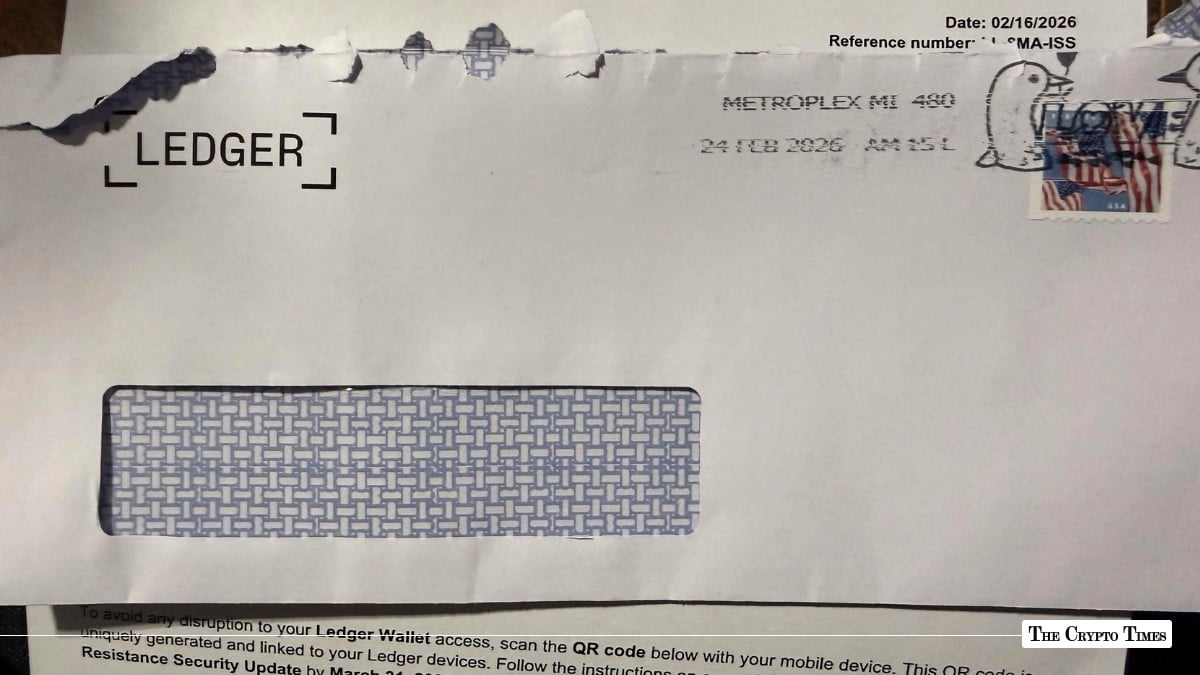
Hardware wallet manufacturer Ledger has publicly warned its users about a new physical mail phishing scam that exploits quantum computing fears to pressure recipients into compromising their crypto wallets, with the fraudulent letters demanding a “Post-Quantum Cryptography Security Update” be completed by June 26, 2026.
The scam first surfaced publicly by Akhil (@akh1l_sol), Validator at the Stronghold, who shared photos of the letter he received and tagged on-chain investigator ZachXBT to ask whether the targeting was “from the latest data leak.” Within an hour, Ledger’s official account responded, confirming the letter is a scam and urging users to ignore it.
What the Letter Claims
The fraudulent letter is designed to closely mimic official Ledger communications. It opens with “At Ledger, securing your digital assets is our highest priority” and introduces what it describes as “Post-Quantum Cryptography, a critical security upgrade designed to protect your assets against threats from quantum computing.”
The letter claims that “powerful quantum computers could brute-force your private keys in seconds, but our quantum-resistant algorithms keep them protected,” and asserts that the Post-Quantum Cryptography Security Update is required for six specific Ledger device models:
- Ledger Nano Gen5
- Ledger Flex
- Ledger Stax
- Ledger Nano S Plus
- Ledger Nano S
- Ledger Nano X
The letter instructs recipients to “scan the QR code below with your mobile device” to “ensure uninterrupted access to your Ledger Wallet,” noting that the QR code “has been uniquely generated for you based on the reference number shown in the top right corner.” Recipients are warned not to share the code.
The letter creates urgency with a June 26, 2026 deadline and threatens consequences for non-compliance, including potential loss of access to the Ledger Wallet, partial loss of Clear Signing functionality, and “limited functionality with future releases.”
Ledger’s Response
Responding to Akhil’s post, Ledger’s official account stated directly: “you should ignore that — it’s a scam. We appreciate your efforts to warn others about these scam attempts.”
The company restated its security guidance: “Ledger will never call, DM, or ask for your 24-word recovery phrase. If someone does, it’s a scam. Stay cautious, keep your crypto safe and always Clear Sign transactions where possible.”
Ledger also addressed the question of how the scammer obtained Akhil’s physical address. “Scammers impersonating Ledger and other crypto brands are unfortunately common. While we actively report and block them, malicious actors often pull from multiple leaks across the industry,” the company wrote. “In practice, even if a scam letter mentions Ledger, the address may have been sourced from any number of crypto-related breaches. Because Ledger is a trusted name in self-custody, scammers use our brand to increase the likelihood of tricking users.”
The company also urged users not to engage with anyone claiming to be Ledger employees or offering to help recover funds, and directed users to its official support channel at support.ledger.com/contact-us.
Why the QR Code Routing Matters
The most significant tactical evolution in this scam is what it does not do: directly ask for the user’s 24-word recovery phrase.
Years of education from Ledger and the broader crypto industry have trained users to refuse any request for their recovery phrase. Phishing scams that directly ask for the phrase have become easier for sophisticated users to identify and report. This new scam adapts by routing victims through a QR code that presumably leads to a fraudulent website, where the actual credential theft occurs—potentially through a fake firmware update interface, a fraudulent wallet recovery flow, or a malicious browser extension prompt.
The technique exploits a gap in user training. Most Ledger holders know not to give their seed phrase to anyone, but the QR code presents itself as a routine device synchronization step rather than a credential request. The scam relies on the user completing the “upgrade” process voluntarily, potentially entering their recovery phrase on a fraudulent website that mimics Ledger’s interface.
The quantum computing framing reinforces the legitimacy of the social engineering. The crypto industry has been actively discussing post-quantum cryptography in 2026, with Google Quantum AI’s March research paper significantly accelerating Q-Day timeline concerns, and Ripple publishing a four-phase post-quantum roadmap for the XRP Ledger targeting 2028. Users who have read these stories may find a “Post-Quantum Cryptography Security Update” letter from their hardware wallet provider entirely plausible.
The 2020 Breach Long Tail
Ledger’s response acknowledged that the recipient’s address may have been sourced from any of multiple crypto-related breaches. The most likely source remains the July 2020 Ledger e-commerce data breach, in which the personal data of over 270,000 customers—including names, postal addresses, phone numbers, and ordered products—was exposed and subsequently posted publicly.
That 2020 breach has been the source of a persistent stream of physical mail and digital phishing campaigns targeting Ledger customers for the past five years. Earlier 2025 attacks included physical letters disguised as official correspondence with seed phrase requests on enclosed scratch cards, demonstrating that scammers have continued to evolve their methodology against the same victim list.
The June 2026 letter represents the latest evolution in that long-tail attack stream — refined social engineering (quantum framing), updated device targeting (including newer Ledger models like Stax and Flex), and a more sophisticated technical vector (QR code routing rather than direct seed phrase request).
What Users Should Do
Ledger’s standard guidance applies. The company will never call, direct message, or ask for the user’s 24-word recovery phrase under any circumstances. Any communication — physical mail, email, text, phone call, or social media message — that requests the recovery phrase or routes the user to a non-Ledger website to enter wallet information is fraudulent.
For users who received this specific letter, Ledger recommends ignoring it entirely. Do not scan the QR code, do not visit any URL it routes to, and do not enter any wallet information into any interface that the QR code might present.
For users uncertain whether a communication is legitimate, Ledger’s official support channel (support.ledger.com/contact-us) is the only verified route for confirming the authenticity of any Ledger communication. The company does not initiate firmware updates through physical mail and does not require users to scan QR codes from letters to complete security updates.
Hardware wallet security remains structurally strong against the threats the scam claims to address. As Ledger stated in its response: “At Ledger, we’ve designed our technology so that your crypto and private keys remain safe, regardless of external incidents. Ledger devices are purpose-built to keep your assets secure and entirely under your control.”
The scam targets users, not devices. The defense is awareness.