There is a quiet contradiction sitting at the center of crypto’s corporate-treasury era, and almost no one has named it.
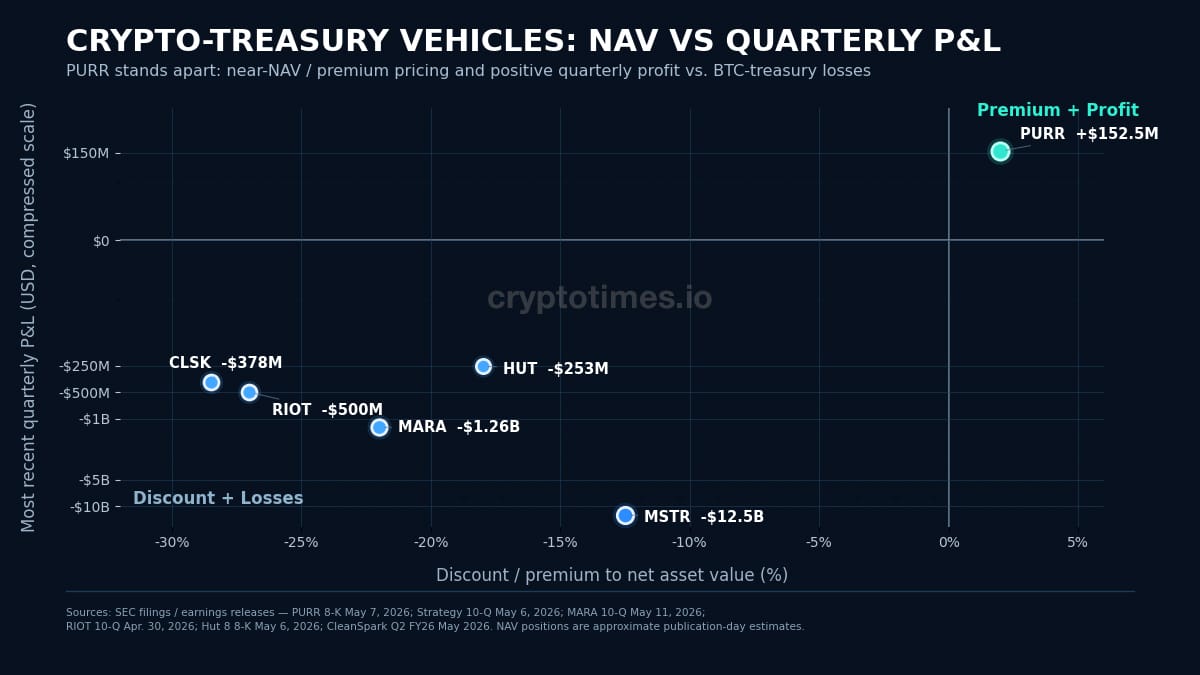
The digital-asset-treasury (DAT) trade, the MicroStrategy template of a public company stuffing its balance sheet with a single token, has been in distress since late 2025. Treasury vehicles built on Bitcoin (BTC), Ethereum (ETH), and Solana (SOL) have spent months nursing deep paper losses, and many now trade at steep discounts to the value of the coins they hold. The market has, in effect, stopped paying a premium for the privilege of holding crypto through a stock ticker.
And yet one DAT is doing the opposite. Hyperliquid Strategies Inc. (NASDAQ: PURR), the largest publicly traded vehicle built entirely around Hyperliquid’s HYPE token posted a $152.5 million quarterly profit for the period ended March 31, 2026, driven by $198.4 million in unrealized gains on its HYPE holdings. It carries no debt, holds roughly 20 million HYPE (worth close to $1.4 billion at current prices) plus around $103 million in cash, and, unusually for the sector, trades near parity with its net asset value rather than at a punishing discount.
That gap DATs failing almost everywhere, working here is the real story. It is not that HYPE is “a treasury asset.” Plenty of outlets have said that. It is why this one works when the others have stalled.
Key Takeaways
- Hyperliquid’s HYPE traded near $72 on June 1, up 13–14% for the week, with $100 a $15B+ market-cap milestone increasingly cited by named analysts.
- The protocol routes 97% of trading fees into automated open-market HYPE buybacks — over $1.3B since launch, roughly $1M per day, at an annualized rate of 7% of market cap.
- Hyperliquid Strategies (NASDAQ: PURR) posted $152.5M in Q3 2026 profit on $198.4M in unrealized HYPE gains. The company trades near NAV while Bitcoin and Ethereum treasury vehicles trade at deep discounts.
- Bitwise’s spot HYPE ETF (NYSE: BHYP) recorded a $19M single-day inflow on May 27 and accumulated roughly $55M in HYPE within weeks of launch.
- Risks remain live: a ~9.92M token unlock around June 6, governance-set (not bedrock) buyback policy, and regulatory uncertainty around fee-funded buybacks under US securities law.
How Hyperliquid buyback works: 97% of fees, $1M a day
Hyperliquid is not a speculative side project. It is the dominant venue for on-chain perpetual futures, clearing more than $180 billion in trading volume in a single recent 30-day window, with sub-second finality and throughput measured in the tens of thousands of orders per second.
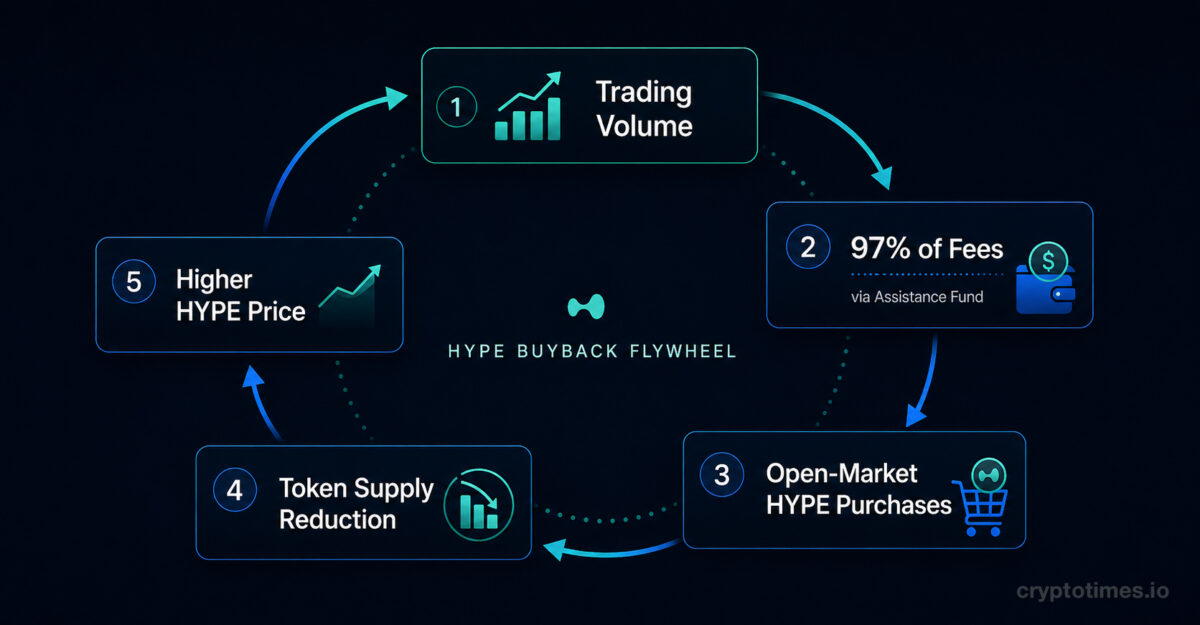
The piece that matters for treasuries sits in the tokenomics. Through an on-chain mechanism called the Assistance Fund, roughly 97% of Hyperliquid’s protocol trading fees are routed into continuous, automated open-market purchases of HYPE every day, with no manual intervention. A December 2025 governance vote, passed by about 85% of validators, raised the allocation toward 99% for certain fee categories and committed to permanent burns on a portion of the Fund’s holdings, moving the program from “policy that could change” to a governance-enforced commitment.
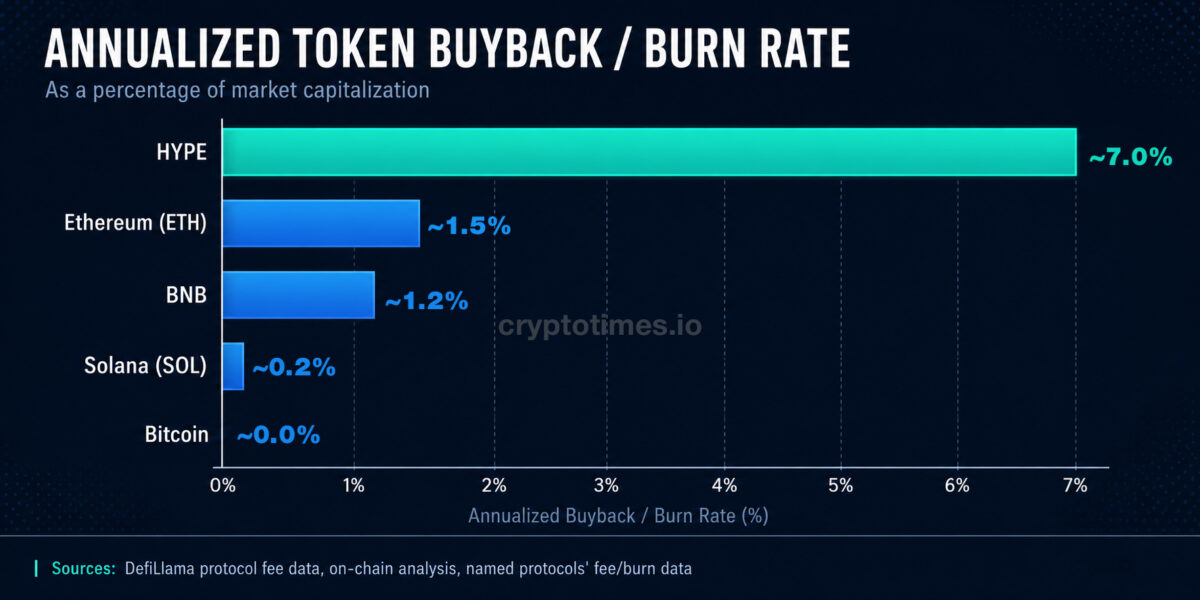
The scale is the part most casual observers miss. The Assistance Fund has spent more than $1.3 billion buying back HYPE since launch, averages roughly $1 million in purchases per day, and runs at an annualized buyback rate of about 7% of market capitalization — four to five times Ethereum’s effective burn rate, roughly six times BNB’s, and many times Solana’s. By one widely cited estimate, Hyperliquid accounted for nearly half of all token-buyback activity across the entire crypto industry in 2025.
Put in equity terms, this is a business returning the overwhelming majority of its revenue to token holders through buybacks — a payout ratio that would be considered reckless for a normal company, but which is sustainable here because infrastructure and validator costs are funded through separate token allocations rather than out of trading fees. Whatever one thinks of the valuation, the mechanic is real, it is verifiable on-chain, and it is mechanically tied to actual usage: more volume, more buybacks; less volume, fewer.
Why HYPE works when BTC and ETH treasuries don’t
The reason BTC, ETH, and SOL treasuries have struggled is structural. Their entire return depends on the coin going up. There is no internal engine — only external demand and a holding company layered on top, which adds fees, dilution risk and a discount the moment sentiment cools. When the premium evaporates, as it has, the model has nothing to fall back on.
HYPE changes the inputs. A company holding it is not merely betting on price; it is a co-beneficiary of three distinct, continuous revenue streams flowing to the token:
The first is the buyback itself — the 97% fee recycling described above, which functions as a persistent structural bid. The second is staking, which lets holders earn protocol rewards while retaining governance rights; PURR booked $2.6 million in staking revenue in a single quarter and launched a validator partnership (with Unit Labs) specifically to monetize its treasury further. The third, newer stream comes from reserve yield on stablecoin balances on the platform, redirected back toward the token through a deal struck in mid-May.
This is the distinction worth drawing sharply: a Bitcoin treasury is a leveraged bet on scarcity. A HYPE treasury is a claim on a cash-flowing piece of financial infrastructure that happens to be denominated in a volatile token. That is a fundamentally different risk object — closer to owning a high-payout-ratio operating business than to holding digital gold in a vault.
The clearest institutional endorsement of that logic is Bitwise. Its spot Bitwise Hyperliquid ETF (NYSE: BHYP), launched May 15, 2026, recorded a roughly $19 million single-day inflow on May 27 — among its largest to date, and, per CEO Hunter Horsley, enough to make it the largest Hyperliquid ETF in the world at the time.
On-chain analytics firm Arkham reported on June 1 that Bitwise had bought roughly $20 million of HYPE in a single day, following about $41.8 million in ETF-client purchases the prior week, bringing the total HYPE accumulated and natively staked through the fund to around $55 million — a figure broadly corroborated by SoSoValue’s cumulative BHYP inflow data. Independent data from Kairos Research found that spot HYPE ETFs absorbed about 1.04% of HYPE’s market cap in their first ten trading days — a stronger debut, on a market-cap-adjusted basis, than the early spot Bitcoin (0.59%), Ether (0.41%) or Solana (0.31%) ETFs.
Distinct from those ETF flows, Bitwise also pledged to devote 10% of BHYP’s management fee to holding HYPE directly — a separate, fund-level demand channel deliberately mirroring the protocol’s own buyback model. Bitwise CIO Matt Hougan has leaned into the pitch, telling advisors that the fact nearly all protocol fees go to repurchasing the token makes the conversation, in his words, easy.
The case for $100: where the price targets come from
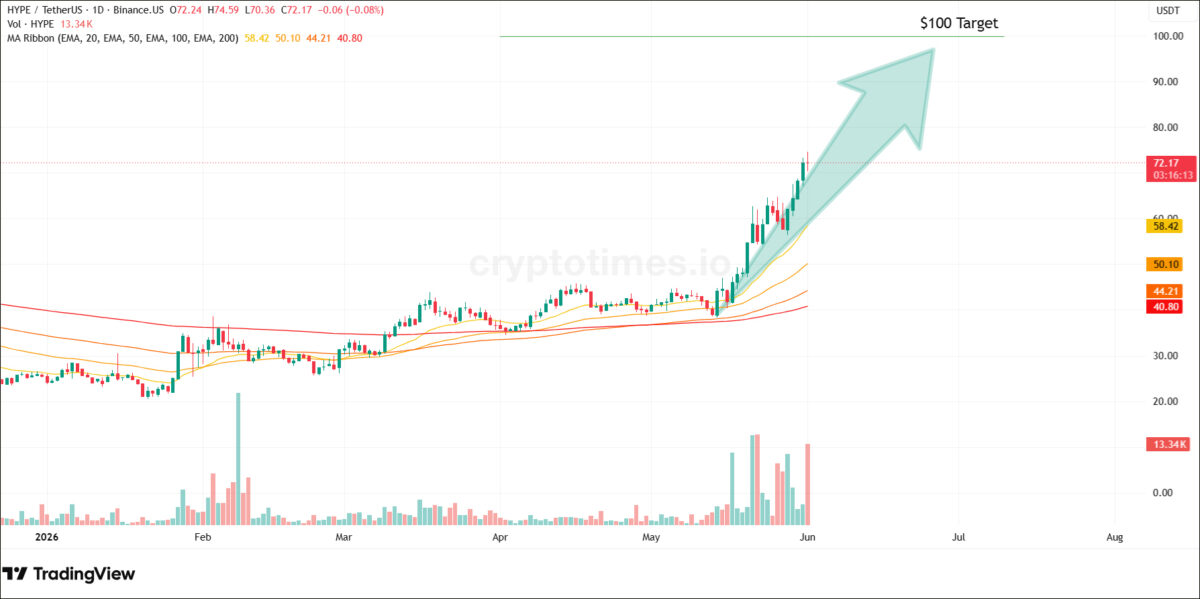
HYPE traded near $72–73 on June 2, up roughly 13–14% over the prior week and pressing into all-time-high territory after flipping Dogecoin to enter the top 10 by market cap, as per CoinMarketCap data. Market capitalization sits in the $15–17 billion range.
The $100 target, increasingly common in coverage, is not arbitrary, but it belongs to analysts, not to this publication. Chartist Ali Martinez has framed $93 — and as high as $163 — as reachable with HYPE in “price discovery” mode. BitMEX Co-Founder Arthur Hayes, who described HYPE as “fundamentally de-risked” in his Valhalla thesis, has a standing $100,000 charitable bet that the token overtakes Solana. ICE chief executive Jeff Sprecher recently went as far as calling Hyperliquid “bigger than Nasdaq.” From roughly $72, $100 represents about 39% upside — aggressive, but not the kind of multiple that requires a mania to reach if ETF inflows and buyback velocity hold.
The honest version of the bull case is conditional, not guaranteed: the buyback intensity that underpins the valuation only persists if trading volume persists. The tokenomics are not the thesis in isolation — they are the thesis given continued protocol growth.
The five risks every HYPE bull should price in
A treasury thesis that omits the downside is marketing, not analysis. Several risks are live.
- A supply wall arrives in days. A token unlock scheduled around June 6 releases roughly 9.92 million HYPE — on the order of $700 million — into the market, with further monthly unlocks of roughly 10 million tokens running through October 2027. Buybacks have largely absorbed this supply so far, but “so far” is doing real work in that sentence. How price behaves around June 6 is the nearest-term test of whether structural demand can outpace structural supply.
- The buyback has no floor. Because it scales with volume in both directions, a sustained drop in trading activity — from competition, a market downturn, or fee compression as centralized and rival decentralized venues fight for share — would cut buyback intensity proportionally. A 50% volume decline roughly halves the 7%-of-market-cap rate.
- The policy is governance, not bedrock. The 97–99% allocation was set by validator vote and can be changed by one. It has only ever been strengthened, but the lever exists.
- Regulation is unsettled. Fee-funded token buybacks occupy ambiguous territory in U.S. securities law, and prediction-market expansion invites competition from regulated entrants such as Kalshi seeking CFTC approval.
- Concentration cuts both ways. A HYPE treasury is a single-protocol bet. The same mechanics that amplify the upside amplify a drawdown — and a treasury company layered on top adds its own dilution and execution risk, as the broader DAT sector’s recent paper losses demonstrate. Even bullish-leaning equity analysts note that PURR’s NAV-parity pricing leaves little margin of safety.
What this means for crypto’s next treasury cycle
Strip away the price-target noise and the durable insight is this: the corporate-treasury era is bifurcating. The first generation — Bitcoin and its imitators — was a bet that a scarce asset would appreciate and that a holding-company wrapper would earn a premium for providing access. That premium has largely collapsed. The second generation, of which HYPE is the clearest example, ties the reserve asset to a live, cash-generating protocol, so the treasury earns yield and benefits from a structural bid even when sentiment turns.
Whether HYPE specifically reaches $100 is, ultimately, a question about trading volume, unlock absorption and macro conditions that no honest writer can promise. But the more important shift is already visible. By the end of 2026, expect more issuers to copy Bitwise’s fee-to-treasury structure and more Nasdaq-listed vehicles to frame themselves around productive, revenue-linked tokens rather than passive stores of value. The companies that recognize the difference between holding an asset and holding a cash-flow engine will be the ones whose treasury strategies survive the next cycle.
Also Read: HYPE Hits New ATH Above $73 as ETF Inflows and CFTC Boost Rally