
On June 2, 2026, Bitcoin (BTC) breached the key psychological support level and dipped below the $70,000 price mark, shifting the market sentiment to bearish side.
The cryptocurrency has erased roughly 4% in the past 24 hours and remains down more than 44% from its all-time high above $126,000 recorded in late 2025.
This sharp correction is fueled by a combination of fresh on-chain supply pressure, a symbolic corporate sale, and entrenched macroeconomic headwinds. These converging forces have rapidly eroded investor confidence, turning what was initially a measured consolidation into a decisive breach of major support levels.
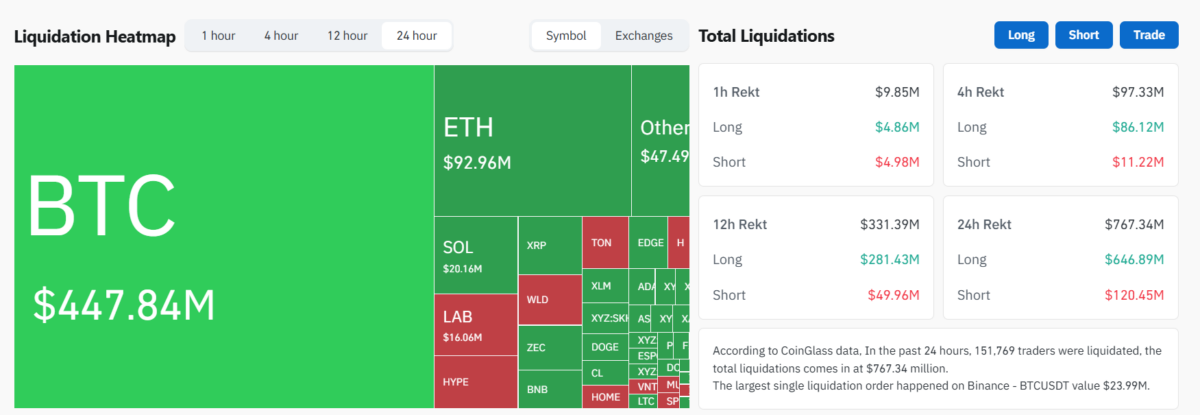
The resulting cascade of liquidations—over $767 million wiped out in the past 24 hours—and stop-loss triggers has further amplified downside momentum across the broader crypto market.
The reason behind the drop
This latest drop below $70,000 in BTC price was triggered by fresh supply pressure from Mt. Gox wallet transfers and the symbolic sale of 32 BTC by Strategy Inc. These two events reignited fears of increased selling and shattered the strong corporate HODL narrative, rapidly amplifying market fear and downside momentum.
Mt. Gox Transfers Spark Renewed Supply Fears
Earlier today, the Mt. Gox estate transferred approximately 10,306 (valued at roughly $731 million at the time) from cold wallets to new or unknown addresses, including a hot wallet.
These movements, tracked by on-chain analysts, represent the first major activity in nearly two months from the defunct exchange’s remaining ~34,500 BTC holdings. While creditor repayments are scheduled through October 31, 2026, the visible transfers have reignited fears of eventual selling pressure, contributing to the day’s downside momentum.
Strategy’s First Bitcoin Sale Since 2022 Breaks the “Never Sell” Narrative
Strategy Inc. disclosed the sale of 32 BTC between May 26 and May 31 for about $2.5 million (average ~$77,135), according to a June 1 SEC filing. The proceeds were used to fund the company’s preferred stock distributions.
Despite still holding over 843K BTC, this small divestment—negligible in size but massive in symbolism—shattered the long-standing corporate HODL narrative championed by Michael Saylor. The news amplified bearish sentiment and coincided with leveraged position unwinds.
Price Action and Technical Breakdown
The 1-hour Bitstamp chart paints a clear picture of sustained selling pressure throughout late May and into early June.
Bitcoin opened the recent period near $73,000–$74,000 before entering a pronounced downtrend. The price experienced a sharp decline from highs around $73,941 (visible on the 200-period EMA), breaking through multiple support zones and culminating in a steep drop below the key psychological level of $70,000.
The latest hourly candle reflects this volatility, with an open at $69,998, high of $70,168, low of $69,631, and close at $70,045—showing a modest rebound but still trading well below the key moving averages.
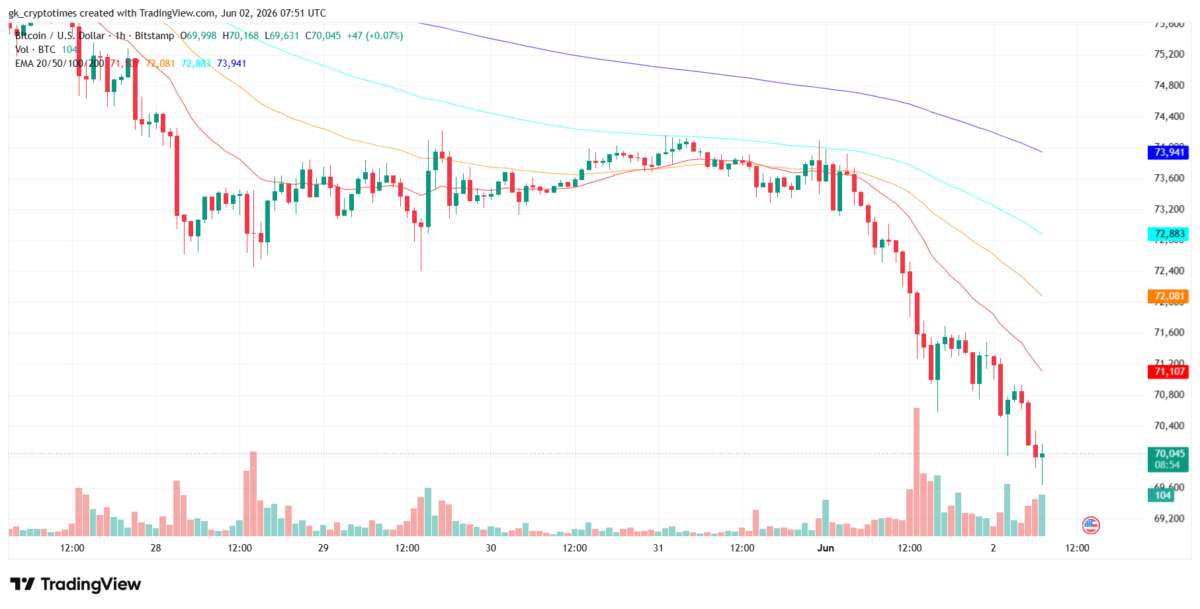
The EMA stack has broken down significantly, with the 20, 50, 100, and 200-period EMAs (currently clustered between $71,107 and $73,941) all sloping downward and now acting as dynamic resistance overhead.
Bitcoin has decisively broken below these shorter-term EMAs, reinforcing bearish momentum. Volume remains elevated at 104 BTC during the recent volatile sessions, with larger red bearish candles dominating the June 1–2 period and clear spikes in selling volume accompanying the breach of $70,000.
The broader timeframe shows that an immediate support now lies near $69,600–$69,200, while resistance is layered first at $71,107 and then at $72,081–$72,883.
The current momentum shows a classic series of lower highs and lower lows since late May, confirming a short-term bearish trend within the broader 2026 correction. These technical developments have triggered algorithmic selling, stop-loss cascades, and short-term capitulation, further exacerbating the move below $70k.
Market Fear Deepens Amid Broader Pressures and Outlook
The Crypto Fear & Greed Index has sunk into “Fear” territory (readings near 29), reflecting eroded confidence. Persistent ETF outflows, billions in futures liquidations, geopolitical tensions (US-Iran), a stronger dollar, and liquidity drains have compounded the pain.
Bitcoin’s correlation with risk assets during selloffs has prevented it from acting as a safe haven.
Despite the bleak short-term picture, many analysts interpret this as healthy deleveraging within a longer bull cycle while some are attributing the downtrend toward market participant’s cautious approach.
“Bitcoin falling to its lowest level since early April and ETF flows turning negative for the year shows investors are still taking a cautious approach to risk assets,” said Daniel Reis-Faria, CEO of ZeroStack, in an exclusive email to The Crypto Times.
“The recent price weakness reflects a broader slowdown in demand, with many investors becoming more selective about where capital goes amid continued uncertainty in the market,” Daniel emphasized. “When ETF inflows weaken and outflows accelerate, it often signals that institutions are taking a step back and waiting for more clarity before increasing exposure.”
This cautious stance is further reinforced by the post-2025 halving correction phase, where Bitcoin has already corrected more than 44% from its all-time high. Historical patterns show that such 40%+ pullbacks are common even in bull markets, often serving as a necessary reset before the next leg higher. Market participants are now closely watching whether Bitcoin can defend the $68,000–$69,000 support zone or if further liquidation cascades could push it toward $65,000 in the coming days.
“The bigger question isn’t the sale itself, but what investors believe about Bitcoin’s long-term trajectory. Right now, the market is weighing that conviction against near-term uncertainty, which is why headlines around ETF outflows, price declines, and corporate sales are drawing so much attention,” Daniel further amplified.
While near-term pressure remains intense, the underlying fundamentals of Bitcoin—including its fixed supply, growing institutional infrastructure, and global adoption trends—continue to support a constructive long-term outlook.
The current shakeout may ultimately prove to be a healthy consolidation rather than the start of a deeper bear market. As always in cryptocurrency, volatility is the norm, and the coming days will be critical in determining whether fear subsides or deepens further.
Also read: The Unresolved Debate Reignites: Is Bitcoin a Pyramid Scheme?