Aave V4 Surges 150% in TVL to $105M Peak Before Pulling Back to $75M by Late May 2026Aave V4 has delivered impressive performance in its early weeks following the launch in late April 2026.
The latest version of the largest DeFi lending protocol has attracted significant capital despite operating in a turbulent market environment.
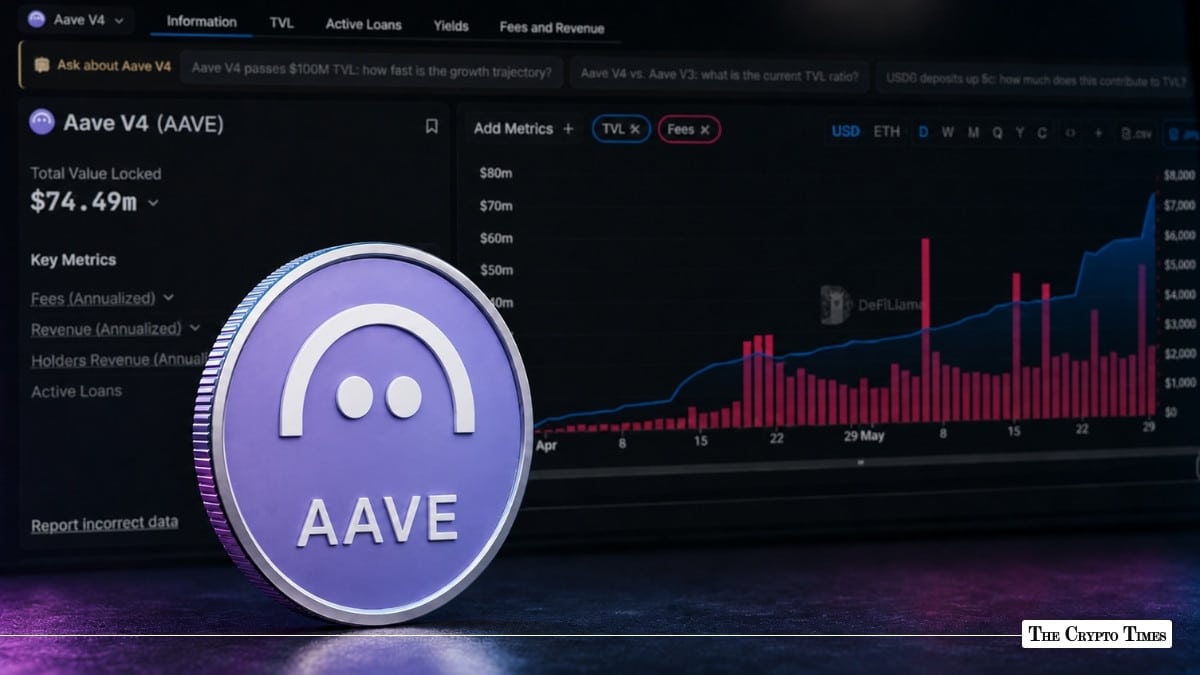
Earlier this week, Total Value Locked (TVL) on Aave V4 reached a high of approximately $105.2 million, marking a 150% surge from about $42 million on April 29. As of May 29, the TVL has moderated to around $75 million but continues to reflect robust underlying interest.
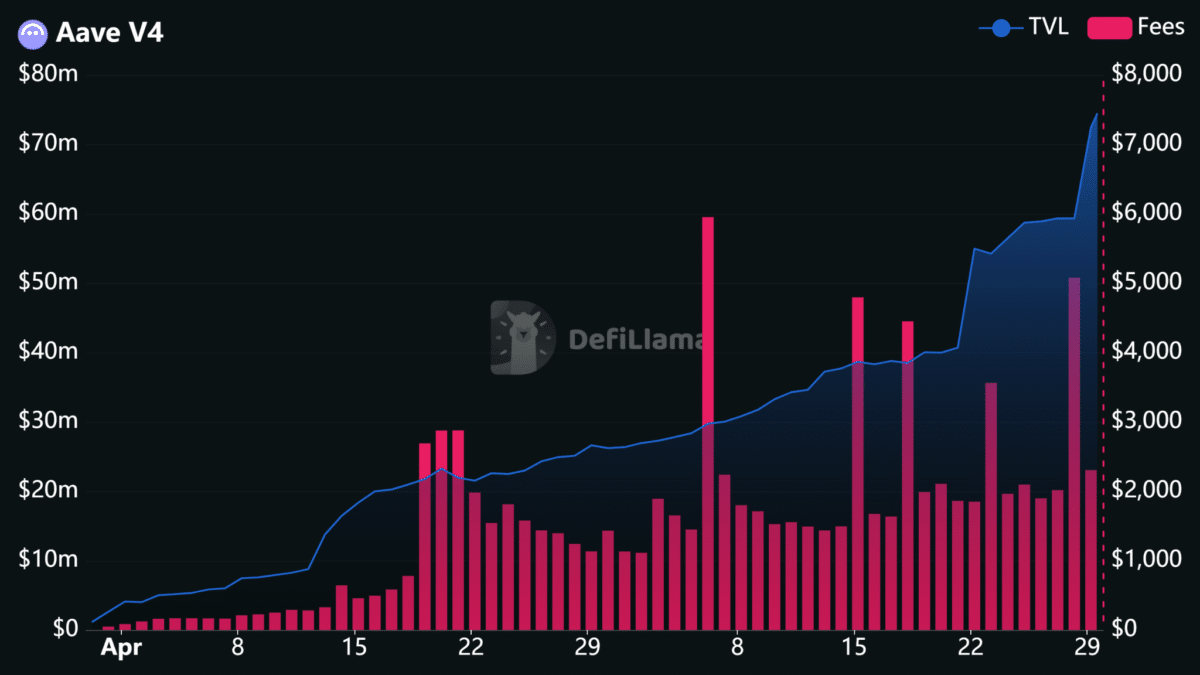
Deposit caps were quickly reached across numerous assets during the surge, signaling strong demand that outpaced initial expectations.
At the same time, rising fee revenue reflected genuine borrowing activity rather than purely speculative flows. These metrics demonstrate that V4 is resonating with both retail and institutional participants seeking reliable lending infrastructure in an increasingly complex DeFi landscape.
V4’s Architectural Edge Drives Early Momentum
Aave V4 uses a modular hub-and-spoke design that isolates risks better than earlier versions. This setup supports safer addition of new assets and cross-chain features while keeping strong liquidity in core markets.
After a modest start, deposit activity picked up quickly. Observers highlighted fast liquidity rotation and good product-market fit.
This latest variant prepares Aave for wider applications such as real-world assets (RWAs) and improved interoperability. The protocol’s governance talks now remain focused on how V4 reduces complexity and allows more precise risk controls.
The Kelp DAO rsETH Exploit Tests the Ecosystem
Days after launch, Aave V4’s growth faced a serious challenge on April 18, 2026. Attackers used a single-signer weakness in Kelp DAO’s LayerZero bridge to mint roughly 116,500 unbacked rsETH tokens worth $290–293 million.
These fake assets were deposited as collateral on both Aave V3 and V4, mainly on Ethereum and Arbitrum. Borrowers extracted over $236 million in real assets like WETH and wstETH, creating bad debt estimated between $123 million and $230 million.
The event caused sharp outflows across Aave, with total TVL falling from around $26.4 billion to $18–20 billion in days. DeFi-wide TVL dropped by about $13 billion, triggering heavy withdrawals and full utilization in stablecoin pools.
Read: A $292 Million Wake-Up Call: Inside KelpDAO Hack That Exposed DeFi’s Fragility
Resilience, Swift Response, and Continued Recovery
Aave reacted quickly and effectively. The Protocol Security Council froze rsETH and wrsETH markets on both V3 and V4. For V4, supply and borrow functions were disabled on the Ethereum Core Hub and Kelp E-Spoke through targeted updates. Extra freezes on WETH markets helped limit the spread.
The protocol confirmed the issue was external and its own smart contracts were unaffected. V4’s risk-isolation features helped contain the damage more effectively than on V3. Recovery efforts included the “DeFi United” coalition, burning of attacker positions, and gradual refilling of rsETH reserves. Operations resumed by mid-May.
By late May, V4 had not only stabilized but shown strong rebound potential, hitting the $105 million peak earlier in the week before settling at $75 million. The modular design proved its value in handling shocks while continuing to attract new deposits.
With governance now refining risk parameters, Aave V4 is positioned stronger than before.The Kelp incident highlighted risks in restaking tokens and bridges.
However, Aave’s decisive response, solid treasury, and V4’s innovations have reinforced its leading position in DeFi. The protocol’s recovery trajectory points to a positive outlook for further adoption in 2026 and beyond.
Also read: Aave Proposes New Technical Framework to Tighten DeFi Asset Listings