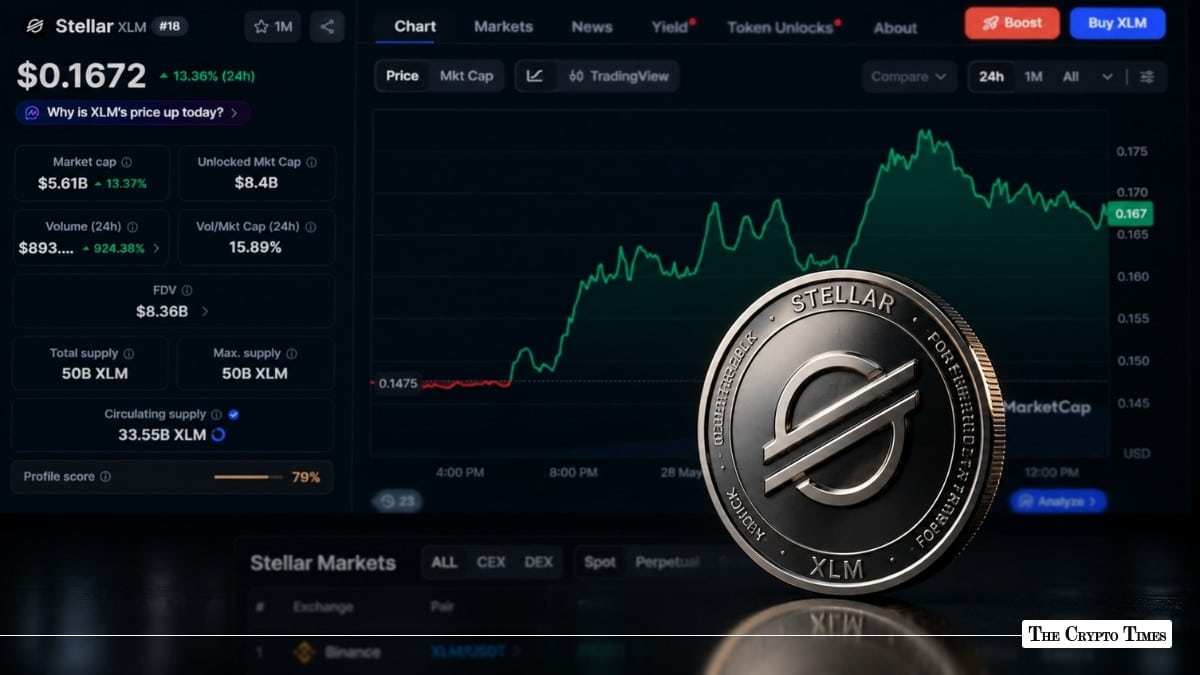
While Bitcoin and the broader crypto market slid more than 3% over the past 24 hours on fresh geopolitical jitters, Stellar Lumens (XLM) ripped in the opposite direction, posting one of the strongest single-day moves among large-cap tokens.
XLM is trading near $0.1712, up roughly 15% on the day, with a 24-hour low around $0.1462 and a high close to $0.1758. The rally pushed its market capitalization back above $5.67 billion and lifted 24-hour trading volume above $900 million as buyers piled into the move.
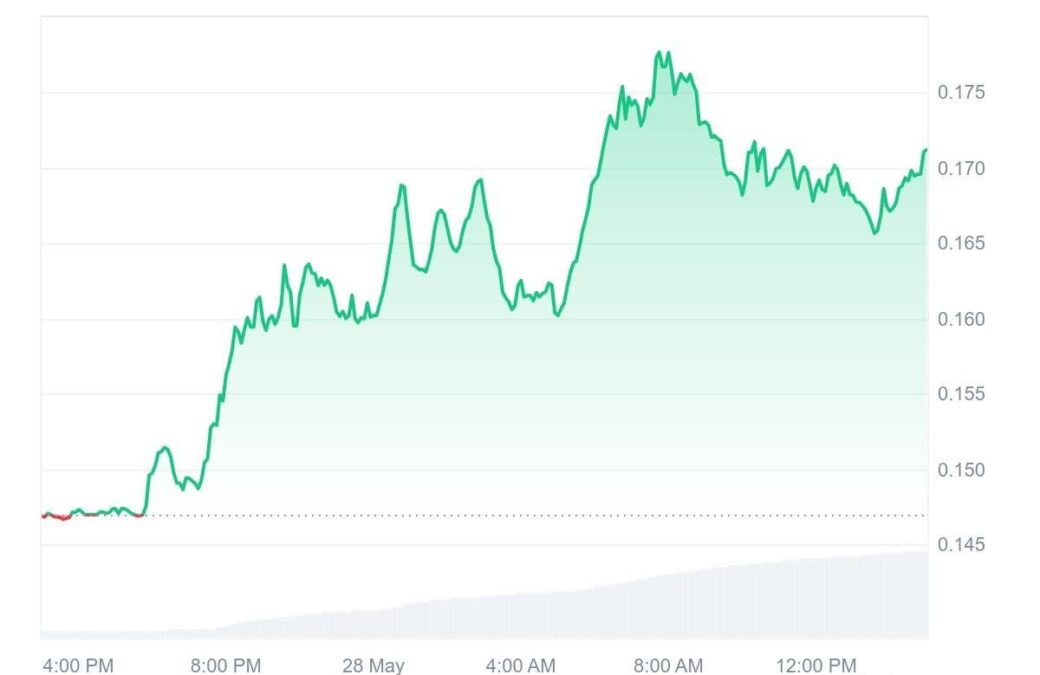
The trigger isn’t a mystery. A day earlier, the Depository Trust & Clearing Corporation (DTCC)—the post-trade infrastructure giant that underpins much of the U.S. securities market—confirmed plans to tokenize DTC-custodied assets on the Stellar public blockchain.
In a market obsessed with real-world asset (RWA) tokenization, that single headline was enough to decouple XLM from the macro tape.
Market Snapshot: Broader Crypto Under Pressure
However, the wider market is in a defensive crouch. As covered in our reporting on the latest sell-off, renewed U.S.–Iran tensions—including concerns over the Strait of Hormuz and stalled ceasefire talks—have reignited inflation fears and risk-off sentiment across assets.
Bitcoin slipped to around $72,900, the total crypto market cap dipped below $2.5 trillion, and the sell-off triggered over $950 million in liquidations—as per CoinMarketCap data.
The Fear & Greed Index remains firmly in “Fear” territory, and persistent U.S. spot Bitcoin ETF outflows—exceeding $1.5 billion over recent weeks—have only added to the pressure. Major altcoins like Solana and XRP traded down 2–4% on the day.
Against that backdrop, XLM’s outperformance stands out sharply. The contrast is a textbook reminder that a concrete institutional catalyst can override broad market sentiment—at least in the short term.
The Catalyst: DTCC’s Landmark Tokenization Deal With Stellar
The driver behind the move is the May 27, 2026 announcement from DTCC and the Stellar Development Foundation (SDF) outlining plans to enable tokenization of assets held in DTCC’s subsidiary, The Depository Trust Company (DTC), on the Stellar network.
The initiative forms part of DTCC’s broader multi-chain strategy to integrate traditional securities with distributed ledger technology. Under the plan, DTC-custodied assets are scheduled to become available on Stellar in the first half of 2027. The rollout will initially focus on assessing use cases for highly liquid assets—including stocks in the Russell 1000 index, major exchange-traded funds, and U.S. Treasury securities.
The timeline builds on earlier regulatory groundwork, including a 2025 SEC no-action letter that cleared the way for tokenization pilots. The connection is designed to support the rapid conversion of traditional assets into tokenized form and to handle the full asset lifecycle, including corporate actions and reporting.
Denelle Dixon, CEO and Executive Director of the Stellar Development Foundation, framed the integration as a bridge between public blockchains and regulated market plumbing. “DTCC is the backbone of global capital markets, and integrating their tokenization service with Stellar connects public blockchain networks to regulated market infrastructure,” she said, adding that the network was built to serve as a rail institutional-grade markets can depend on.
DTCC, for its part, has emphasized that tokenized assets will carry the same entitlements, ownership rights, and regulatory safeguards as their conventional counterparts—a recurring theme in its measured, compliance-first approach.
Why This Matters: Institutional Adoption and RWA Momentum
DTCC has been building toward this for years. Earlier in May 2026, it reported collaboration with more than 50 financial firms to shape its DTC tokenization service, with initial limited production trades targeted for July 2026 and a broader launch planned for October 2026.
The firm has also previously partnered with Canton Network for U.S. Treasury securities—a sign it is deliberately testing multiple chains rather than betting on a single technology.
That multi-chain context matters for how investors should read the Stellar news. This is not an exclusive arrangement, but Stellar’s selection as the public-blockchain component of DTCC’s strategy is still a meaningful validation. Stellar was chosen, DTCC says, for design features aligned with institutional needs, including efficiency and built-in compliance tooling.
The RWA backdrop helps explain the market’s enthusiasm. The real-world asset tokenization market (excluding stablecoins) has more than tripled from around $12 billion in early 2025 to roughly $33.88 billion in on-chain value, per RWA.xyz data.
Stellar already ranks among the pioneers in the sector—fourth globally, with 41 tokenized real-world assets worth about $1.8 billion and a roughly 5.39% market share, trailing only Ethereum, BNB Chain, and Solana. Its total value locked in RWAs has grown more than 13% over the past 30 days.
Technical Picture: Breakout on Heavy Volume
The move has a clean technical story behind it. XLM broke decisively above the $0.15–$0.16 zone—a band that had repeatedly capped rallies in recent weeks — and pushed toward the $0.17–$0.18 region on a sharp spike in volume.
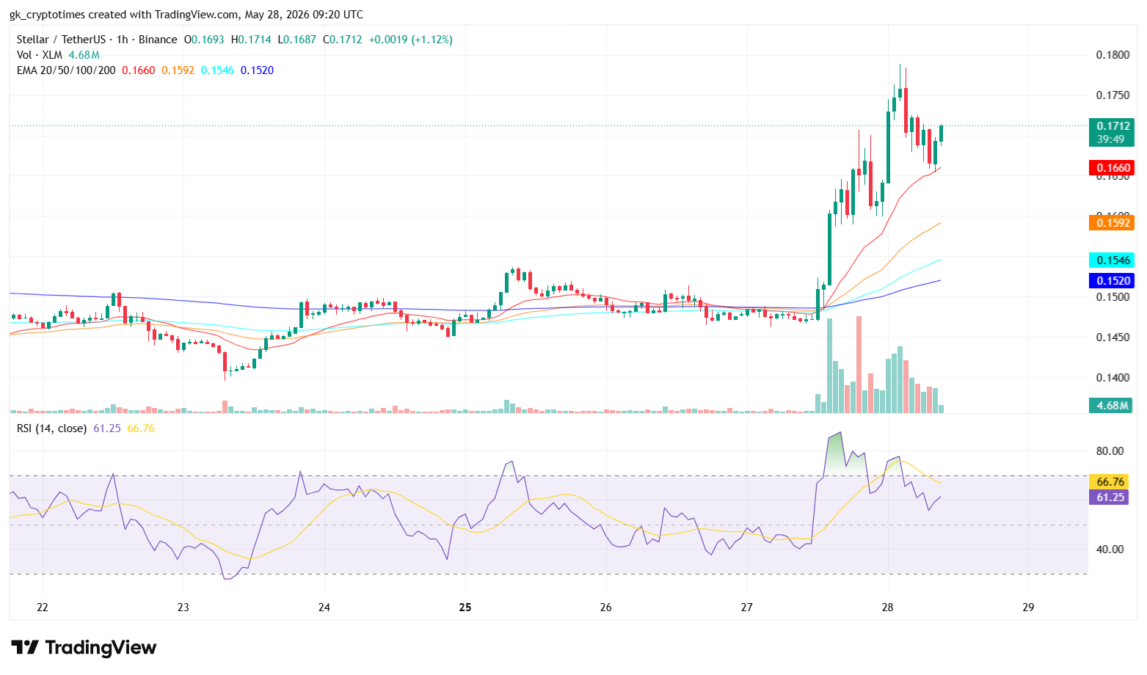
The token is now trading above its 20-day and 50-day moving averages, though it remains below the longer-term 200-day average near $0.19, underscoring that this is, for now, a strong short-term move within a still-recovering longer-term structure.
Momentum readings are constructive but not yet overheated, leaving room for follow-through if buying persists—or for profit-taking if the news-driven enthusiasm fades.
Outlook and Context
XLM’s surge is a clear demonstration of how a single, concrete institutional partnership can cut through an otherwise gloomy market. While the broader tape stays cautious amid geopolitical risk and ETF outflows, Stellar’s long-standing focus on payments, cross-border settlement, and compliance-minded infrastructure has positioned it to capture a wave of RWA-driven attention.
That said, perspective is warranted. The DTCC integration is a plan targeting 2027, not live volume today, and it sits within a broader multi-chain strategy that also includes rivals. Traders will be watching whether XLM can hold above the $0.156–$0.165 support zone and challenge resistance at $0.18–$0.20, and whether the move attracts follow-through from other institutional headlines.
As always, crypto remains volatile — but today’s price action is a reminder that, even in turbulent conditions, real utility and credible institutional backing can still command the market’s attention.
Also Read: XLM’s Next Stop: $0.25 or Pullback? Key Levels to Watch After Stellar’s 40% Surge