The Depository Trust & Clearing Corporation (DTCC) and the Stellar Development Foundation have outlined plans to enable tokenization of assets held in DTCC’s subsidiary, The Depository Trust Company (DTC), on the Stellar blockchain network.
The announcement, made on May 27, 2026, forms part of DTCC’s broader multi-chain approach to integrating traditional securities with distributed ledger technology. Under the plan, DTC-custodied assets are scheduled to become available on Stellar in the first half of 2027.
This timeline follows DTCC’s earlier regulatory steps, including a 2025 SEC no-action letter that cleared the way for tokenization pilots. The initiative will initially focus on assessing use cases for highly liquid assets, such as stocks in the Russell 1000 index, major exchange-traded funds, and U.S. Treasury securities.
Background on DTCC’s Tokenization Efforts
DTCC, which provides post-trade infrastructure for much of the U.S. securities market and handles trillions in annual transaction value, has been developing tokenization capabilities for several years. In May 2026, the organization reported collaboration with more than 50 financial firms to shape its DTC tokenization service. Initial limited production trades are targeted for July 2026, with a broader launch planned for October 2026.
The service aims to maintain existing investor protections, ownership rights, and regulatory compliance while allowing tokenized versions of assets to function on compatible blockchains.
DTCC has previously partnered with Canton Network for U.S. Treasury securities, indicating a strategy of testing multiple chains rather than committing to a single technology.
Stellar, an open-source public blockchain known for facilitating cross-border payments and asset issuance, was selected by DTCC for its design features that align with institutional needs, including efficiency and compliance tools, the firm claims.
The Stellar Development Foundation, a nonprofit supporting the network, has described the collaboration as advancing interoperability between traditional finance and digital systems.
“DTCC is the backbone of global capital markets, and integrating their tokenization service with Stellar connects public blockchain networks to regulated market infrastructure,” said Denelle Dixon, CEO and Executive Director, Stellar Development Foundation.” Our network was built for this moment—we have always believed that blockchain’s utility for finance is to be the rail that institutional-grade markets can depend on.”
Potential Implications for Market Infrastructure
Tokenization involves representing traditional securities as digital tokens on a blockchain, which can enable faster settlement, potentially 24/7 operations, and improved transparency in certain processes.
This development reduces costs and enhances liquidity, though implementation will require addressing technical, operational, and regulatory challenges.
DTCC has emphasized that tokenized assets will carry the same entitlements and safeguards as their conventional counterparts. The multi-chain strategy is intended to promote openness while preserving the resilience of existing market infrastructure.
The real-world asset (RWA) tokenization market has experienced explosive growth in 2026, currently sitting at $33.88 billion in on-chain value (excluding stablecoins) as of latest data from RWA.xyz, more than tripling from around $12 billion in early 2025.
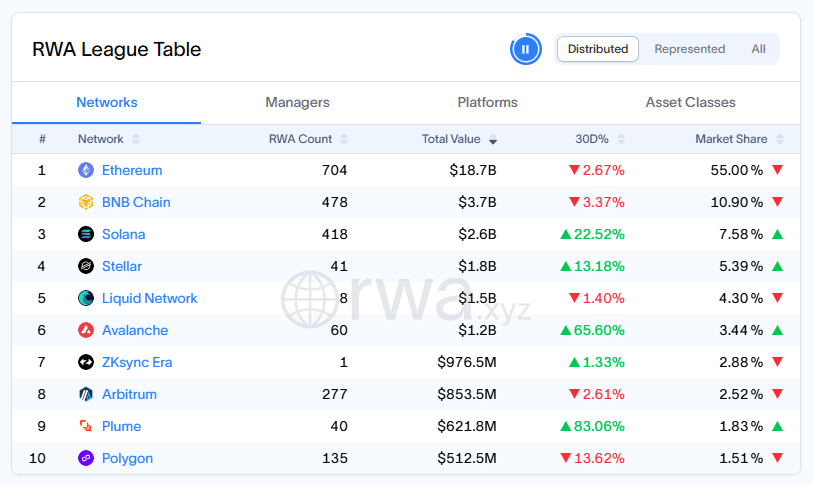
Stellar is currently one of the pioneers in RWA tokenization, ranking #4 globally with 41 tokenized real-world assets valued at $1.8 billion and a solid 5.39% market share, according to the latest RWA League Table. It trails only Ethereum (704 assets, $18.7B, 55% share), BNB Chain (478 assets, $3.7B, 10.9% share), and Solana (418 assets, $2.6B, 7.58% share).
Other top leaders in the sector includes Liquid Network ($1.5B), Avalanche ($1.2B), and ZKSybc Era ($976.5M) and Abitrum ($853.5M).
Stellar has posted a strong 13.18% growth in total value in the past 30 days, demonstrating robust momentum among leading public blockchains in the rapidly expanding tokenization landscape.
Context Within Evolving Financial Landscape
This development occurs amid growing institutional interest in real-world asset tokenization. Financial institutions and market infrastructures are exploring distributed ledger technology to modernize post-trade processes, which have historically relied on centralized systems with T+1 or longer settlement cycles.
DTCC’s approach remains measured, focusing on voluntary services developed in coordination with market participants. The organization has highlighted collaboration through industry working groups to align on best practices and technical standards.
The Stellar integration adds a public blockchain component to DTCC’s efforts, which have also included permissioned networks. Details on specific volumes, eligible assets beyond the initial assessment phase, and exact technical architecture are expected to emerge as planning progresses toward the 2027 target.
The announcement reflects incremental steps by a major market utility toward digital asset integration. While the potential benefits include greater efficiency and accessibility, outcomes will be determined by practical execution, risk management, and market response over the coming years.
Also read: Coinbase Expands Global Fiat Rails With Standard Chartered