
Institutional investors pulled back sharply from Bitcoin exchange-traded funds last week, delivering one of the heavier redemption stretches of 2026 so far.
According to data from SoSoValue, the 11 U.S. spot Bitcoin ETFs logged net outflows of approximately $1.256 billion across the five trading days from May 18 to May 22. This marked the continuation of a six-day redemption streak, underscoring a notable shift in institutional sentiment.
The selling pressure built steadily. Monday, May 18, saw the heaviest single-day exit at $648.64 million—one of the largest daily redemptions in recent months. Flows then moderated but remained negative, flowing $331 million out on Tuesday, $70.5 million on Wednesday, $100.8 million on Thursday, and $105.2 million on Friday.
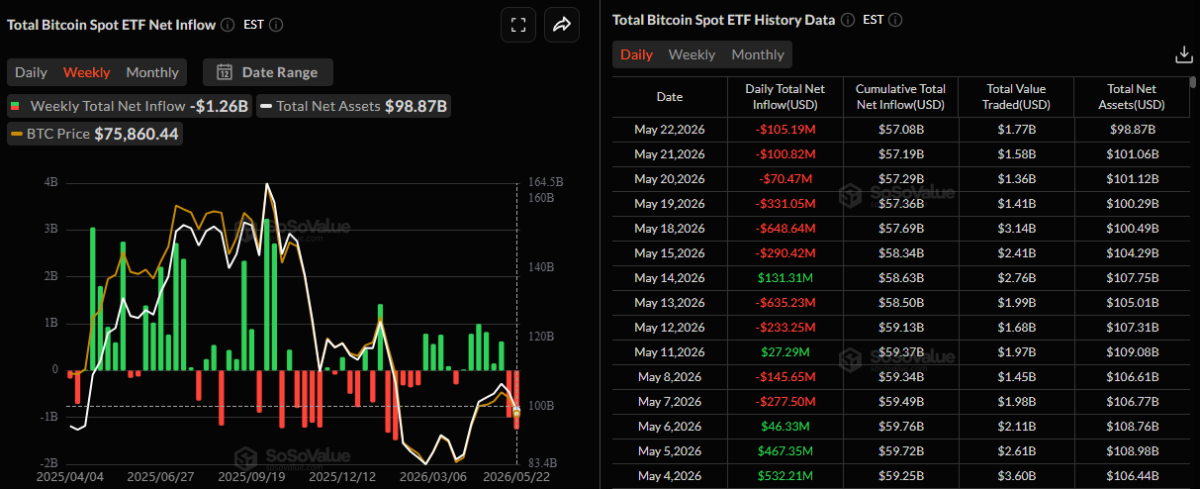
By week’s end, total assets under management had slipped to roughly $98.87 billion, representing about 6.49% of Bitcoin’s market capitalization.
BlackRock’s iShares Bitcoin Trust (IBIT) and Fidelity’s Wise Origin Bitcoin Fund (FBTC) once again dominated the action. On the final trading day alone, IBIT shed $68.89 million while FBTC lost $36.29 million. Grayscale’s GBTC, still burdened by its higher fees, posted zero or minimal movement on several days but continues to weigh on the overall cumulative picture with long-term net outflows exceeding $26 billion since its conversion to an ETF.
The retreat comes after a stronger April and early May, when the ETFs attracted billions amid hopes of stabilizing prices and softer monetary policy. That momentum reversed amid fresh macroeconomic caution.
Federal Reserve Governor Christopher Waller signaled a more hawkish stance on inflation in a May 22 speech, cooling expectations for near-term rate cuts. Bitcoin itself traded around $75,860 by Friday’s close, down from recent highs near $77,000–$78,000 earlier in the period. At the time of publishing, Bitcoin had recovered to $77,320.
Whether the redemption wave continues will likely hinge on Bitcoin’s ability to hold support near $75,000 and any fresh signals from the Fed. With trading volumes across the ETFs remaining healthy—topping $1.77 billion on Friday—liquidity is not an issue. But the direction of institutional capital remains the key variable investors will watch in the days ahead.
At the time of publishing, Bitcoin was trading at $77,320 as it has already recovered against the recent decline.
Weekly Flow Breakdown: A Sharp Reversal
The week ending May 22 stood out for its consistency in outflows rather than isolated heavy days. While May 18’s $648.64 million redemption grabbed headlines, the steady bleed across all five sessions painted a broader picture of caution. This followed a robust April that saw roughly $2 billion in net inflows—the strongest monthly total of 2026—and an early-May streak that pushed cumulative inflows since inception past the $57 billion mark.
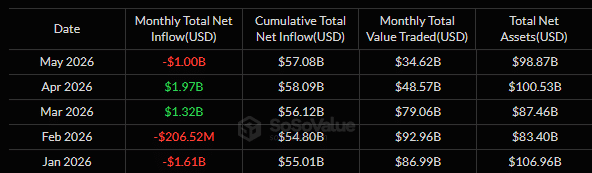
The shift could point to several overlapping factors as corporate Bitcoin accumulation also slowed dramatically in mid-May, dropping as much as 80% from earlier peaks. The combination created a feedback loop: weaker spot demand, softer BTC price action, and accelerated ETF redemptions.
Smaller funds showed mixed resilience. Some, like Bitwise’s BITB and ARK’s ARKB, posted only modest outflows or occasional flat days, while the larger players absorbed the brunt of institutional repositioning.
Overall, the 11 ETFs now hold approximately 727,000 BTC, a substantial war chest that continues to underpin long-term confidence despite short-term pressure.
Dominant Players and Structural Dynamics
BlackRock and Fidelity remain the clear heavyweights, together commanding the majority of weekly flows and assets. IBIT’s consistent performance has solidified its position as the go-to vehicle for institutions seeking clean Bitcoin exposure. Fidelity’s FBTC similarly benefits from strong brand trust and competitive fees.
Grayscale’s GBTC, by contrast, continues its multi-year outflow trend. Its higher management fee (still 1.5% versus sub-0.3% for newer entrants) has prompted many investors to rotate into lower-cost alternatives, creating persistent selling pressure even during broader inflow periods. This structural drag has resulted in over $26 billion in net redemptions since the 2024 conversion, highlighting how fee sensitivity shapes ETF longevity.
The concentration of flows in just two or three issuers raises questions about market maturity. While it reflects institutional preference for liquidity and credibility, it also means that decisions at BlackRock or Fidelity can disproportionately sway daily sentiment and BTC price action.
Broader Market Context and What Lies Ahead
This latest outflow episode arrives against a complex macroeconomic backdrop. Waller’s comments on May 22, emphasizing that inflation remains “not headed in the right direction” and advocating removal of the Fed’s easing biases, shifted market expectations.
Yet Bitcoin has shown resilience, rebounding from Friday’s lows to trade near $77,320 at publication. This recovery suggests some investors view the dip as a buying opportunity, especially with ETF trading volumes remaining robust.
Healthy liquidity indicates that redemptions are orderly rather than forced liquidations.Looking forward, several catalysts could influence the next phase. Any softening in inflation data or dovish Fed signals would likely revive inflow momentum.
Conversely, persistent hawkishness or renewed geopolitical tensions could extend the redemption streak. Historical patterns show that sharp outflow periods often mark local bottoms, followed by renewed accumulation once sentiment stabilizes.
Ultimately, the spot Bitcoin ETF market has matured significantly since its 2024 launch. Cumulative inflows exceeding $57 billion and nearly three-quarters of a million BTC under management demonstrate deep institutional entrenchment.
While weekly swings of $1 billion-plus grab attention, they reflect normal market mechanics in a volatile asset class rather than a fundamental breakdown.
Also read: Strategy’s STRC Hits $10.5B Market Cap to Lead Global Preferred Stocks