Key Highlights
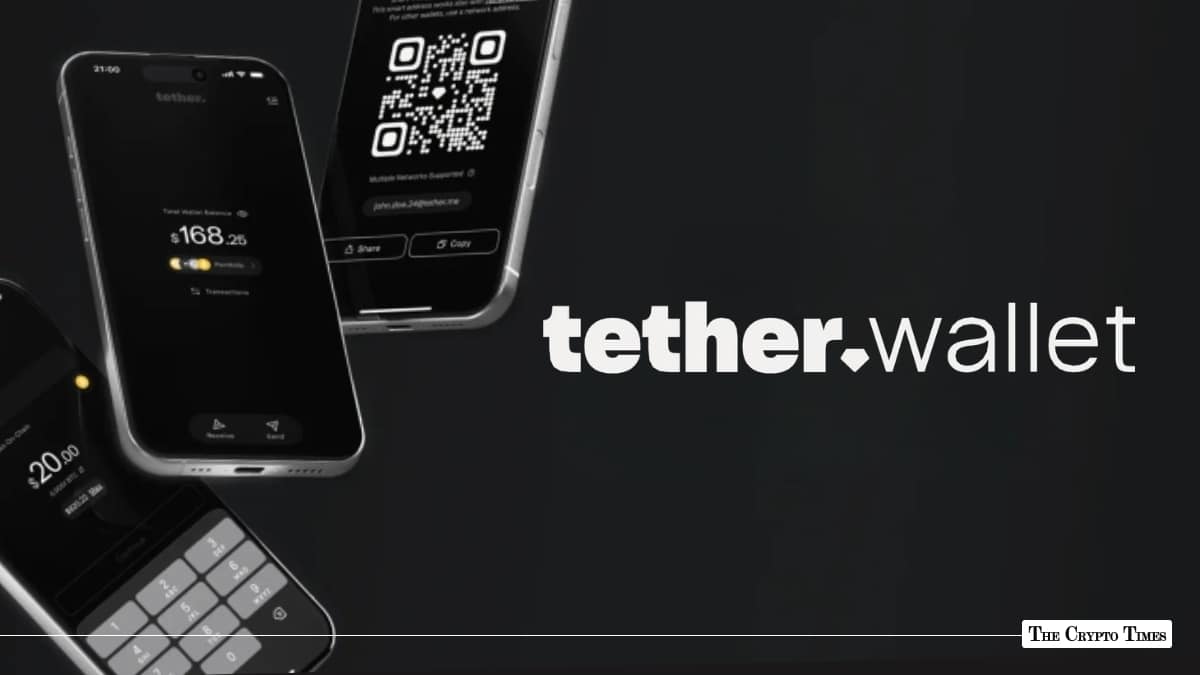
- Tether has launched tether.wallet, marking its entry into the consumer crypto wallet market after years as a backend infrastructure provider.
- The wallet removes major friction points by enabling username-based transfers and allowing gas fees to be paid in the same asset.
- It supports USD₮, Bitcoin, and XAU₮ across multiple networks, while excluding altcoins, NFTs, and memecoins to keep the experience simple.
Tether, the El Salvador-headquartered issuer of the world’s largest stablecoin USD₮, on April 14 announced the launch of tether.wallet, a self-custodial digital wallet that brings the company’s financial infrastructure directly to retail users for the first time.
The product marks a clear shift in Tether’s positioning. The company has so far operated as the underlying settlement layer for the digital asset economy, with USD₮ being used across more than 160 countries for liquidity, payments, and trading. With tether.wallet, the firm is now entering the consumer wallet market, which is currently dominated by players like MetaMask, Trust Wallet, and Phantom.
According to the company, Tether’s technology is currently used by more than 570 million people globally as of March 2026, with adoption growing at the pace of tens of millions of new wallets every quarter.
Supported assets and networks
The wallet supports a deliberately narrow asset list, which the company describes as the only assets that matter for most of its target users. There is no support for general altcoins, NFTs, or memecoins, separating it from most existing crypto wallets.
At launch, the supported assets and networks are:
- USD₮ on Ethereum, Polygon, Plasma, and Arbitrum
- XAU₮ on Ethereum, Polygon, Plasma, and Arbitrum
- USA₮ on Ethereum
- Bitcoin on-chain and via the Lightning Network
The company has said that more blockchains will be added after the initial release.
Removing long addresses and gas tokens
The wallet attempts to address two of the most common pain points in self-custody. Users can send funds using a simple human-readable identifier such as name@tether, instead of pasting long wallet addresses, which has historically been a major reason for irreversible user errors.
Network fees can also be paid directly in the asset being sent, removing the need for users to hold a separate gas token like ETH or POL just to move their stablecoins.
The application is fully self-custodial, with all transactions signed locally on the user’s device before being broadcast to the network. Private keys and recovery phrases stay with the user at all times, and Tether does not have access to user funds.
What Paolo Ardoino said
Commenting on the launch, Tether CEO Paolo Ardoino said: “Tether has achieved, without any doubts, the widest financial inclusion success story in the history of humanity.” The company notes that more than 570 million people are already using its technology.
“The objective is to remove the complexity that has prevented broader adoption while preserving the properties that make the digital assets technology valuable. Users should be able to send value as easily as sending a message, without relying on intermediaries and without giving up control of their assets.”
Built on Tether’s wallet development kit
tether.wallet is built on the open-source Wallet Development Kit (WDK) by Tether, which the company released as a modular toolkit for developers, institutions, and AI agents to build self-custodial wallets without relying on centralised providers.
The WDK has been used in earlier integrations as well. In January, Tether and Nasdaq-listed video platform Rumble used the same kit to launch Rumble Wallet, which embedded self-custodial USD₮, XAU₮, and Bitcoin payments into Rumble’s creator ecosystem.
A busy stretch for Tether
The wallet launch comes during an active phase for the company. Five days back, on April 9, the QVAC team at Tether launched the QVAC SDK, an open-source cross-platform AI development kit that the company is positioning as a building block for on-device AI.
Earlier this month, The Crypto Times reported that Tether was making a final push for a $500 billion private valuation, targeting a raise of $15 to $20 billion for roughly a 3% stake. The company later scaled the round back to around $5 billion after investor pushback.
In late March, Tether also brought its tokenised gold product XAU₮ onto BNB Chain, after gold posted its biggest annual gain in 40 years in 2025. The company holds nearly 116 metric tons of physical gold as of Q3 2025, making it the largest non-sovereign gold holder in the world.
USD₮ currently has more than $184 billion in circulation, holding around 58% of the total $317 billion stablecoin market, according to data from DeFiLlama.
Also Read: CoinDCX Wins Indian Patent for ‘Cognitive’ Crypto Wallet Security Tech