Key Highlights
- Introduced by Sen. Chris Murphy and Rep. Greg Casar, the bill would ban wagers on terrorism, assassinations, and government actions.
- The legislation follows highly scrutinized, high-value trades on Polymarket placed hours before the U.S. strikes on Iran and the extraction of Nicolás Maduro.
- The bill marks the fourth major piece of legislation targeting the prediction market sector in less than three months.
- The regulatory crackdown arrives just as leading platforms like Polymarket and Kalshi push for valuations near $20 billion amid record trading volumes.
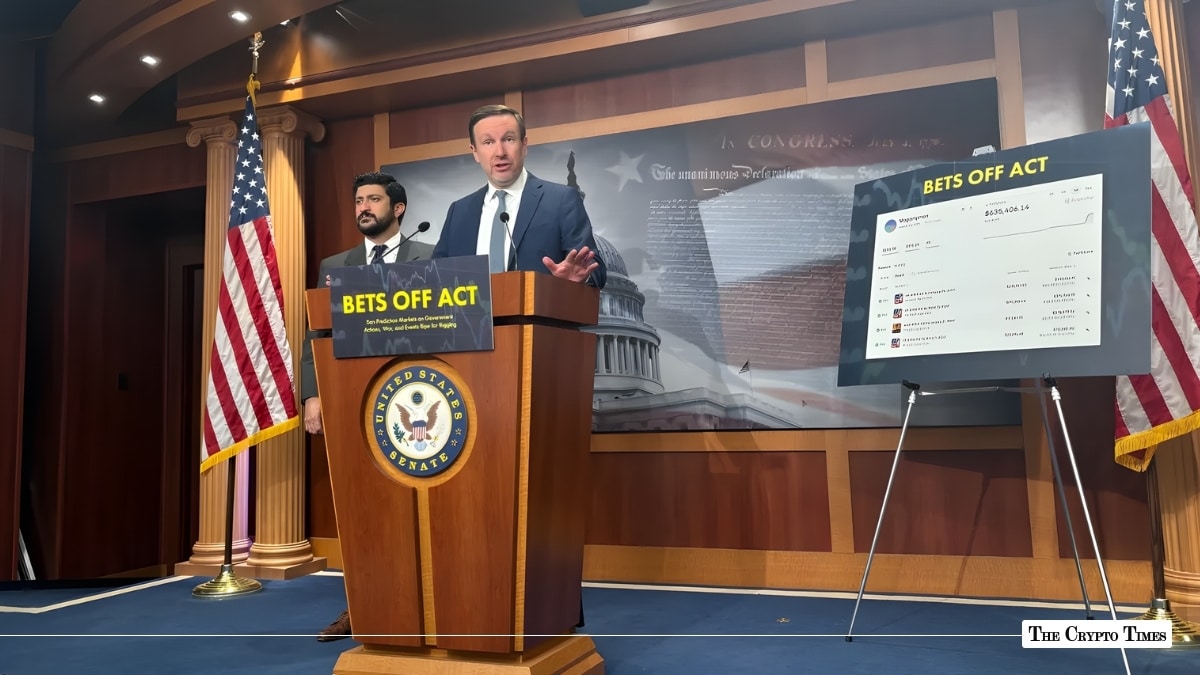
Senator Chris Murphy (D-Conn.) and Representative Greg Casar (D-Texas) have introduced a bicameral legislation that would outlaw prediction market wagers on government actions, war, terrorism, assassinations, and any event where an insider knows or controls the outcome. The BETS OFF Act, short for Banning Event Trading on Sensitive Operations and Federal Functions, marks the fourth major piece of legislation targeting the sector in less than three months.
The legislation arrives amid mounting outrage over suspicious trades on platforms like Polymarket and Kalshi. Hours before both the U.S. strikes on Iran and the extraction of Nicolás Maduro in Venezuela, anonymous users placed massive bets correctly forecasting the events and cashed out for hundreds of thousands of dollars.
What the BETS OFF act would do
The bill creates a blanket prohibition: it would be unlawful for any person to place, accept, or facilitate a wager on what the legislation defines as a “specified event.” That term covers acts of terrorism, assassinations, wars, and any non-financial, commercial, or economic event whose outcome is either a government action, under the complete control of any individual, or known to any person in advance.
Crucially, the bill extends beyond domestic platforms. Because many event contracts trade offshore, the BETS OFF Act amends federal gambling statutes to reach international operators. Payment processors would be required to cut off financial flows to illegal platforms, and U.S.-based individuals who promote or manage these businesses would face criminal penalties. The bill also amends the Commodity Exchange Act to bar any registered entity from listing or clearing the specified event contracts.
Suspicious trades and national security fears
Senator Murphy pointed to what he described as a “perverse incentive” structure: when government officials or associates can profit from anonymous bets placed before policy decisions go public, the line between governance and gambling evaporates.
The bill’s sponsors argue that this dynamic warps policy-making by giving decision-makers a financial stake in specific outcomes. New polling from Data for Progress found that 61% of independents and 57% of Republicans support banning wagers on government actions, while 80% of voters oppose betting markets on terrorism or assassinations.
A rapid-fire legislative onslaught
The BETS OFF Act does not exist in a vacuum. It is the latest salvo in the most concentrated legislative assault on prediction markets since the industry’s inception. In January, Rep. Ritchie Torres (D-N.Y.) introduced the Public Integrity in Financial Prediction Markets Act, barring federal officials and executive branch employees from placing bets on markets linked to government decisions. That bill was triggered by a Polymarket trader who turned $30,000 into over $400,000 betting on Maduro’s ouster hours before U.S. forces acted.
On March 5, Representatives Blake Moore (R-Utah) and Salud Carbajal (D-Calif.) introduced the bipartisan Event Contract Enforcement Act, which would require the Commodity Futures Trading Commission (CFTC) to ban contracts on terrorism, assassination, war, sports, elections, and government activity. Notably, that bill includes an opt-out provision allowing individual states to permit sports-related contracts within their borders.
Five days later, Senator Adam Schiff (D-Calif.) and Rep. Mike Levin (D-Calif.) unveiled the DEATH BETS Act, which would permanently prohibit any CFTC-registered entity from listing contracts tied to war, terrorism, assassination, or an individual’s death. That bill was a direct response to $529 million in Iran-related trading volume on Polymarket and a class-action lawsuit against Kalshi over its controversial “death carveout” settlement. On the same day, Senator Richard Blumenthal (D-Conn.) introduced the Prediction Markets Security and Integrity Act, a broader proposal targeting insider trading, market manipulation, underage gambling, and AI-driven marketing tactics, while also seeking to restore state regulatory authority over prediction markets.
What it means for the industry
The legislative barrage lands at a pivotal moment. Both Kalshi and Polymarket are reportedly pursuing valuations near $20 billion, with combined monthly volumes exceeding $18 billion in February. The CFTC, under Chairman Michael Selig, withdrew a 2024 draft rule that would have banned political event contracts and has signaled a friendlier posture toward the sector. But the Congressional response suggests that friendliness may be short-lived.
Crypto-native platforms are particularly exposed. Polymarket, which dominates geopolitical event contracts, would find its most-traded categories rendered illegal under multiple overlapping proposals. The platform’s March 10 announcement of an AI-powered monitoring system built with Palantir reads as preemptive self-regulation — a signal that the industry is scrambling to police itself before Congress does it for them.
The BETS OFF Act takes effect 30 days after enactment. Whether any single bill clears a Republican-controlled Congress remains uncertain, but the sheer volume of proposals and bipartisan appetite for action signals that the regulatory reckoning the prediction market industry has long feared is no longer theoretical.
Also Read: U.S. Lawmakers Introduce New Bill to Protect Blockchain Developers